


State staff discover one of oldest Hawaiian honeycreepers on Big Island
Hawai’i Department of Land and Natural Resources Division of Forestry and Wildlife staff recently recaptured — and re-released — one of the oldest ʻiʻiwi ever observed.
This Hawaiian honeycreeper likely hatched in the winter/spring of 2015-16 and is a minimum of 10 years old, which is rather amazing considering the typical lifespan of ʻiʻiwi is, maybe, half of that at 3 to 5 years.
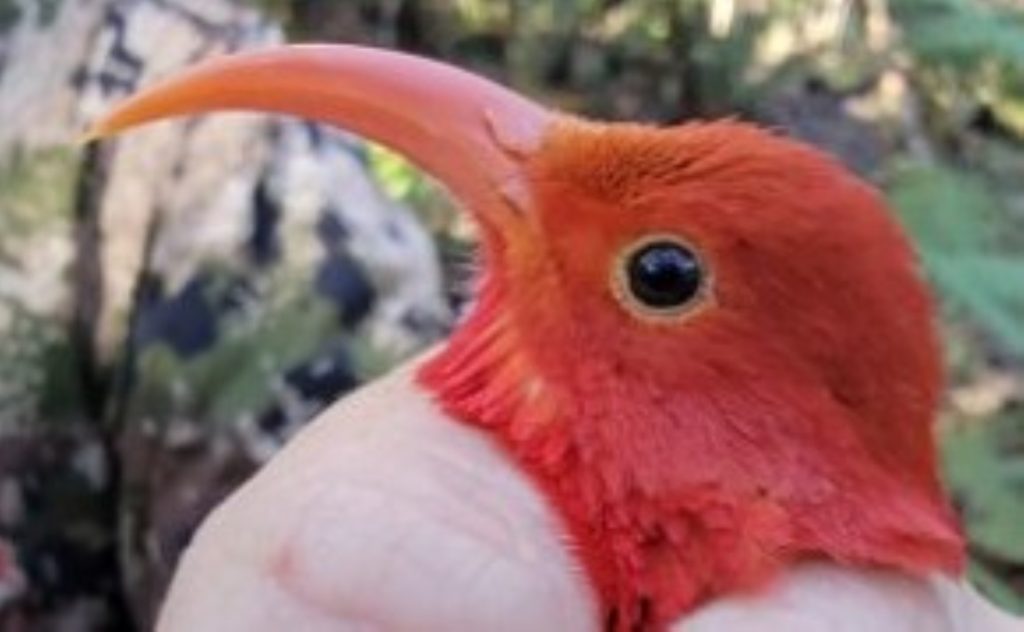
The forest bird kupuna was originally banded in at least it’s second year of life in 2018 by University of Hawai’i at Hilo staff.
Division of Forestry and Wildlife recaptured the male in January in the same area.
The bird’s unique color band combo is white/white orange/aluminum and he might be seen along the Na ʻAla Hele Puʻuʻōʻō Trail — in the Upper Waiakea Forest Reserve — on Hawaiʻi Island.
ʻIʻiwi are endemic, or native, to Hawaiʻi and listed by the state as endangered on O‘ahu, Moloka‘i and Lāna‘i.
NatureServe ranks the honeycreeper as apparently secure globally, meaning the honeycreeper is faiirly low risk of extinction or collapse because of its extensive range and/or population, but with possible cause for some concern as a result of local recent declines, threats or other factors.
The nonprofit — comprised of biodiversity scientists who want to apply the best information to decision-making — also says the bird is critically imperiled on O‘ahu and Moloka‘i and possibly even extinct on Lāna‘i.
International Union for Conservation of Nature also has the forest bird species on its Red List, calling it vulnerable.
“The ‘i‘iwi is one of the most beautiful of the extant Hawaiian honeycreepers,” says the Hawai’i Department of Land and Natural Resources Division of Forestry and Wildlife website. “Both males and females are vermillion red with a black tail and wings and a long, decurved pink bill.”
Native Hawaiians created feather capes using hundreds of thousands of ‘i‘iwi feathers; such capes signified power and prestige. Like ‘apapane, ‘i‘iwi often fly long distances in search of flowering ‘ōhi‘a trees and are important ‘ōhi‘a pollinators.
Their diet consists primarily of nectar from a variety of native and non-native flowers and the presence of non-native flowers could have contributed to increases in some populations.
‘I‘iwi also eat small arthropods.
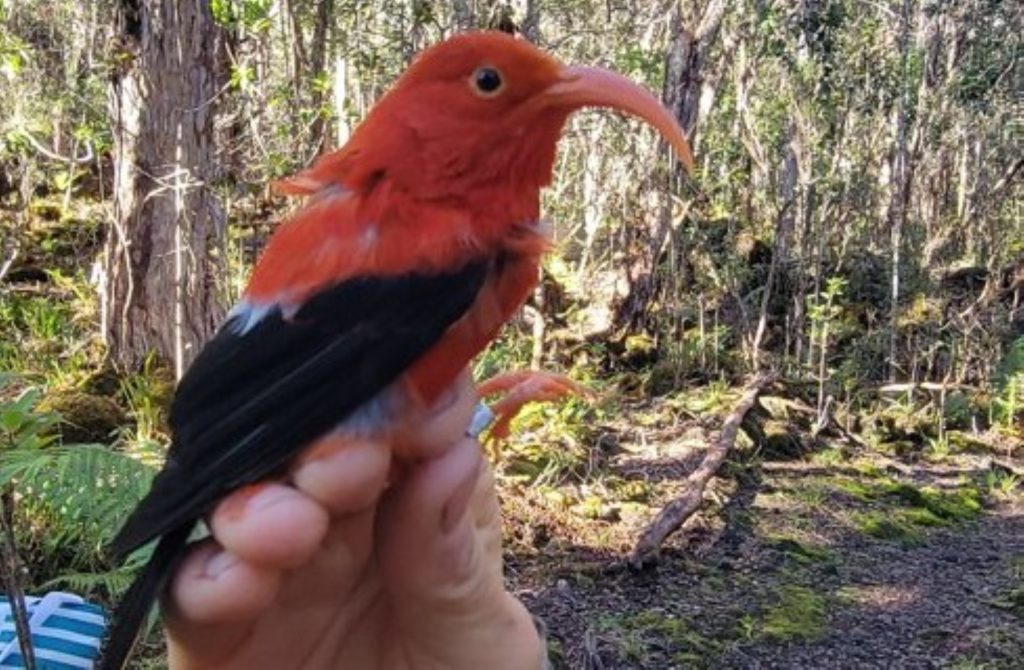
The Hawaiian honeycreeper can be found above 4,100 feet in elevation on Hawai‘i Island, Maui and Kaua‘i, and at reduced densities below. Relict populations occur on O‘ahu and Moloka‘i.
‘I‘iwi were historically common down to low elevations on all the main Hawaiian Islands.
They thrive in mesic and wet forests dominated by ‘ōhi‘a and koa. However, loss and degradation of habitat and high densities of cold-intolerant Culex mosquitoes, an important disease vector, in lowlzand areas restrict most birds to elevations above 4,100 feet.
Habitats with the highest ‘i‘iwi densities also support kōlea, naio and hapu‘u tree ferns. Māmane is common in high-elevation foraging habitat.
Although much of the species’ current range is under state or federal jurisdiction, habitat quality as well as habitat protection and restoration varies considerably
“Although populations appear stable on the islands of Hawai‘i and Maui, they are likely susceptible to the same factors that threaten other native Hawaiian forest birds, including habitat loss and degradation, predation by introduced mammals and disease.” the Division of Forestry and Wildlife website says.
The following is of particular concern:
- Diseases: Avian malaria and avian pox.
- ‘I‘iwi are very susceptible to these two diseases. Nine of 10 individuals died within 37 days after receiving a single bite from mosquitoes infected with Plasmodium, which causes avian malaria. Individuals infected with pox also are more likely to be infected with malaria. Because the highest points on Moloka‘i and O‘ahu are below 4,100 feet, this susceptibility likely explains the severe population declines noted on those islands. Foraging movements increase their exposure to disease.
Learn more about ʻiʻiwi and other native birds of Hawaiʻi at the Hawaiʻi Department of Land and Natural Resources Division of Forestry and Wildlife website.