



Perfluorooctanesulfonic acid detected in Pepe‘ekeo well; amount within acceptable federal standards
Hawai‘i County Department of Water Supply detected low levels of Perfluorooctanesulfonic acid for the first time in Kula‘imano Well A during voluntary drinking water well testing around the island.
The testing results ranged from 2.6 to 3.0 nanograms per liter, which are within acceptable limits of safe drinking water standards set by the Environmental Protection Agency.
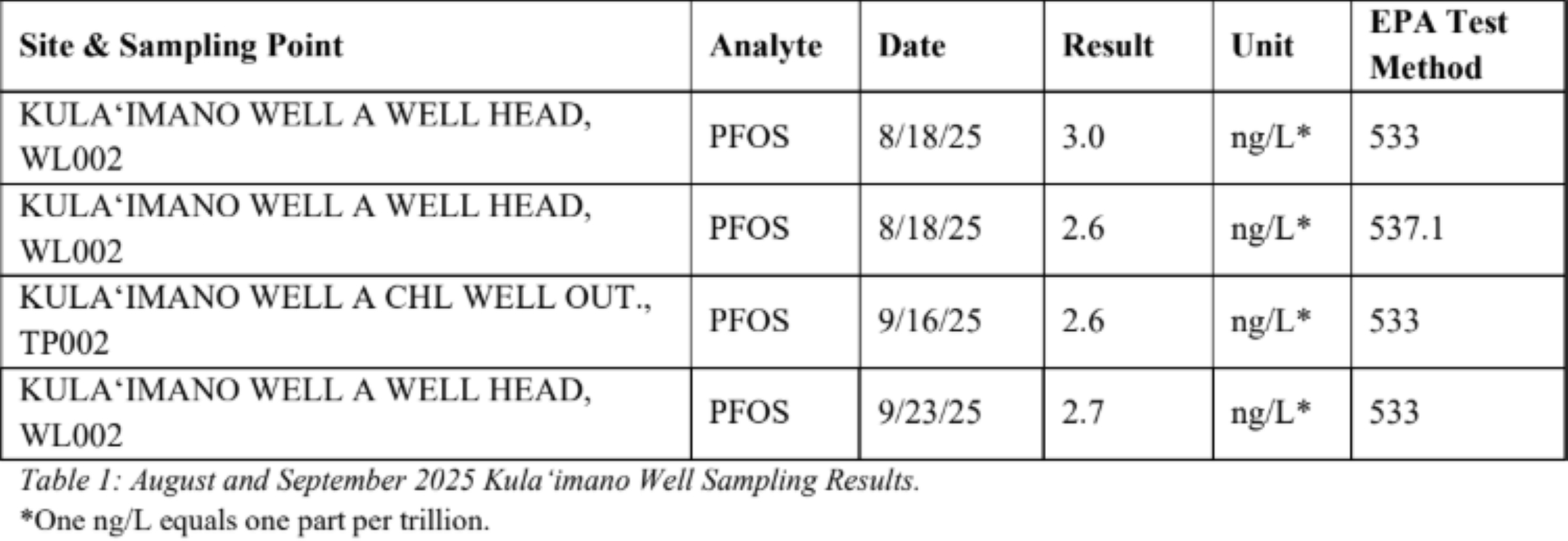
The Environmental Protection Agency’s maximum contaminant level for Perfluorooctanesulfonic acid is 4.0 nanograms per liter.
Kula‘imano Well A is one of two groundwater sources in the Pepe‘ekeo Water System. The primary groundwater source is Kula‘imano Well B, which is under repair.
Department of Water Supply reported the findings to Hawai‘i Department of Health in accordance with state law.
Perfluorooctanesulfonic acid is part of the group of perfluoroalkyl and polyfluoroalkyl substances.
These substances are concerning for their persistence in the environment and links to adverse health outcomes in humans and animals, especially at high concentrations or with long-term exposure.
Perfluorooctanesulfonic acid is one of thousands of human-made compounds that have been commonly used in non-stick, non-stain and water-resistant industrial and household products since the 1940s.
The primary U.S. manufacturer of Perfluorooctanesulfonic acid voluntarily phased out production of this chemical compound in 2002.
“Our customers’ safety is our top priority,” said Hawai‘i County Department of Water Supply Manager and Chief Engineer Keith Okamoto in the department’s announcement. “Although the new federal compliance regulations do not take effect for a couple of years, we did not want to wait to act.”
The county is proactively sampling active drinking water sources around the island — more than 60 locations — now that should be finished by the end of the year.

“The drinking water [Department of Water Supply] provides meets all federal and state drinking water standards — it is safe to use and drink,” Okamoto added. “While I am proud of our proactivity and openness on the issue of [perfluoroalkyl and polyfluoroalkyl substances], it’s important to know most peoples’ exposure comes from everyday products — nonstick food packaging, stain-resistant fabrics and upholstery and cosmetics, to name a few.”
Water Supply will also test the use of granular activated carbon for perfluoroalkyl and polyfluoroalkyl substance treatment implementation. Those tests are scheduled to begin in early 2026.
Visit the Hawai‘i Department of Health website or Environmental Protection Agency website for additional information about perfluoroalkyl and polyfluoroalkyl substances.
Sponsored Content

_1770333123096.webp)

Subscribe to our Newsletter
Comments