



University of Hawaiʻi’s telescope dedicated in 1970 now honored for enduring impact on space exploration

In 1970, the University of Hawaiʻi’s 2.2-meter telescope was dedicated at the summit of 13,803-foot Maunakea, becoming the world’s highest and first computer-controlled telescope.
The innovations developed or tested by the UH88, its nickname because 2.2 meters is 88 inches, have shaped astronomy worldwide. They include breakthrough digital imaging, adaptive optics, and the HAWAII near-infrared detectors used on NASA’s James Webb Space Telescope.
On Thursday, UH88 was recognized by the Institute of Electrical and Electronics Engineers as an IEEE Milestone. It is a recognition of technological innovation and excellence for the benefit of humanity.
“This recognition speaks to the visionary work of University of Hawai‘i astronomers and engineers who transformed UH88 into a platform for groundbreaking discovery,” said Mark Chun, director of the telescope that still operates today. “For more than five decades, their innovations have not only shaped the telescope’s legacy but also helped push the boundaries of what’s possible in astronomy.”
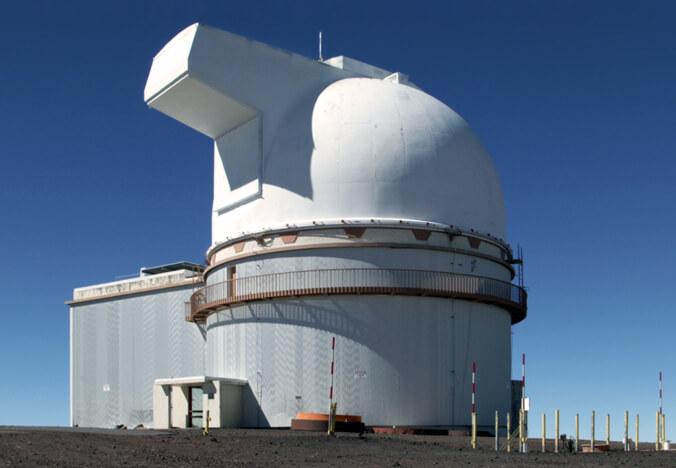
In 1964, Gerard Kuiper, director of the Lunar and Planetary Laboratory at the University of Arizona, was the first to propose placing a telescope on the summit of Maunakea. The exact location is 13,786 feet above sea level.
At that elevation, the telescope would be above much of Earth’s atmosphere and water vapor, providing a nearly complete view of the sky.
Physicist John Jeffries agreed with Kuiper and created a proposal for the University of Hawai‘i to build and run a facility for UH88 in Hawai‘i. After being awarded $3 million for his proposal in 1965, Jeffries founded the University of Hawaiʻi Institute for Astronomy and began building the telescope and scientific research facility.

But it was a challenge to build at the summit, with snowy weather, no paved road and no electricity. Early researchers often traveled on off-road vehicles and slept in trailers at Hale Pōhaku, located at 9,200 feet above sea level. Some got stuck at the summit for days.
The State of Hawai‘i eventually built support buildings at Hale Pōhaku, a road and a power line, and provided government positions for astronomers and engineers. The decision to build at the site was quickly vindicated by the level of collection success, according to the Institute for Astronomy.
During the dedication ceremony of the new observatory in 1970, Kuiper claimed the Maunakea summit to be the best site in the world to study space and the place where the most advanced observations from Earth can be made.

Ann Boesgaard and Alan Stockton, both professors emeriti at the University of Hawai‘i Institute for Astronomy, Robert McLaren, a former director of the Institute for Astronomy, and Mark Rognstad, a professor emeritus of the Hawai‘i Institute of Geophysics and Planetology, hosted a panel, shared old photographs, and talked about the early days of UH88.
They were among the first researchers to study space on Maunakea in the 1970s and witnessed other observatories and telescopes follow UH’s lead and build on the summit. The first to join UH88 was the Canada-France-Hawai‘i Telescope.
“The French were talking about going to Mexico with their telescope, but John Jeffries somehow convinced them to look at Maunakea,” Boesgaard said.
She remembers having a man from France, who would become the first director of that telescope, at her house: “He was so enthusiastic about the quality of the site. The French convinced the Canadians to commit to Hawai‘i.”

The Institute of Electrical and Electronics Engineers Milestone recognizes decades of innovation that has helped shape modern astronomy. Along with the facilities on Maunakea and Hawaiʻi Island, UH88’s legacy can be seen in observatories and space missions around the world.
“Every astronomy facility is based on the things that we’ve done in the past, the science that we’ve learned, and the technology we’ve developed,” Chun said. “At the 88-inch telescope, you see that we’re part of that ecosystem, and that’s worldwide — ground-based telescopes, space telescopes — we played a big role in all of those.”
Some accomplishments include:
- Collection of data used to support Apollo missions to the moon;
- Study and discovery of dozens of Pluto-like objects;
- Discovery of the Kuiper Belt and distant objects beyond Neptune that led to the demotion and declassification of Pluto as a planet;
- Remaining a testbed for cutting-edge instruments such as next-gen infrared detectors and fully automated observing systems.
“Being named an IEEE Milestone underscores the world-class excellence of the University of Hawai‘i’s astronomy program,” said Doug Simons, director at the Institute for Astronomy. “It affirms that the innovation happening on Maunakea has global impact, from advancing how we explore the universe to training the next generation of astronomers right here in Hawai‘i.”

To commemorate this milestone, a bronze plaque unveiling took place on Thursday at the UH88 on the summit of Maunakea, followed by a presentation and panel discussion at the Institute for Astronomy on the University of Hawai‘i at Hilo campus.
UH88 is the first IEEE Milestone recognized on Hawai‘i Island and one of only a few statewide. Other milestones in Hawai‘i include revolutionary wireless communication technology ALOHAnet, developed at UH Mānoa nearly 50 years ago, and the original electric lights at ‘Iolani Palace.
Sponsored Content


Subscribe to our Newsletter
Comments