


Residents miss cultural traditions, family gatherings on Coconut Island during years to repair bridge
The island in Hilo Bay is not accessible after a Hawaiʻi County excavator drove over the pedestrian bridge, causing it to partially collapse with just a temporary fix to take two years.
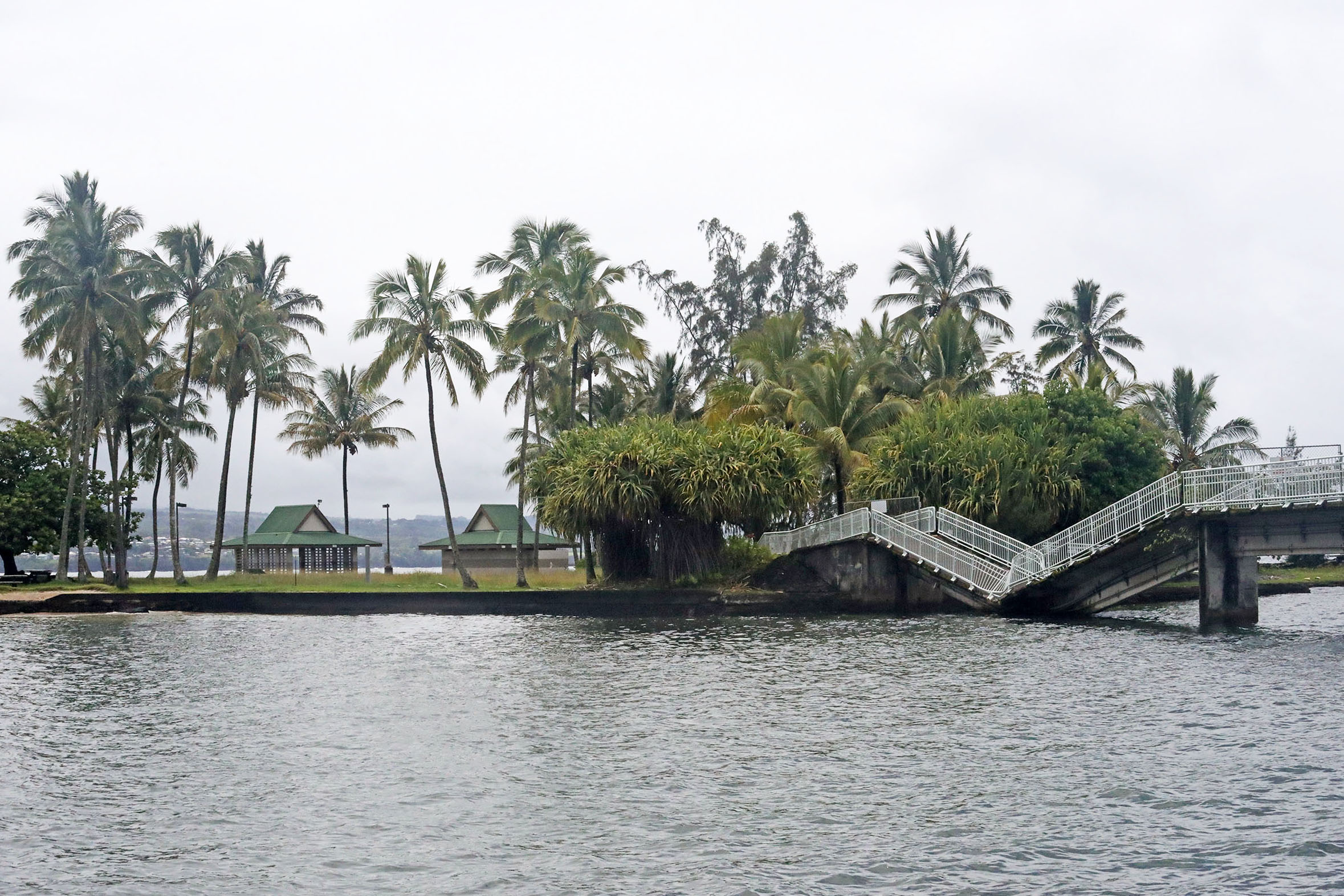
Mokuola — also known as Coconut Island — has historically been a sacred place of refuge, where people who broke kapu (religious laws) could seek protection and where families buried the piko, or umbilical cords, of newborns to symbolize life, health and connection to lineage.
In the present day, Mokuola has become a beloved area for families to gather at picnic tables, for kids to swim or jump off the iconic landing, for visitors to explore and for fishermen seeking their next catch.
But nobody has been able to go to the island since last November, when a portion of the 250-foot-long pedestrian bridge unexpectedly collapsed as a Hawaiʻi County Parks and Recreation crew drove on it with an 8,000-pound mini excavator.
Even with a temporary fix, it will be two years before pedestrians can again walk on the bridge that connects the shore near Liliuokalani Gardens on Banyan Drive to Mokuola. For a permanent repair, the date is three years away, in 2029.
“It is sad to see the island is no longer accessible due to the damage to the bridge,” said Lilinoe Keliʻipo-Young, a former resident of Mokuola. “I’m upset that the county would think heavy equipment could be transported over the footbridge. At the same time, I think the island needed time to rest and recover.”
Keliʻipo-Young and her family lived in a one-bedroom house with her parents and siblings, who all took care of the island in the summer and even transported people to the island when there was no bridge at all.
“My father operated a ferry service using rowboats to and from the island before the first footbridge was built in 1951,” Keliʻipo-Young said. “Even back then, families made it a tradition to come on the weekends to swim and barbecue.”
The family members were the last caretakers of Mokuola before the 1960 tsunami devastated Waiākea Town, which was a vibrant, close-knit community living on the coast of Hilo. Instead of rebuilding the area, the County of Hawaiʻi designated the coastline as open space and opened Liliʻuokalani Gardens to honor the predominantly Japanese community with a Japanese garden.
The county began rebuilding the bridge to Mokuola in 1968, and it was complete by 1969. In the early 2000s, the bridge deck was reinforced to increase its load capacity, and similar equipment had crossed the structure in the past without incident, according to Parks and Recreation.
Parks and Recreation also noted there was no posted weight limit for the bridge. The most recent inspection was conducted in 2022.
“I just don’t really understand why anyone thought it would work to drive large machinery across the bridge that was already deteriorating,” said Hua Maluhia, a frequent fisherman at Mokuola.
The temporary fix will cost $2 million and a permanent repair is expected to cost $20 million.
“The cost is the thing that irked me,” Keliʻipo-Young said. “When the county announced that the repair would be $20 million and would take over two years, I was confused. I met my husband when he was on the crew that built this bridge in 1968. The county funded the construction company, and it took $48,000 and 10 months to complete.”
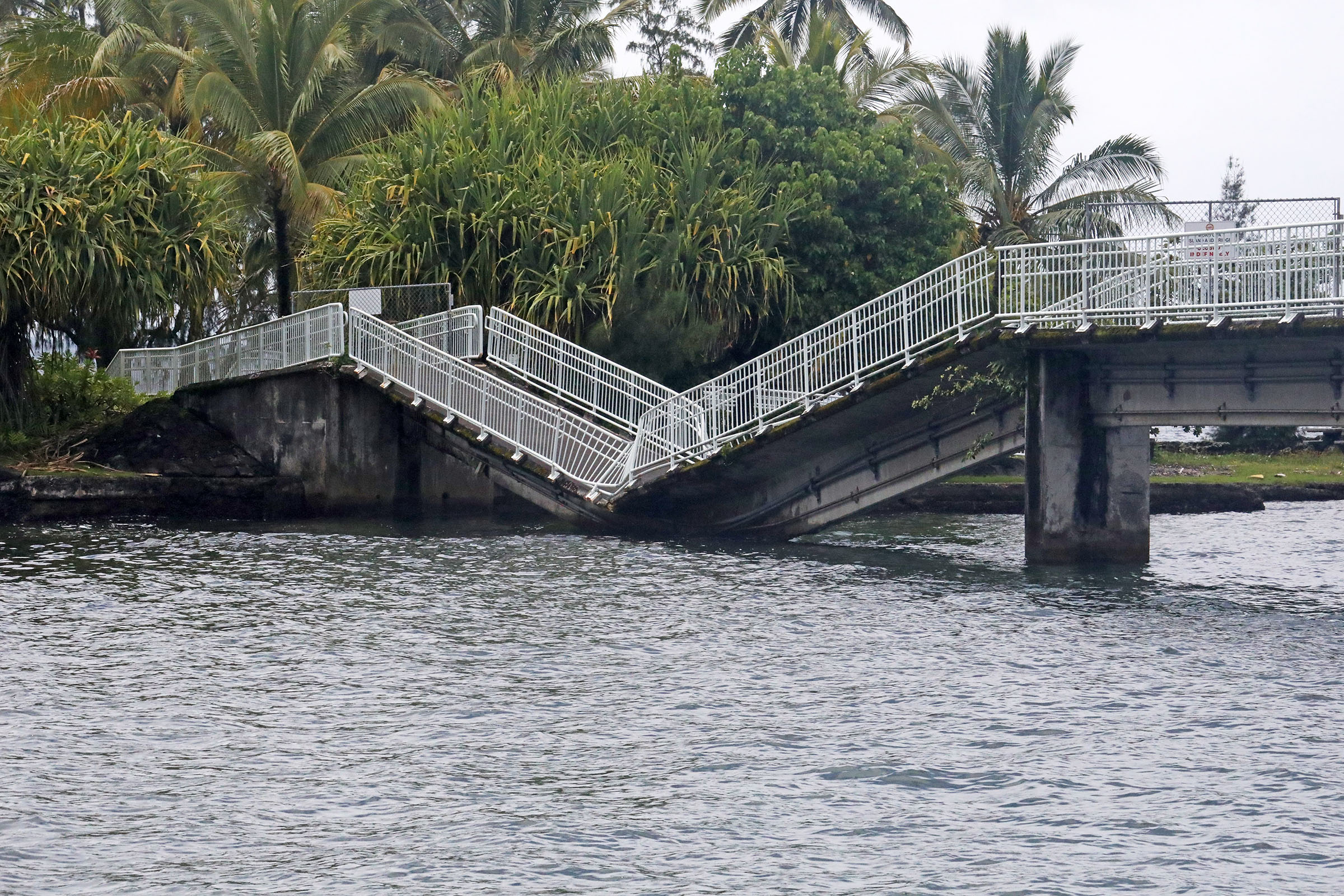
Since the incident, the Department of Public Works has contracted with WSP USA for the temporary bridge. That contract includes design and permitting for the removal of the collapsed bridge section and replacement of that section with a temporary structure.
According to the county, the plan is to combine the environmental assessment for both the temporary and permanent bridges into one single review. The site sits directly on Hilo Bay, with coastal and reef considerations that require careful review, and by bundling both projects into one environmental process, the county avoids repeating those steps later.
“In my opinion, I think they should build a rope bridge, or something that wouldn’t be toxic to the reef like concrete,” Maluhia said. “Because of the way the bridge is built, the environmental assessment and design is going to take much longer and cost more money.”
“But, kūpuna should be able to access the island too, so a concrete bridge is needed eventually,” Maluhia continued.
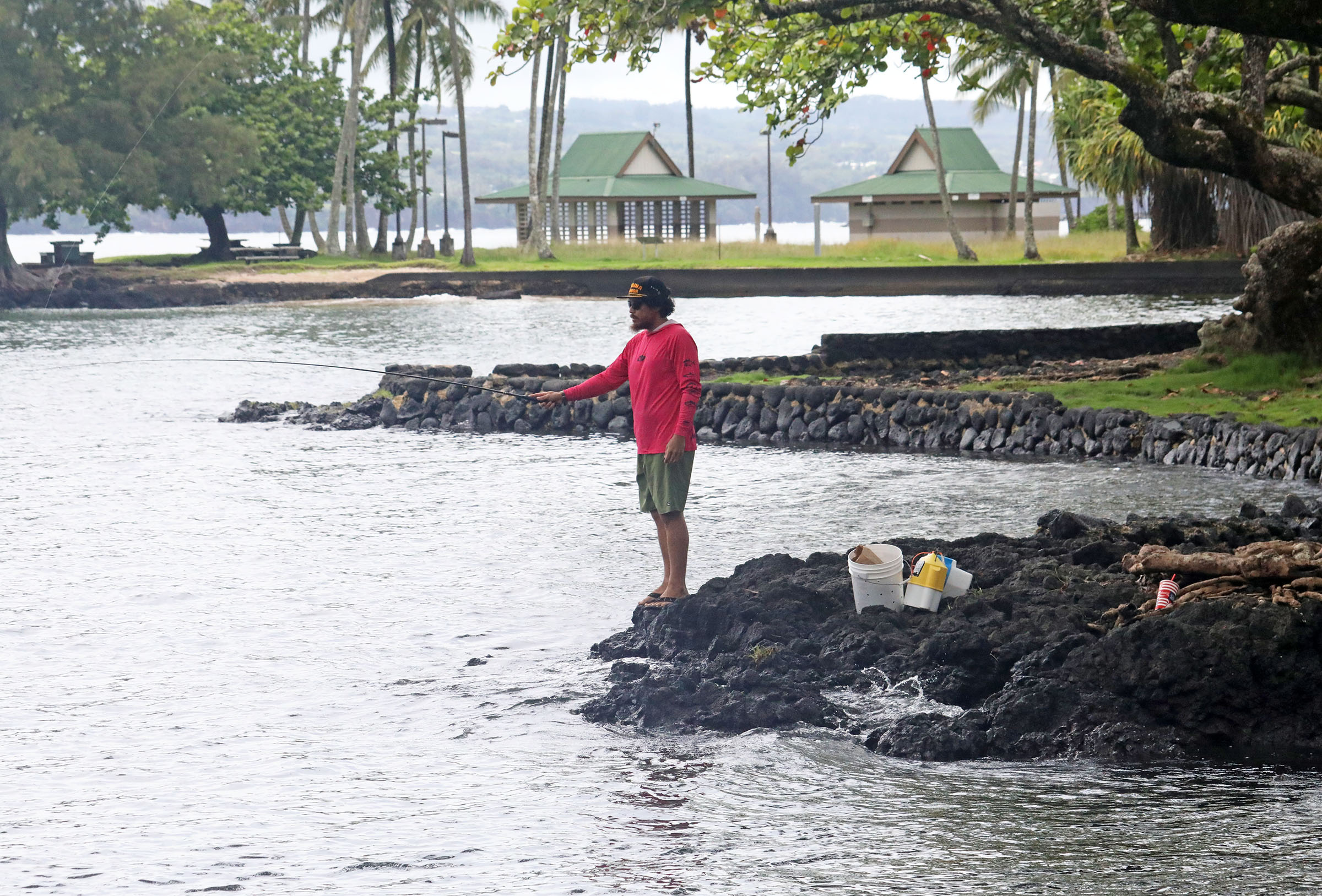
Currently, Mokuola stands in silence without the company of people as the grass grows tall and all access to the island is restricted to everyone, including swimmers and paddlers.
While Keliʻipo-Young understands why access to Mokuola is restricted, she does feel that many Native Hawaiians are unable to take part in important, spiritual traditions that help them connect to the ʻāina (land) and kūpuna (ancestors).
“One ceremony my family has been involved in was the graduation ceremony for students at the Hawaiian immersion school in Keaʻau (Ke Kula ʻo Nāwahīokalaniʻōpuʻu),” Keliʻipo-Young said. “Since 1999, the graduating students would swim out to the healing rock at Mokuola in a silent, traditional pilgrimage that helps connect them spiritually to their Hawaiian culture. This year’s graduation had to be postponed and they don’t know when they will be able to experience it.”
For now, Keliʻipo-Young believes the fix is not so complicated and hopes the county is able to get to it quickly, so people can access it as soon as possible. For now, she will continue to share the history of Mokuola and stories from her family’s 51 years on the island.
“I think the focus should be on what the island needs to reopen. Make it simple but safe,” Keliʻipo-Young said. “Many local families are already missing this space, whether it’s for a baby’s birthday, a memorial service or a simple barbecue on a weekend. Get the island open.”
While the County of Hawaiʻi is working to rebuild Mokuola, Keliʻipo-Young is excited to focus on the Hawaiʻi Community Development Authority, which is leading the charge for the redevelopment of Banyan Drive in Hilo.
Twenty-two community members, business owners, Native Hawaiians and longtime residents have been chosen to be part of a planning advisory committee for the redevelopment of the area, which is known as the Waiākea Peninsula. The committee will be meeting for the first time at 4:30 p.m. on Thursday at the meeting room in the Hilo Hawaiian Hotel.