


Energy affordability signaled as state priority with Public Utilities Commission decision
The first decision and order issued by Hawaiʻi Public Utilities Commission, under the direction of Chairperson Jon Itomura, signals energy affordability as a state priority.
That would support broad state initiatives for affordable housing, health care and a firm commitment to reduce the cost of living for Hawaiʻi residents.
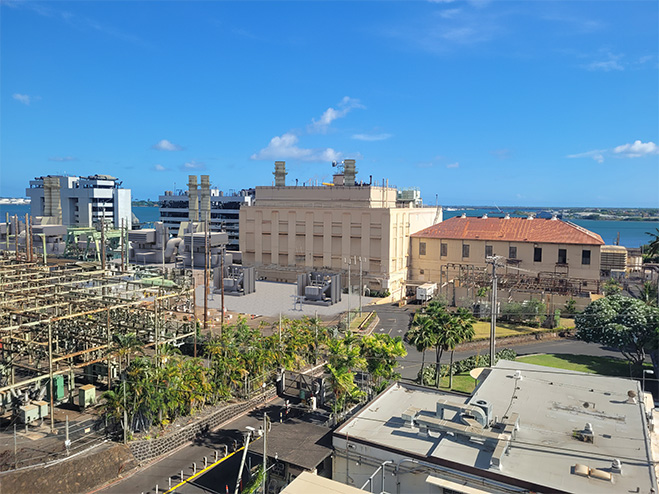
The commission’s decision does not approve Hawaiian Electric’s request to recover up to $1.155 billion from ratepayers to upgrade the 75-year-old Waiʻau power plant.
Instead, in a win for ratepayers, it sets a cost-recovery cap at the utility’s original competitive bid of $847 million, plus a limited inflation adjustment of 10%.
“This administration will continue to fight for greater affordability for Hawaiʻi’s people,” said Hawaiʻi Gov. Josh Green in a state release. “Hawaiʻi residents have dealt with reliability concerns and the highest electricity costs in the nation due to polluting fuels imported from places like Libya and inefficient power generation for decades.”
The governor said the state has a generational opportunity to make meaningful change. His administration has been united in saying it will not condemn another generation to costly utility bills that it can’t afford.
Agencies including Public Utilities Commission, Consumer Advocate and Hawaiʻi State Energy Office supported the imposition of strict cost controls to limit the financial impacts of the decision on customers.
Commissioners also require Hawaiian Electric to meet specific renewable-fuel milestones to ensure the Waiʻau project supports the state’s transition to a 100% renewable energy future.
The order requires the utility to operate the units with at least 51% renewable fuel by 2032, or when the first four units begin service, whichever occurs first, and then 75% renewable fuel by 2040 and 100% renewable fuel by 2045.
Chief Energy Officer Mark Glick in a statement of position filed in the Waiʻau docket previously requested that the Public Utilities Commission delay final approval of the Waiʻau Repower Project to more fully address the project’s revised cost profile that exceeded limits imposed by the competitive bidding framework.
Glick also asked to be made aware of a more comprehensive firm capacity proposal under a strategic partnering agreement with JERA, Japan’s largest energy supplier and Hawaiʻi’s energy partner, announced Oct. 7, 2025, that is estimated to reduce costs for the average Hawaiʻi household by $500 a year.
Glick lauded the imposition of cost controls despite the delay not being granted, saying the order is consistent with the competitive bidding framework limits cited by the State Energy Office.
“The [Public Utilities Commission’s] action on this docket reflects a continued commitment to balancing safety, reliability and affordability that underlies Hawaiʻi’s long‑term clean energy goals,” he said in the state release.
Green’s administration will continue to aggressively advocate for local residents and businesses alike by pushing for cost accountability at Public Utilities Commission, protecting renewable development support and spearheading new energy opportunities that lower consumer bills.
JERA identified liquefied natural gas in a proposal submitted to the state March 17 as a cost-effective component of lowering the state’s carbon emissions, accelerating renewable energy integration onto the grid and going well beyond estimated savings in the Hawaiʻi State Energy Office Alternative Fuels, Repowering and Energy Transition Study.
The Japan energy supplier proposes conclusive cost savings of 20% compared with oil — an average of $500/year per household — and 50% savings compared with imported biofuels, with liquefied natural gas infrastructure paid back in less than 2 years.
A full proposal to Public Utilities Commission is pending, which will provide regulators and ratepayers with additional energy pathways — all of which will have to undergo commission and regulatory evaluation.
Continuing on a status quo path will result in increasing energy cost and Hawaiʻi continuing to generate electricity by burning oil, when the price of crude oil hovers close to $100 per barrel and gasoline has spiked at more than $5 a gallon.
“We have a credible proposal on the table to make energy more affordable,” Green concluded. “People want change — this administration will continue to deliver change that prioritizes the needs of the people of Hawaiʻi.”