


Workers at Kona, Hilo Kaiser Permanente clinics to join strike for safer staffing, fair pay
Employees at the Kona and Hilo Kaiser Permanente clinics will be among the tens of thousands of registered nurses and health care professionals across Hawai‘i and California to hit the picket line this week, demanding safer staffing, fair pay and better patient care.
This strike marks the largest action in the 50-year history of the United Nurses Associations of California/Union of Health Care Professionals. Members of the health care union Unite Here Local 5 chapter will be striking at the Kona and Hilo clinics starting today at 7:30 a.m. and will continue through Friday.
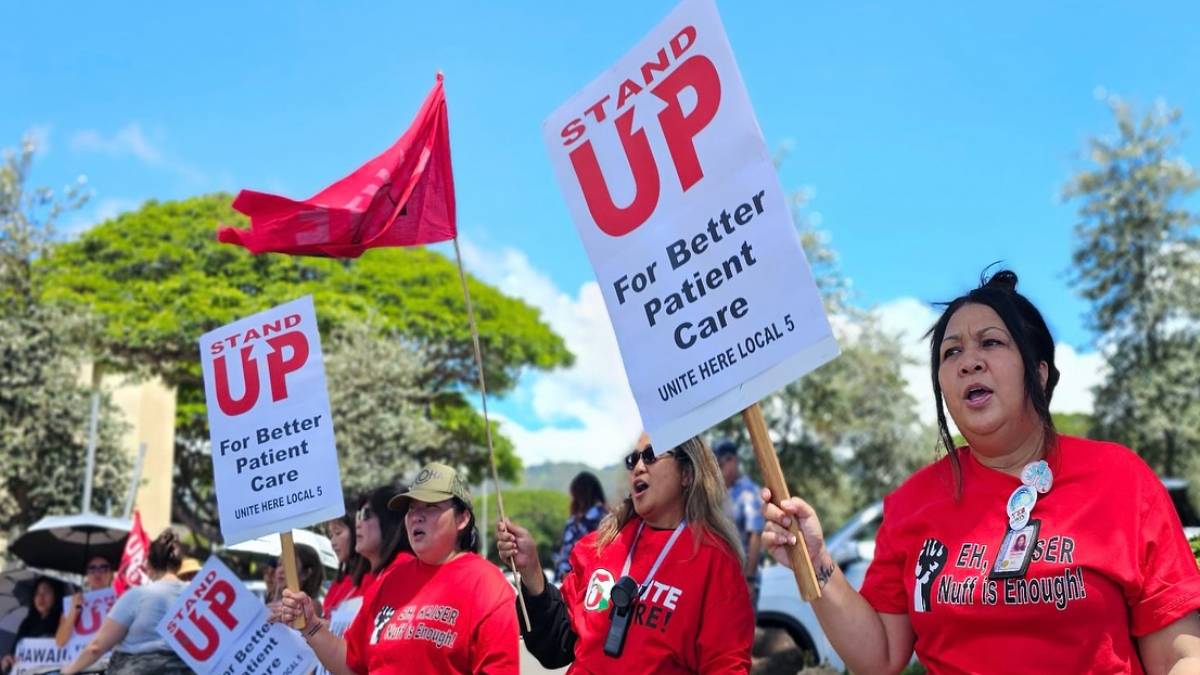
Workers are going on strike after Kaiser executives have refused for months of negotiations to settle a fair contract that includes safe staffing, equitable pay and benefits, and a voice for frontline caregivers, union officials stated in a press release.
Up to 46,000 Kaiser employees could join strike lines in California, Hawai‘i, and Oregon.
“Stagnant wages and unsafe staffing threaten both the workforce and the high-quality care patients depend on,” according to a news release from the United Nurses Associations of California/Union of Health Care Professionals. “Kaiser currently holds $66 billion in reserves — much of it accumulated during the COVID-19 pandemic, when frontline caregivers sacrificed their health, families, and, in some cases, their lives.”
Among those taking to the picket line is Lisa Pang, a licensed practical nurse who runs the general surgery department, works with traveling providers and patients at the Kona and Waimea clinics.
Pang has worked for Kaiser for 17 years. She assists with about four minor surgeries at the clinics daily, as well as schedules appointments for patients.
She said she and her colleagues have been asking for additional staffing “forever.”
“We’re tired of hearing it’s not in the budget when Kaiser can afford it,” Pang said Monday.
Pang said Hawai‘i workers are paid 30% less than their counterparts in California, adding: “It makes us feel like we’re second class.”
“For me, it’s exhausting,” Pang said of the workload and the lack of staffing, saying there are times that she can’t call patients back for a couple of days because she’s busy with her daily caseload. “I feel like I can’t do enough for the patients. I go home thinking I could’ve done more.”
According to union officials, Kaiser is resisting fair pay and refuses to fix staffing. Additionally, the release states the health care company is pouring money into expansion projects in Pennsylvania, Nevada, and North Carolina without solving its staffing issues.
Since May, Kaiser officials stated they’ve worked to reach new national and local agreements—achieving 52 tentative agreements, holding over 900 local bargaining sessions, and reaching comprehensive agreements at 17 of 54 local tables.
“We’ve enhanced proposals, initiated mediation, and extended bargaining. Even after receiving 10-day strike notices, we continued negotiating, seeking agreement,” officials stated in an email Monday.
The email stated that “at the heart of this negotiation is a dispute about wages.”
For months, Kaiser officials say they’ve been preparing contingency plans to ensure members continue receiving safe, high-quality care if a strike occurs. During the strike, the hospital, emergency department, urgent care centers, and most medical offices will remain open.
Some of the pharmacy and laboratory locations, however, will be closed.
According to the email from Kaiser, the union is seeking a 25% wage increase over four years, a figure, officials say, is “out of step” with today’s economic realities and rising health care costs.
“This would dramatically increase the current $6.3 billion annual payroll and lead to higher rates for members and customers, with serious market implications,” the email reads. “Our 21.5% offer will increase payroll for this group by nearly $2 billion in total by 2029. To support this level of increase, we’re reducing internal costs and optimizing operations.
“Anything beyond 21.5% will require us to further increase rates for our members and customers, at a time when health care costs are increasingly unaffordable and many are having to make the difficult choice to go without coverage. We have a responsibility to do the right thing for our employees and our members and customers.”
Kaiser officials said they respect the union and its members.
“A strike is unnecessary when a generous offer is on the table. It is designed to disrupt the lives of our patients—the very people we are all here to serve,” Kaiser officials stated.