


Military convoys, training scheduled for next nearly 2 weeks around Big Island
Numerous convoys as part of military training are scheduled during nearly the next 2 weeks, traveling to and from Keʻāmuku Maneuver Area, adjacent to Wāikiʻi Ranch; Pōhakuloa Training Area; Ellison Onizuka Kona International Airport; and Kawaihae Harbor.
Convoy movement is now expected to begin as early as noon Friday from Ellison Onizuka Kona International Airport, with the last convoy departing the airport no later than 7 p.m.
The change is because of heavy lift aircraft scheduling.

Military Police with Pōhakuloa Training Area will escort the convoys during the training exercises through main intersections along Queen Kaʻahumanu Highway at Keāhole Airport Road and Waikōloa Access Road as well as Highway 190 (Māmalahoa Highway) at the sundial above Waikōloa.
There also will be traffic control at the entry point into the training area just off Highway 190, about 3 miles north of the Waikōloa Drive and Highway 190 Intersection.
Motorists can expect increased traffic northbound between the Kona airport, Waikōloa Drive intersection and Kawaihae harbor.
Convoy leaders will continually assess conditions and conduct pull-over procedures on permissible straightway sections of the road to allow residents to bypass the convoy safely and reduce backed-up traffic.
“We are asking for the community to be patient, as traffic can build up behind a convoy, and use extreme caution when passing a convoy,” said U.S. Army Garrsion Hawaiʻi Public Affairs Director Michael Donnelly. “Our commitment to the surrounding community is of the utmost priority and we appreciate the continued understanding and support.”
The scheduled convoys are part of U.S. Army participation in a regional combat training exercise highlighting its ability to operate in contested environments and achieve shared tactical, operational and strategic objectives.
The 25th Infantry Division U.S. Army Garrison Hawaiʻi from Nov. 6-17 will conduct a significant portion of the Joint Pacific Multinational Readiness Center exercise on Hawaiʻi Island.
Supported by U.S. joint forces and multinational partners, the training exercise includes participants from the United States and partner nations. It will also be ongoing on Oʻahu, Maui and Kauaʻi, with personnel and equipment set to return Nov. 25 to their home stations.
Big Island training exercises will take place at Pōhakuloa Training Area, with support activity tied to the Kona airport and Bradshaw Army Airfield on Oʻahu. Residents may see military traffic associated with movement between Kona, Kawaihae Harbor, and Pōhakuloa Training Area, however, exact times and routes will vary based on the training scenario.
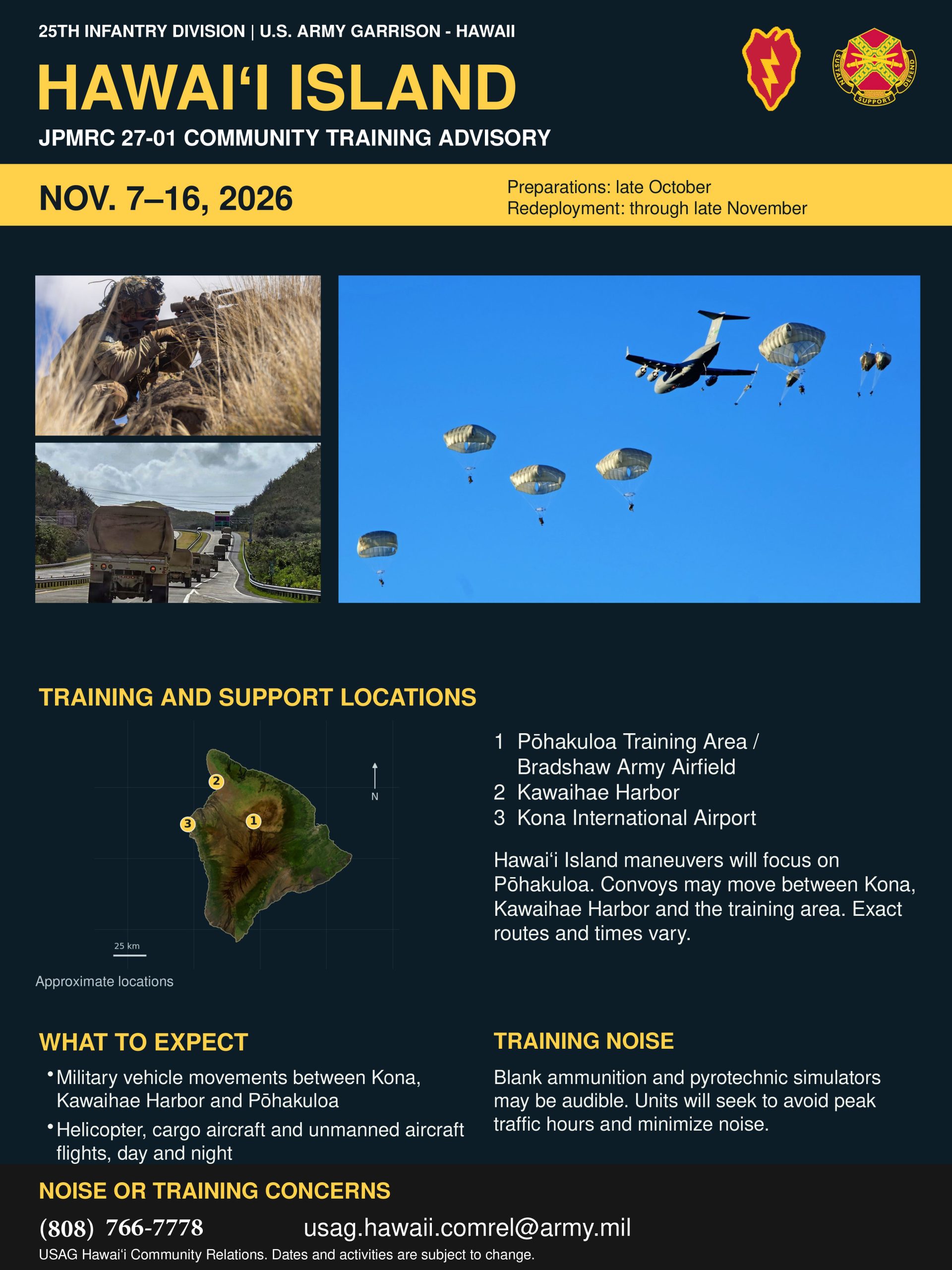
Joint Pacific Multinational Readiness Center training schedule
Nov. 6
- Activity: Paratrooper drops and nighttime helicopter landings.
- Expected community impact: Low-flying aircraft flying approximately 1,000 feet near Wāikiʻi Ranch boundary and noticeable daytime and nighttime aircraft noise.
Nov. 6-9
- Activity: 24/7 ground maneuvers, drone flights, and blank-firing exercises.
- Expected community impact: Intermittent simulated gunfire (blanks) and military vehicle traffic throughout Keʻāmuku Maneuver Area.
Nov. 7-9
- Activity: Cargo, vehicle, and supply parachute drops.
- Expected community impact: Intermittent daytime aircraft passes and noise near Wāikiʻi Ranch.
Nov. 10
- Activity: Troop transition from Keʻāmuku Maneuver Area to Pōhakuloa Training Area.
- Expected community impact: Active training in Keʻāmuku Maneuver Area ends the night of Nov. 9; reduced activity as units relocate.
Nov. 11-16
- Activity: Training at Pōhakuloa Training Area.
- Expected community impact: Vehicle movements in the training area adjacent to Highway 200 (Daniel K. Inouye Highway)
Nov. 17-25
- Activity: Vehicles and personnel movement to home stations.
- Expected community impact: Convoys from Pōhakuloa Training Area to Kawaihae; personnel movement from Pōhakuloa Training Area to Kona airport.
The U.S. Army will follow strict safety precautions to protect the community and surrounding areas. The precautions include:
Noise and livestock protection
- 1,000-foot noise buffer: Ground troops are barred from entering a designated 1,000-foot buffer zone along the Wāikiʻi Ranch boundary to lessen noise impacts, particularly at night.
- Ranch and pet precautions: Ranches, pet owners and residents are encouraged to take precautions for livestock and animals sensitive to sudden noise from low-flying planes and blank ammunition.
- No live fire at Keʻāmuku Maneuver Area: All simulated gunfire utilizes blank ammunition only. No live rounds or pyrotechnics are permitted at Keʻāmuku Maneuver Area.
Parachute and drop zone safety
- All drops occur in designated military zones under strict safety protocols.
- Pōhakuloa Training Area maintains active recovery teams on standby to locate and secure any gear or personnel that might land off-target.
Comprehensive wildfire prevention
Given heavy brush and grass growth following recent storms, Pōhakuloa Training Area is enforcing stringent fire safety measures.
- Strict bans: Zero live ammunition, tracer rounds or pyrotechnics in Keʻāmuku Maneuver Area.
- Vegetation fuel breaks: Mowed and cleared firebreaks along key access roads and along the Wāikiʻi Ranch border.
- Dedicated fire crews: 24/7 on-site presence of the Pōhakuloa Training Area Fire Department with dedicated apparatus positioned for instant response.
- Agency coordination: Continuous operational coordination with Hawaiʻi Fire Department, Wāikiʻi Ranch, Parker Ranch and Waikōloa fire teams.
- Active oversight: Direct supervision by safety officers and exercise controllers throughout all phases.
Convoys consisting of 10 to 15 military vehicles carrying personnel and equipment will have two routes during the exercise.
Ellison Onizuka Kona International Airport and Keʻāmuku Maneuver Area
- Departures begin as early as noon, with the last departure expected no later than 7 p.m. Nov. 6.
- Queen Kaʻahumanu Highway to Waikōloa Access Road to Highway 190 to the training area gate north toward Old Saddle Road to Wāikiʻi Ranch.
- Hawaiʻi Police Department, in conjunction with Pōhakuloa Training Area Military Police, will establish traffic control points at critical intersections.
Pōhakuloa Training Area to Kawaihae Pier
- 8:30 a.m. to 6 p.m. Nov. 4-6 and 16-25.
U.S. Army Garrison added that Saturday convoys throughout the exercise period are scheduled from 7 a.m. to 7 p.m.
Contact the U.S. Army Garrison Hawaiʻi Community Concern Line at 808-776-7778 or email to usag.hawaii.comrel@army.mil to report any concerns related to noise or training.
Concerns are responded to during regular business hours from 8 a.m. to 4 p.m. Monday through Friday.