


Volcano Watch: Where did the September fissure vent lava at Kīlauea’s summit come from?
“Volcano Watch” is a weekly article and activity update written by U.S. Geological Survey Hawaiian Volcano Observatory scientists and affiliates. Today’s article is written by Hawaiian Volcano Observatory geologist Heather Winslow and U.S. Geological Survey data scientist Marco Bagnardi.
A set of 6 new eruptive fissure vents opened in mid-September at Kīlauea summit along the western wall of Halemaʻumaʻu Crater. They opened after a period of re-pressurization of the summit magma storage system in August following the end of Episode 54 lava fountaining of the ongoing episodic summit eruption.
Pressure increases in the summit magma reservoir are inferred primarily from deformation data collected by instruments around the summit area.
Uēkahuna tiltmeter, for example, measured about 13 microradians of ground tilt downward toward the center of the crater Aug. 25 during Episode 54. This tilt indicated a decrease in pressure in the magma reservoir during fountaining.
The pressure drop fully recovered by Sept. 7, when the tilt recorded returned to pre-fountaining level.
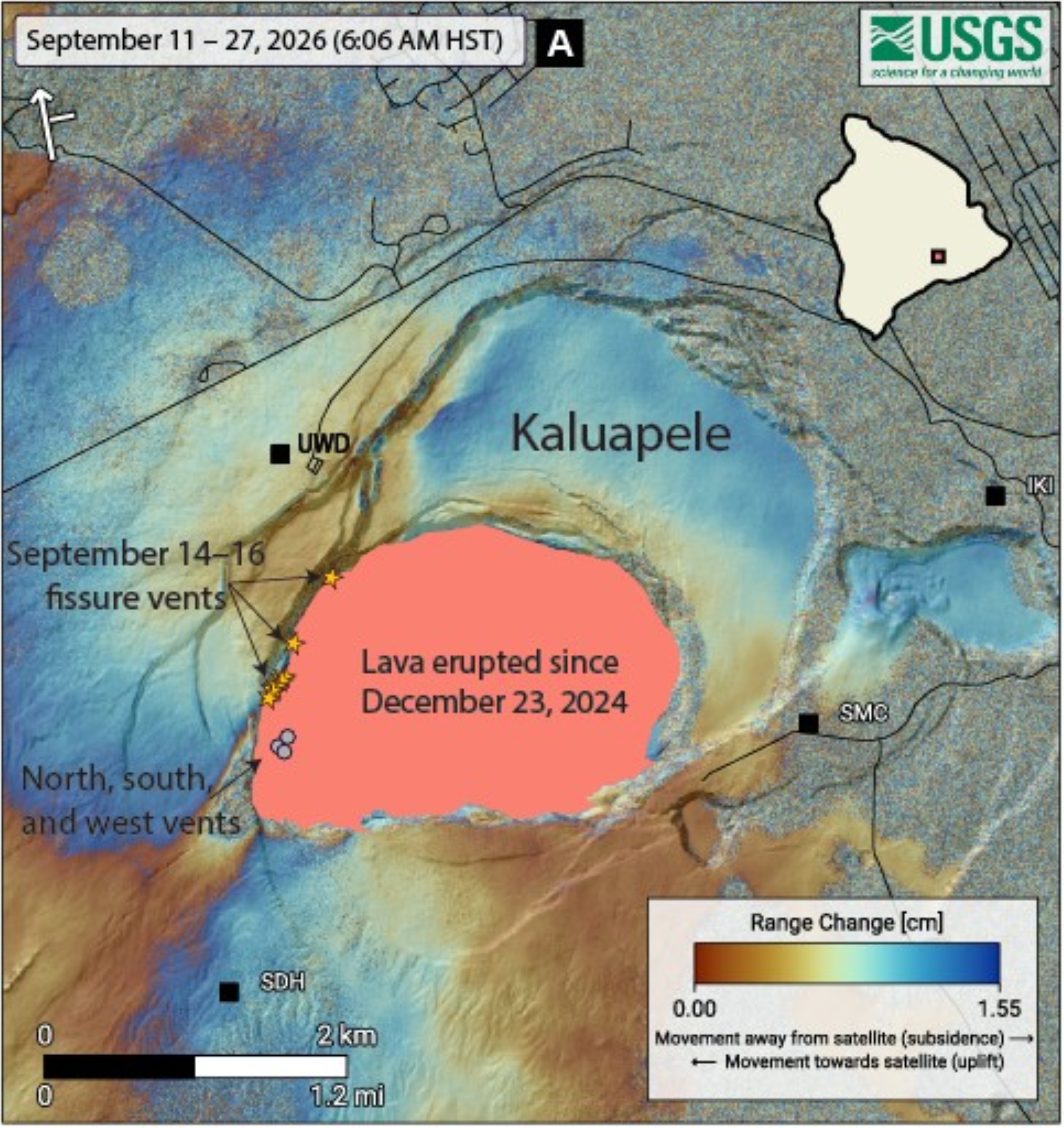
At that point, the summit vents began to overflow, indicating pressure in the summit reservoir was rebuilt.
However, fountaining did not follow the overflows as it had during previous episodes. Instead, the summit storage system continued to further pressurize, albeit intermittently.
Along with tilt data, global navigation satellite system (GNSS), often referred to as GPS, also indicated increasing pressure through uplift and extension throughout Kīlauea’s summit region.
This further pressure increase led to the opening of the new fissures Sept. 14-16.
The 6 new vents extend from 0.1 to 0.6 of a mile north of the main vent complex in Halemaʻumaʻu, where lava fountaining occurs, and are about 150 feet below the base level of the northern vent.
No significant seismicity or surface deformation were detected. An interferometric synthetic aperture radar satellite image spanning the opening of the vents did not record any significant surface displacements in the proximity of the new vents or elsewhere.
Absence of seismicity and deformation suggests magma could have moved through pre-existing cracks or pathways, or it opened a new path to the surface without significantly fracturing and displacing adjacent solid rock.
Hawaiian Volcano Observatory geologists sampled the lava from the new vents while they erupted to determine the magma’s origin, collecting water-quenched samples while lava is still molten by scooping the molten lava into a bucket of water to rapidly cool the sample.
This method is preferred because it preserves pre-eruptive chemistry and crystal sizes (termed “texture”), which can otherwise be altered when lava slowly cools and solidifies at the surface.
Texture and chemistry of the lava erupted from the 6 new vents in September show it matched what usually erupted from the shallow magma chamber beneath Halemaʻumaʻu. The water-quenched sample was mostly glassy — meaning it had very few crystals — and its chemistry was very close to material erupted during Episode 54, with about 6.9 weight percent magnesium oxide.
Chemistry and texture of the lava tell us several important things:
- The fissure vents were not fed by fresh, new, deeper magma. If they were, the lava would contain more magnesium and be much hotter.
- The lava’s low crystal content shows it also wasn’t residual material from an older buried lava lake eruption being squeezed out by increasing pressure.
- Because the new lava has similar magnesium levels and is crystal-poor, it most likely came from the same shallow magma chamber beneath Halemaʻumaʻu that feeds typical fountaining episodes.
The combination of deformation and geochemical datasets show the new fissure vents were the same magma source we have seen in previous fountaining episodes and likely formed because the magma system was highly pressurized and simply forced its way along the easiest path to the surface.
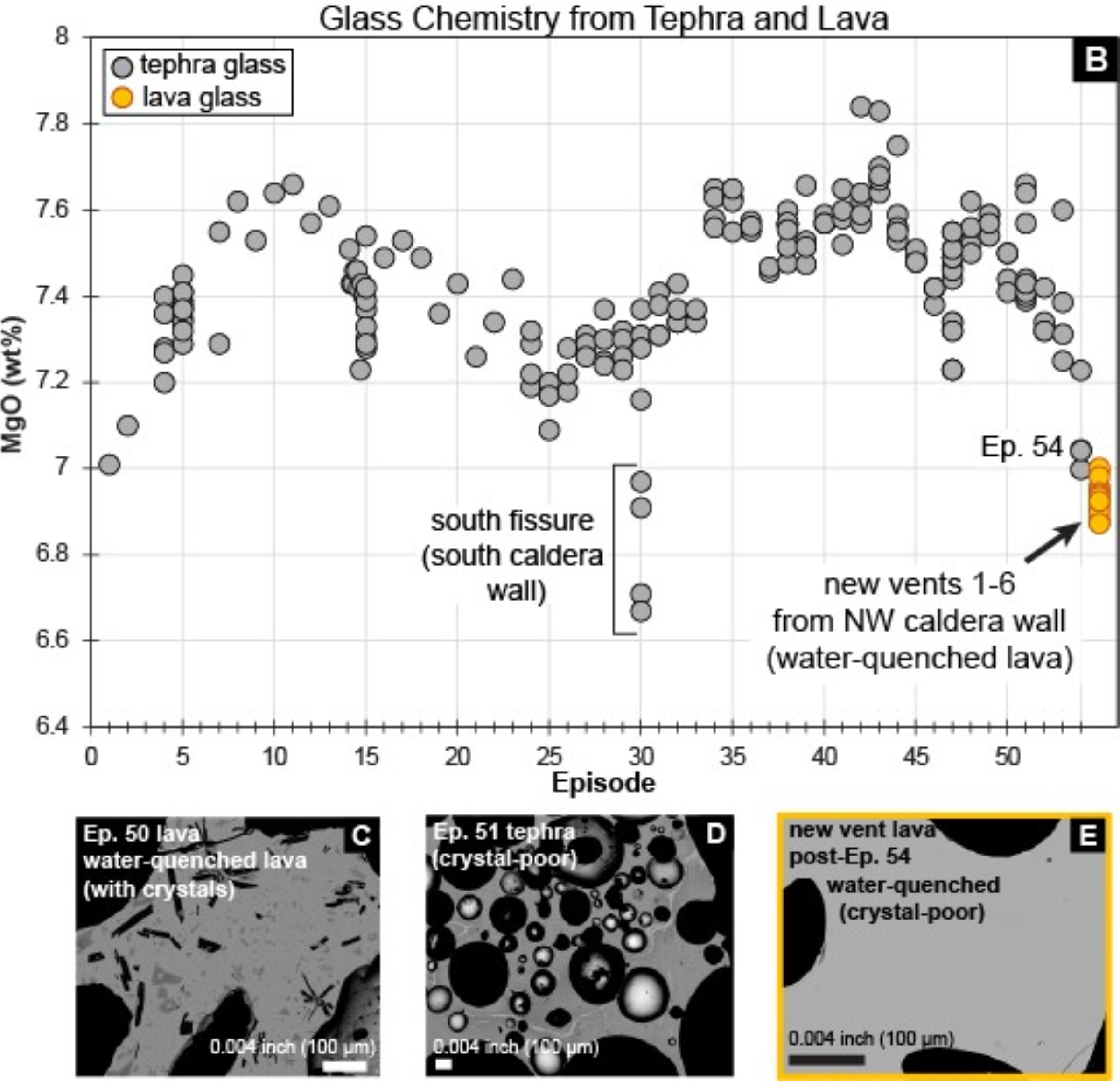
This quiet opening of new vents differed from the Sept. 30-Oct. 1 intrusion northeast of the eruptive vents in Halemaʻumaʻu. Though lava didn’t make it to the surface then, more than 100 earthquakes and significant ground surface deformation occurred as new cracks formed on the caldera floor.
With continued pressurization at Kīlauea, changes remain possible below and above the surface.
* * * * * * * * *
VOLCANO ACTIVITY UPDATES
KĪLAUEA volcano
VOLCANO ALERT LEVEL: Watch
Kīlauea has erupted episodically since Dec. 23, 2024, within the volcano’s summit caldera.
North and south vents in Halemaʻumaʻu Crater intermittently erupted spatter and lava flows during the past week, with strong glow and flames visible overnight. Sulfur dioxide emissions are in the range of 1,000 to 5,000 tonnes per day.
The summit region remains at a high level of pressurization. Current conditions remain favorable for another fountaining episode or change in eruptive activity.
No unusual activity was noted along Kīlauea’s East Rift Zone or Southwest Rift Zone.
MAUNA LOA volcano
VOLCANO ALERT LEVEL: Normal
Mauna Loa is not erupting. Read the most recent monthly Mauna Loa activity update online.
Hawaiian Volcano Observatory continues to closely monitor Kīlauea and Mauna Loa.
* * * * * * * * *
EARTHQUAKE ACTIVITY UPDATES
One earthquake was reported felt during the past week in the Hawaiian Islands:
- MAGNITUDE-3.1 earthquake at 3:09 p.m. Oct. 12 located 7 miles south-southeast of Fern Forest at a depth of 3 miles.
Visit the Hawaiian Volcano Observatory website for past “Volcano Watch” articles, Kīlauea and Mauna Loa updates, volcano photos, maps, recent earthquake information and more. Email questions to askHVO@usgs.gov.