


Volcano Watch: Tephra time machine; exploring Kīlauea volcano’s past
“Volcano Watch” is a weekly article and activity update written by U.S. Geological Survey Hawaiian Volcano Observatory scientists and affiliates. Today’s article is by Hawaiian Volcano Observatory geologist Kendra J. Lynn.
Hawaiian Volcano Observatory scientists in July visited an exposure of tephra and lava flows in the western wall of Kaluapele, the summit caldera of Kīlauea volcano. The layers were exposed by the 2018 summit collapse and contain important clues to the volcano’s long-term eruptive history.
Because Kīlauea is so frequently active, most of the volcano is covered by young lava flows less than 1,000 years old. That means there are few samples, observations or data for older eruptions, especially at the summit.
Yet we know Kīlauea has been in its shield-building stage for more than 200,000 years, so how do scientists learn about the volcano’s history?
One way is to search along faults, where older rocks are exposed at the surface. But the summit region is tricky because it is constantly changing.
Sometimes Kīlauea’s dynamic nature provides us unique opportunities for geologic investigations. Through the course of a few months during summer 2018, part of the summit caldera collapsed as magma drained to feed the eruption in the lower East Rift Zone.
Afterward, Kaluapele had a 1,640-foot deep collapsed crater where Halema‘uma‘u Crater was.
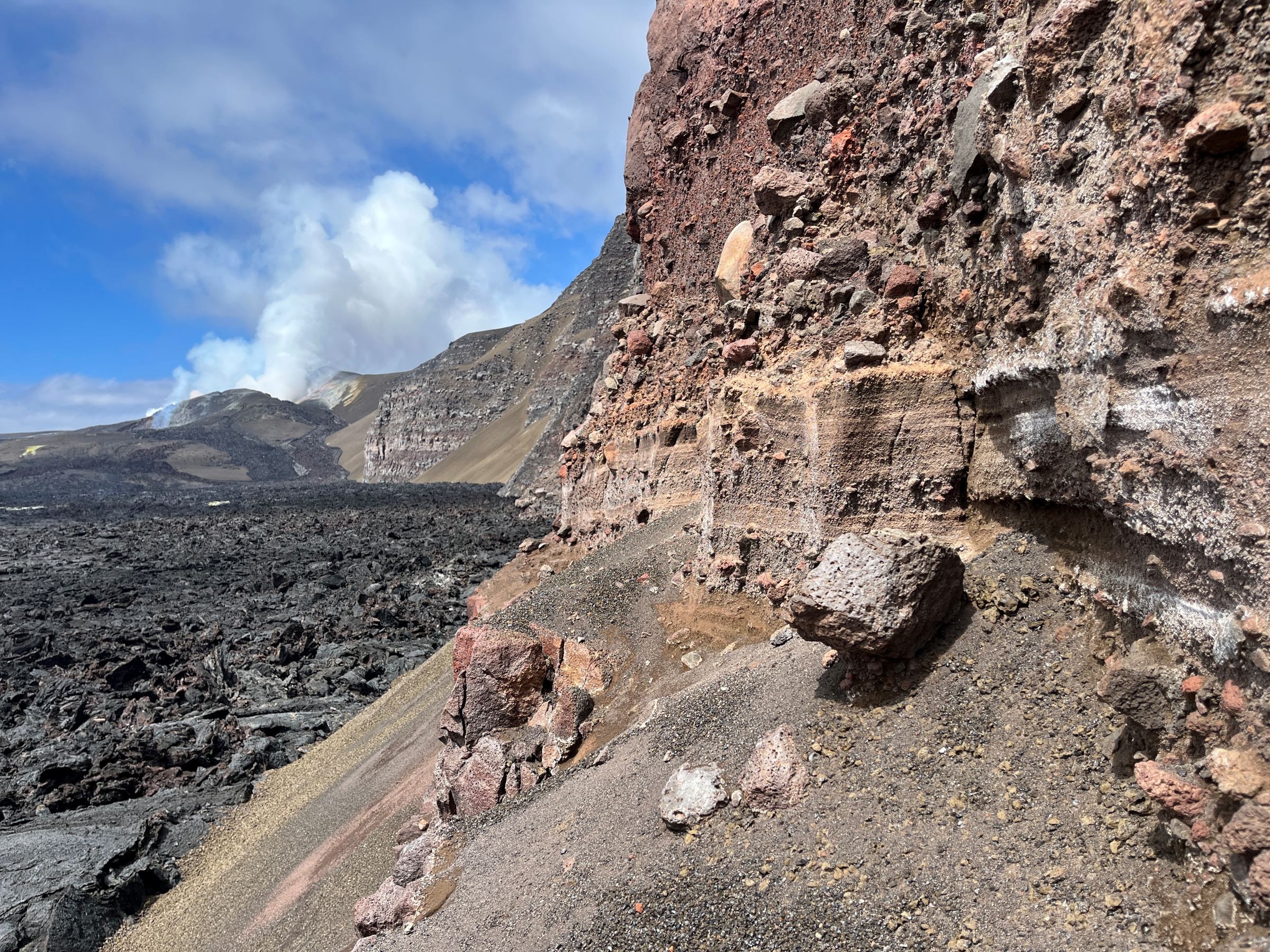
This hulihia — a dramatic change — exposed lava flows and tephra sections that had not been seen at Kīlauea since the 1912 founding of Hawaiian Volcano Observatory. These new exposures preserved deposits from some of the oldest eruptions near Kīlauea’s summit ever catalogued by scientists.
Observatory geologists collected high resolution photographs of the west wall of Kaluapele via uncrewed aircraft systems, or drones, after the 2018 collapse and stitched together a large mosaic of the caldera cliff south of Uēkahuna, the highest point on Kīlauea.
From these images, several sections of explosive tephra were identified, sandwiched among the lava flows.
Hawaiian Volcano Observatory geologists have visited the newly exposed lava and tephra layers since 2023 in search of new insights into Kīlauea’s evolution.
Our first missions focused on the deepest tephra exposure and its surrounding lava flows, likely the oldest tephra ever studied near the summit caldera.
The deepest tephra exposure has since been re-buried by lava flows filling in the 2018 collapse. Starting this past spring, observatory staff were carefully monitoring the rising lava in Halema‘uma‘u as it approached the second tephra section of interest.
Episodic lava fountain forecasting aided in accessing this exposure, as field work could be planned for periods between episodes to maximize safety. It was during a pause between fountaining Episodes 50 and 51 this summer that geologists returned to the crater wall to examine the tephra.
When they landed, they traversed fresh lava flows over to the caldera wall where tephra from recent lava fountains accumulated. Tephra exposure was about 20 feet above the caldera floor, where during a few hours the crew described and sampled the lava flows and tephra layers preserved in the crater walls.
A week later, Episode 51 sent lava flows to the north along the western crater wall and raised the surface of Halema‘uma‘u to just beneath the tephra sequence. Episode 52, during late July, once again sent lava flows to the north.
An overflight July 29 after the episode confirmed the tephra is now buried again, after being exposed for less than 8 years following the 2018 eruption.
There are additional lava flow and tephra exposures that Hawaiian Volcano Observatory scientists will visit as the floor of Halema‘uma‘u rises, if conditions allow. Each sample provides a unique glimpse of summit eruptive history that cannot be found anywhere else on the volcano.
One of the largest tephra sections identified in the new caldera walls was previously partially exposed during the early 19th century, and was last documented during a July 1913 visit by Thomas Jaggar. A few years later, it was buried by the 1919 summit eruption.
Re-exposed in 2018, Hawaiian Volcano Observatory scientists wonder if it could be associated with the Uēkahuna Ash — which is 1,000 to 2,000 years old — as it sits at a similar level in the caldera walls to other exposures farther to the north in Kaluapele.
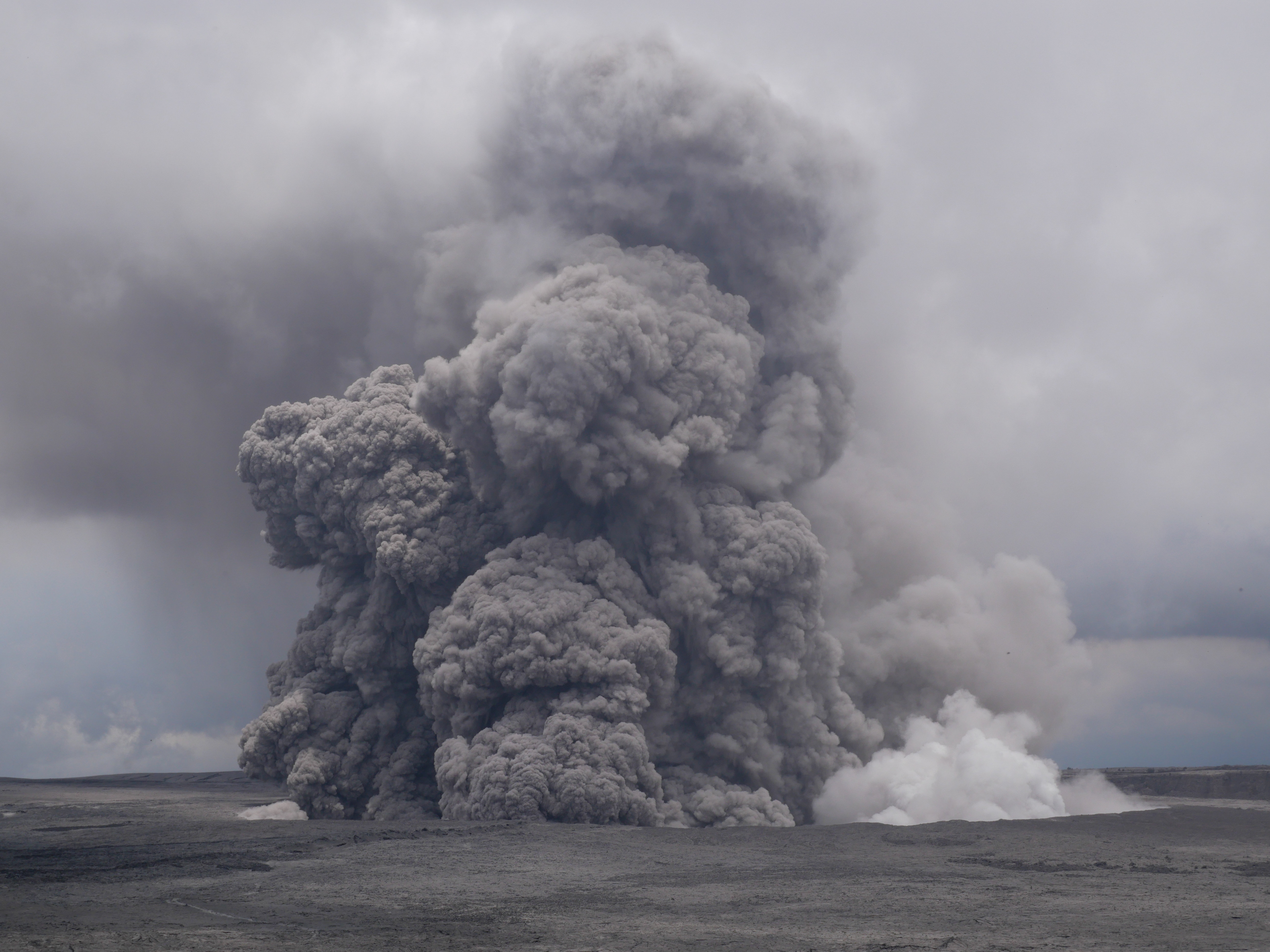
Tephra exposures Hawaiian Volcano Observatory geologists visited in 2023 and 2026 are lower and could be much older than the Uēkahuna Ash. Therefore, they could represent eruptions never before studied.
Analysis of the samples will help us determine when and how they erupted, providing insight into a murky period of Kīlauea’s eruptive history.
* * * * * * * * *
VOLCANO ACTIVITY UPDATES
KĪLAUEA volcano
VOLCANO ALERT LEVEL: Advisory
Kīlauea has erupting episodically since Dec. 23, 2024, within the summit caldera. Episode 54 of lava fountaining lasted 9 hours Aug. 25. Summit region inflation resumed initially after the end of the episode but was followed by variable ground deformation. No unusual activity was noted along Kīlauea’s East Rift Zone or Southwest Rift Zone.
WHAT’S NEXT: Another lava fountaining episode is likely in the coming weeks, if normal tilt patterns resume. More data are needed to model the forecast window.
MAUNA LOA volcano
VOLCANO ALERT LEVEL: Normal
Mauna Loa is not erupting. Find additional information about Mauna Loa and read the most recent monthly volcano activity update at the Hawaiian Volcano Observatory website.
Hawaiian Volcano Observatory continues to closely monitor Kīlauea and Mauna Loa.
* * * * * * * * *
EARTHQUAKE ACTIVITY UPDATE
One earthquake was reported felt during the past week in the Hawaiian Islands:
- MAGNITUDE-3.2 earthquake at 2:25 a.m. Aug. 23 located 11 miles north of Pāhala at a depth of 4 miles.
Visit the Hawaiian Volcano Observatory website for past “Volcano Watch” articles, Kīlauea and Mauna Loa updates, volcano photos, maps, recent earthquake information and more. Email questions to askHVO@usgs.gov.