



Hawai‘i County prosecuting attorney, police concerned about recent releases of felony-charged arrestees

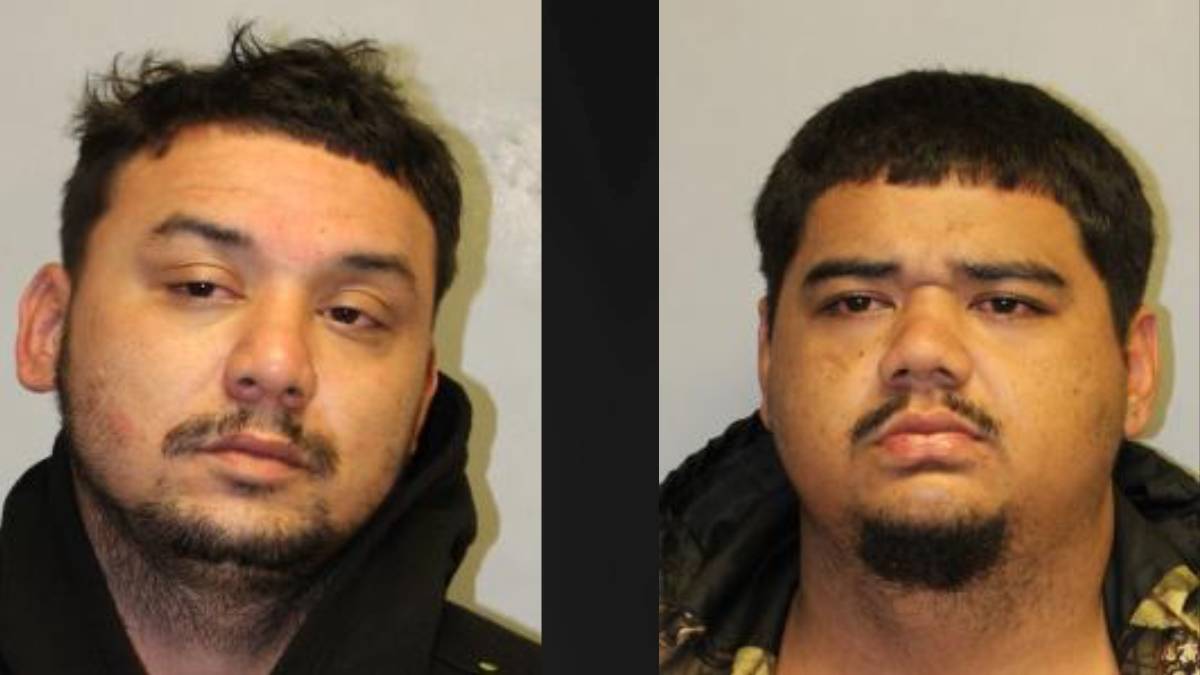
On Monday, brothers Ha‘oli Kanawaliwali Santos and Hunta Santos were arrested and charged with a string of burglaries over three weeks that were concentrated within a one-square-mile area in Hilo.
Bail was set at $131,000 for Ha‘oli Kanawaliwali Santos, 29, and $20,000 for Hunta Santos, 24. But after their initial appearance in Hilo District Court on Monday, the brothers were granted supervised release over objections from prosecutors.
Hawai‘i Police Capt. Rio Amon-Wilkins also did not think the brothers should have been released back into the community. He had been part of the investigation involving about 20 to 24 burglaries in the past few weeks, of which the brothers allegedly were responsible for some of them.
“There were business owners in the courtroom,” Amon-Wilkins said. “I mean, they may not have been arrested for violent offenses, but it’s definitely a huge impact on the community.”
There is a growing frustration among law enforcement and the Hawai‘i County Prosecuting Attorney’s Office that individuals charged in serious felony cases on the Big Island continue to be granted supervised release or reduced bail after appearing before a judge.
This trend was noticeable in February, after seven people from different cases were all released from jail with a variety of conditions requiring electronic monitoring, staying away from victims, not possessing firearms and/or mandatory drug testing.
The cases filed in the Hawai‘i State Judiciary’s Ecourt Kokua system show at least four instances where these suspects are facing crimes ranging from abuse of a household member to possession of a firearm to sexual assault of a child, all of which were granted reduced bail or supervised release.
As law enforcement and deputy prosecuting attorneys battle this trend in the local courts, Hawai‘i County Deputy Prosecuting Attorney Kelden Waltjen is testifying to state lawmakers against measures aimed at establishing additional protections and rights for the criminally accused.
Bills include:
- HB 2494 – Amends the circumstances under which officers may issue citations in lieu of arrest, among other changes. The bill is scheduled for decision-making on March 3 in the House Committee of Judiciary and Hawaiian Affairs.
- HB 2413 – Requires release on recognizance for defendants charged with violations, traffic offenses, nonviolent petty misdemeanors, nonviolent misdemeanors, and nonviolent class C felonies, subject to conditions. The bill is scheduled for decision-making on March 3 in the House Committee of Judiciary and Hawaiian Affairs.
- HB 1516 – Requires certain factors to be considered when determining a defendant’s financial ability to afford bail. The measure passed out of the Judiciary committee on Feb. 19 unamended.
- HB 1627 – Adds exceptions to mandatory sentencing provisions. This measure was deferred.
“The courts already have the discretion to grant release for an offender,” Waltjen said. “These bills will only make it harder for police and prosecutors to do their job. They’re, to me, a step backwards.”
Tommy Johnson, director for the Department of Corrections and Rehabilitation, said his department is opposing House Bill 1628, which calls for the compassionate release of qualifying incarcerated individuals who are serving life sentences without the possibility of parole.
It passed out of the Judiciary committee with amendments on Feb. 25.
“We believe that the process would circumvent the authority of the penal code and the judges in imposing mandatory minimum terms if they’re allowed to be considered for compassionate release without the court taking action to reduce the mandatory minimum term it previously imposed,” Johnson said.
These issues are not quickly solvable. The judiciary and public safety are dealing with overcrowding at Hawai‘i Community Correctional Center in Hilo as well as a lack of services to help individuals reintegrate back into the community.
Johnson said over the past couple of legislative sessions, he has asked the State Legislature for about $2 million for planning and starting a site selection process for a jail in West Hawai‘i.
Now, the only Big Island jails are both in East Hawaiʻi, HCCC and Kulani Correctional Facility, a 200-bed minimum security prison located 20 miles southeast of Hilo.
The funding request for the West Hawaiʻi jail was not granted again this year as it did not make it into the Governor’s Executive budget, so Johnson said he will try again next year.
“We needed the money a couple of years ago, but we understand that the state has priorities and corrections is not sexy,” Johnson said. “We compete with the need for new schools, roads and hospitals. But I think what the policymakers have to understand is that correctional facilities operate 24-7, and so there’s a lot of wear and tear on the infrastructure for facilities like that.”
Johnson said about a third of the inmate population at Hawaiʻi Community Correctional Center is “from the Kona side.”
“We believe that they should remain on the Kona side, be housed there, and then reintegrate back into the community there so they can be closer to their families and loved ones,” Johnson said.
In 2024, a new Kaumana Housing Unit opened at HCCC, increasing its operational capacity to 274 from 226. As of Friday, the number of inmates is above operational capacity at 287, with 245 men and 42 women.

The vast majority of the inmates are pretrial felons (a person charged with a felony who is awaiting trial but not convicted), Johnson said.
Waltjen supports the addition of a jail on the westside of the island.
“People don’t want to talk about building a jail, but there are things that we could design that would be able to facilitate reintegration-related services that we need, things like wraparound services, … housing, in-house substance abuse treatment, vocational training and more,” he said.
Waltjen said there is a misconception by some lawmakers and members in the community that inmates at the jail are incarcerated on low-level offenses.

“That is not the case,” Waltjen said. “It’s very consistent data-wise, 89 to 90% of the people at HCCC are being held in custody regarding felony charges, whether it be pretrial, sentenced felon, probation violator or parole violator. That’s the large majority of those that are in custody.”
People who are in custody on misdemeanor offenses, Waltjen said, are mostly those with domestic violence-related offenses or misdemeanor probation violators.
“People aren’t in custody on petty misdemeanor, property offenses,” Waltjen said. “They’re not being held in custody on criminal contempt or failure to appear. They’re not being held in custody for simple possession of marijuana offenses. Those are all misconceptions.”
Johnson said the HCCC jail population is fluid, with some inmates there for only five days.
“The longest folks who are with us for jail are the sentenced misdemeanors, which is one year,” Johnson said, adding it is difficult to provide programs to people who are only in custody for shorter-stays.
The department offers referral services to inmates as much as possible. In the jail, the efforts are concentrated on the sentenced misdemeanor population, Johnson said.
Johnson also thinks in some cases police should have the ability and option to take a person who might be suffering from a psychotic episode to a place where they can be assessed and provided treatment, as opposed to being arrested.
“I think that the state as a whole needs to look at deflection more, where police should have the ability to deflect people at the point of contact in the community,” Johnson said. “To place someone in a jail setting who has a serious mental health illness is the least effective, most costly option as opposed to providing community-based services for them.”
While Amon-Wilkins agrees everyone is innocent until proven guilty, as a law enforcement officer “we have a responsibility to also protect the community.”
“Everyone in the justice system (judges, prosecuting attorneys, public defenders) has some level of responsibility in public safety and public service,” Amon-Wilkins said. “Judges have a heavy caseload also. I don’t want to say that they’re doing this deliberately. I think that they make the best decision they can with the information that they have at the time.”
One of the tools used by the court to assess risk of releasing an individual is a pretrial bail report, which assesses an individual’s medical, health, physical and educational needs. It is conducted by the Intake Service Center staff with the Department of Corrections and Rehabilitation.
Johnson said a staff member will go to the cellblock and try to complete the report before a person has their initial court appearance with a judge. The report includes the recommendation for release or bail.
Rachel Thompson, deputy public defender and supervising attorney for the Kona office, said the court is required to determine what statutory factors are needed for a pretrial detainee to be released, whether it’s substance abuse treatment, electronic monitors, curfews, drug testing or no contact.
“The judges have the ultimate say,” Johnson said. “They can look at the bail study and not accept the recommendation, or accept the recommendation, or even accept the recommendation and modify it some.”
That report, Thompson said, also gathers information about a person’s ties to the community to determine the risk of not appearing for court and their financial circumstances.
“People are poor,” Thompson said. “They can’t afford bail.”
It doesn’t matter if the bail is as low as $100. Thompson said many clients are homeless and can’t pay.
“Sometimes it feels we’re punishing people for being poor or homeless,” Thompson said. “These are nonviolent petty misdemeanor offenders.”
A lot of times, Thompson said, people who get arrested and charged get their mugshots “plastered on social media.” That results in a presumption of guilt.
“If bail was maintained and they are wealthy, they will be released because they can make bail,” Thompson said. “Those who are poor who have the same bail set as someone who is wealthy, won’t be able to post. It’s about access to justice.”
Waltjen said lawmakers need to focus on funding for service providers as opposed to focusing on how they can release offenders without the appropriate mechanisms to address whatever their issue is, including a lack of reintegration services.
“I’m not comfortable with making Hawai‘i Island a testing ground to see how this is going to work because this is our home,” Waltjen said, adding judges already have the discretion to release someone or reduce their bail.
Iopa Maunakea, founder of the Men of Pa‘a, a program that helps men reintergrate back into the community after being incarcerated, said Friday he has 20 men in his program and regularly has a waiting list for others.
“I need to figure out how to assess them and move them on to services that can better handle them rather than us, because I cannot handle everybody,” Maunakea said.
The Hawai‘i State Judiciary declined to comment for this story.
Sponsored Content


Subscribe to our Newsletter
Comments