



Hawaiʻi County Police Commission interviews eight finalists from pool of 64 for new chief
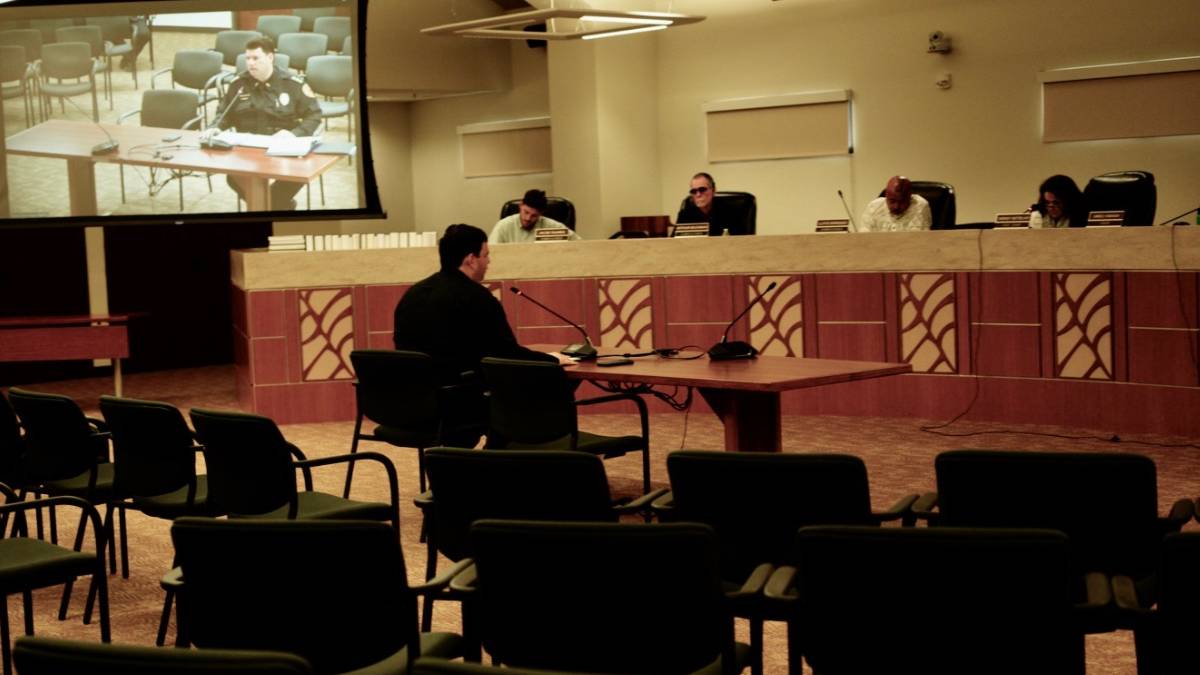
During a special public meeting on Thursday, the Hawai‘i County Police Commission interviewed the eight finalists for chief out of a pool of 64 applicants, of which only 27 met the minimum qualifications.
The nine commissioners will reconvene on Friday to make their final selection. The meeting will be at the West Hawai‘i Civic Center, 74-5044 Ane Keohokalole Highway in Kona. It also will be available to watch online here.
While the interviews were initially divided between commission meetings on Thursday and Friday, Commission Chair Gary Yamada made a motion to interview all candidates on Thursday out of fairness to all finalists and to avoid bias. The order of interviews, originally to be in alphabetical order, was selected randomly.
The finalists all were asked the same 10 questions, including those related to vision, independence and executive judgment, scenario-based decisions, immigration enforcement, recruitment and retention.
Two of the finalists are internal candidates: Interim Chief Reed Mahuna and Assistant Chief Kenneth Quiocho. The other six finalists are from outside of Hawaiʻi. To learn more about each candidates backgrounds, click here.
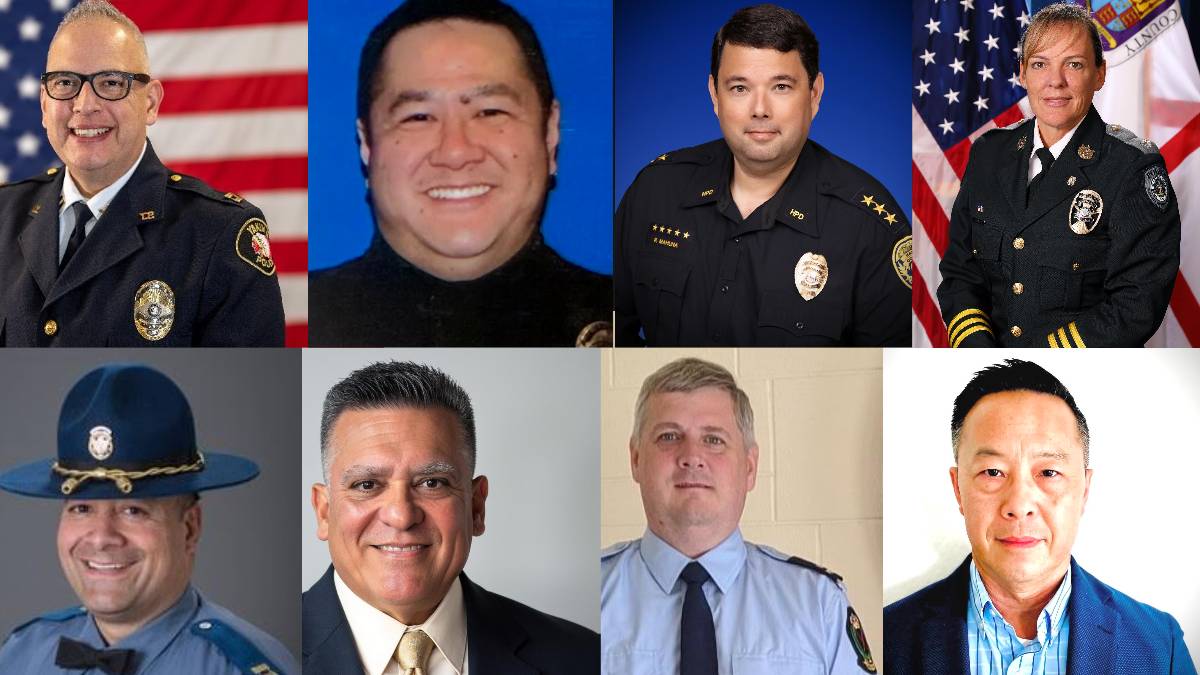
Here is glimpse of each candidate’s interview, beginning with the local candidates and then in the order of appearance before the commission.
Reed Mahuna, 49: Interim Chief, Hawaiʻi Island Police Department
Since the resignation of police chief Ben Moszkowicz, which took effect Aug. 31, Mahuna has served as interim chief.
On Thursday, there was overwhelming public testimony supportive of Mahuna’s leadership from a variety of people, including former Hawai‘i Gov. Linda Lingle and representatives from the State of Hawai‘i Organization of Policing Officers.
If Mahuna, a 28-year veteran of the force, is selected, he would follow in the footsteps of his father Lawrence Mahuna, who was police chief from 2002 to 2008.
“The kuleana of public safety rests with the police chief,” said Mahuna, who was born and raised on the Big Island. “He makes those decisions independently, but he also makes those decisions considering the needs of the commission, the needs of the community, and the needs of the administration.”
When the commission posed the scenario to Mahuna about a fatal officer-inolved shooting and unclear body-worn camera footage, the interim chief said he would release it if he can.
“Transparency is not always convenient…but I think we have to err on the side of being transparent,” Mahuna said, adding the department would adhere to guidance from the prosecuting attorney so as not to jeopardize a criminal case.
Mahuna said he can’t think of a scenario where the police department would be assisting in immigration enforcement.
When asked about recruitment and retention, Mahuna said he would prioritize officer wellness and safety, which is essential to public safety.
“There’s 35% of officers that deal with PTSD, 42% deal with depression,” Mahuna said. “In an officer’s career, he or she may see 150 critical incidents. It leads to relationship issues. It can even lead to suicide.”
Mahuna told the commission: “I came into this job five or six months ago and you gave me the honor of being interim police chief. I have provided steady leadership. I’m asking you now to lead with my vision and unlock the potential of this department.”
If he isn’t selected, Mahuna told Big Island Now he would support the commission’s selection: “It’s not about me, it’s about the community.”
Kenneth Quiocho, 61: Assistant Chief, Hawaiʻi Island Police Department
This is the second attempt to become chief for Quiocho, a 33-year veteran of the department.
“We need to communicate a lot better,” Quiocho told Big Island Now. “Tight-lip chiefs don’t make good chiefs.”
When given the scenario of an officer-involved shooting and the dissemination of information, Quiocho said he would first make sure the department wasn’t jeopardizing any police investigation or providing anything that would hinder something further on down the line.
Quiocho said the police department doesn’t enforce civil immigration activities on the Big Island.
“What we worry about is the law and criminal violations,” he said. “The partnerships we have complement the criminal avenue we’re pursuing.”
Quiocho spoke about his involvement during the 2019 protests on Mauna Kea where thousands of people spoke out against the building of the Thirty Meter Telescope. On the first day, kupuna were arrested.
Initially, it was about providing public safety, Quiocho said.
“But the telescope didn’t go up,” Quiocho said. “And when we looked around at what we were going to have to do to get the telescope up there, and when we looked at what that would do to the community and the relationship with the police department, it wasn’t working.”
Quiocho was ultimately taken off the assignment at Mauna Kea.
He told the commission he thinks the department needs to better establish trust with the community, while understanding there always will be critics.
“I’m also trying to make sure that we resonate confidence and stability with the community that we serve, so when they look at our department and we look at the police officers, they look at them with value and they look at them with high integrity,” he said. “We need to build that back up, because in my opinion, we’re losing that.”
If not selected, Quiocho said he would evaluate whether or not he would stay with the department.
“When it comes to police and working with Hawai‘i County Police Department, it’s all I know,” Quiocho said.
Paul Yang, 56: Retired Lieutenant, San Diego Police Department, California
Yang first came to Hawaiʻi Island about 15 years ago with his family and said he fell in love with it. Ten years ago, he bought property in Puna District’s Hawaiian Paradise Park with the plan to build a home on it.
With his kids now grown, Yang said his heart is on the Big Island and that he has the energy, drive and excitement for the job.
Yang told commissioners that a badge is not a shield from accountability.
“It’s a promise to uphold public trust, and when an officer violates that trust, it harms the legitimacy and it wounds the very people that we are sworn to protect,” Yang said. “As chief, my commitment to you is simple: Design a culture where integrity is non-negotiable and transparency is our standard.”
Yang said the department should prevent harm before it happens.
“Every officer, regardless of rank, will be trained and required to intervene the moment conduct becomes questionable,” Yang said. “Duty to intervene will be embedded in our trainings, evaluations and promotions.”
Yang said community policing is near and dear to his heart. During his time at the San Diego Police Department he developed and announced outreach called “Communities Within Communities to Build Trust” and established legitimacy within the refugee and immigrant communities.
Yang partnered with the National Center for Policing Innovation on two policing projects that he knows will work here on the Big Island. They include a national collaborative training program for local officials, community members and public services to integrate community police in the effort to counter violent extremism.
“The Big Island presents a unique police challenge,” Yang said. “If we are patrolling an area the size of Connecticut with the most limited resources and a one-size-fits-all model simply would not work here. The issues that happen in Hilo Town are different from the rest of the community of Kona.”
When asked about immigration, Yang said his department would not be involved in federal immigration operations.
“Building trust and establishing legitimacy stands at the heart of this issue of immigration,” Yang said. “For a wider county to thrive in safety, every resident, regardless of immigration status, must feel secure when interacting with law enforcement.”
Chad Janis, 49: Captain, Yakima Police Department, Washington
Janis has been visiting the Hawaiian Islands for the past 12 years, and said he fell in love with its people.
He conceded he’s not an expert in Hawaiian culture, but assured the commissioners he’s lived a life where he has had to be the outsider and figured out a way to build relationships and be a part of a community.
Janis was born on the Pine Ridge Indian Reservation in South Dakota, and a member of the Oglala Lakota Nation.
“I was raised on the Yakama and Confederated Tribes and lands of the Yakama Nation, and I’ve spent a career working off of the reservation in an urban environment with the Yakama Police Department,” he said. “I’ve had to learn both what it means to be a member of the Oglala Lakota Nation, what it means to practice and live and work and be raised around the Confederated Tribes of the Yakama Nation, and to work in a westernized environment of a city in an urban population of 100,000 people.”
Janis told Big Island Now that indigenous communities have the highest rates of victimization, and he is passionate about working within those communities.
Janis has served as internal affairs commander for approximately 15 officer-involved shootings.
“The balance that has to be met is protecting the integrity of the investigation while balancing what the community needs to know to set them at ease and at rest,” Janis said. “Both of those things can work collectively to accomplish the same thing, but messaging is the most important.”
For Janis, retention is a passion for him, telling commissioners that he believes employees should be rewarded for their work.
“We want them to have a passion that they started with,” he said. “The longer we can keep that passion, the higher the morale will be while building a system that will invite people in.”
Janis competed at the Arizona Ironman in 2023, but he said he hasn’t qualified for the World Championship event in Kona.
Timothy Wilson, 51: Former Chief of Police, Niue, Pacific Islands
This was Wilson’s first time to Hawai‘i Island, but he said he has spent his career working in the Polynesian islands. He is the only finalist who has been a police chief, serving in that capacity for four years for the small island nation of Niue.
After his wife suffered kidney failure, Wilson was forced to move his family back to Washington State. Since then, he’s been looking for an opportunity to return to the Pacific islands, and thinks the Big Island would be a great place that also has access to quality medical care.
“We feel at home in the Pacific,” Wilson told Big Island Now. “Our goal is not to go back to the mainland. This would be my retirement.”
During his interview with commissioners, Wilson said he was the first-ever American to be selected as police chief for the small island in the Pacific, between Samoa and Tonga.
“You have to build trust with those people and bring them into decision-making,” Wilson said. “You just have to try to be part of that community.”
Regarding immigration enforcement, Wilson said the department cannot be seen as taking either side, saying: “Immigrants need just as much police service and protection.”
When asked about what he would prioritize, retention and officer wellness or recruitment, Wilson said both are important.
“You do need the infusion of new energy, but you also have to maintain what you have,” Wilson said. “You want those people who are maybe the crusty old cops to become a little more excited because they’re the ones who are passing on the culture to the new guys.”
John Matagi, 52: Captain, Washington State Patrol, Washington
Matagi graduated from high school on O‘ahu and left Hawaiʻi in his 20s. He has visited the Big Island several times over the years. He is eligible to retire this year from Washington State Patrol, but wants to come home to Hawai‘i regardless of whether he gets the chief job.
But if he became chief, Matagi said he would propose having a report card that includes a variety of metrics from officer retention, case clearance times and response times.
“I believe that a report card is one way of holding yourself accountable, in addition, though, the chief needs to be in the middle,” Matagi said. “They need to be able to work with the union association to have those conversations about what officers need to have a safe workplace.”
Matagi told commissioners he felt it was important to put the Hawaiian language on the police website for everything from job postings to policing policies.
“I believe that we need to use that language consistently, and even to the point where it’s uncomfortable because people have to know that they’re in Hawai‘i,” Matagi said, adding he firmly believes the language holds the culture, and the culture holds the community’s values.
Matagi also opposed civil immigration enforcement.
“One of the things that I know is that if one of us is not safe, none of us is safe,” he said. “When we as a police department have a community that can’t trust us, that means they can’t report crimes.”
Matagi said he would prioritize officer wellness over retention and recruitment.
“If you don’t do that, your problems are only going to get bigger,” he said. “But I would recommend that this be looked at as a staffing stabilization effort, not a rushing and fill the holes effort.”
Anthony Kumamaru, 57: Retired Lieutenant, Las Vegas Department of Public Safety, Nevada
With family on Hawai‘i Island, Kumamaru grew up running through the coffee fields of Holualoa and spending weeks fishing at South Point. He retired at his job in Las Vegas because of a medical injury but said he has since recovered.
“I’m not looking for a job,” Kumamaru told the commissioners. “I’m looking for a legacy position.”
When talking about how he would handle the dynamics of releasing information in an officer-involved shooting, Kumamaru said he’d consult with the legal team for the county.
“There has to be a balance struck in those things, because there’s evidentiary value in that body-cam footage, and we shouldn’t be trying to incite riots by setting things out before they’re ready to be done,” he explained. “My philosophy is always that we need to be responsive to what all sides want, and we have to be very measured in what we do, and we shouldn’t be quick to do something without figuring out all the consequences of those actions.”
Commissioners asked Kumamaru to describe how he would handle a situation where a decision he made turned out to be wrong or harmful.
“First of all, you own it,” Kumamaru said. “You can’t hold your people accountable without holding yourself accountable.”
With regard to community trust and cultural understanding, Kumamaru said a chief has to have an understanding of the individual microclimates and how to deal with that.
“We need to do that balance of trying to figure out how we can deal with these folks and not infringe on people’s civil rights, he said. “There’s always a balance to that, and it’s hard because you’re never really going to keep everyone happy, but you have to do the best to find a happy medium with that.”
Firm, fair and consistent is the way to do it, Kumamaru said.
“If we stick to those values, we’re going to be fine,” he said. “We cannot lose our aloha in policing. It’s critical, especially here.”
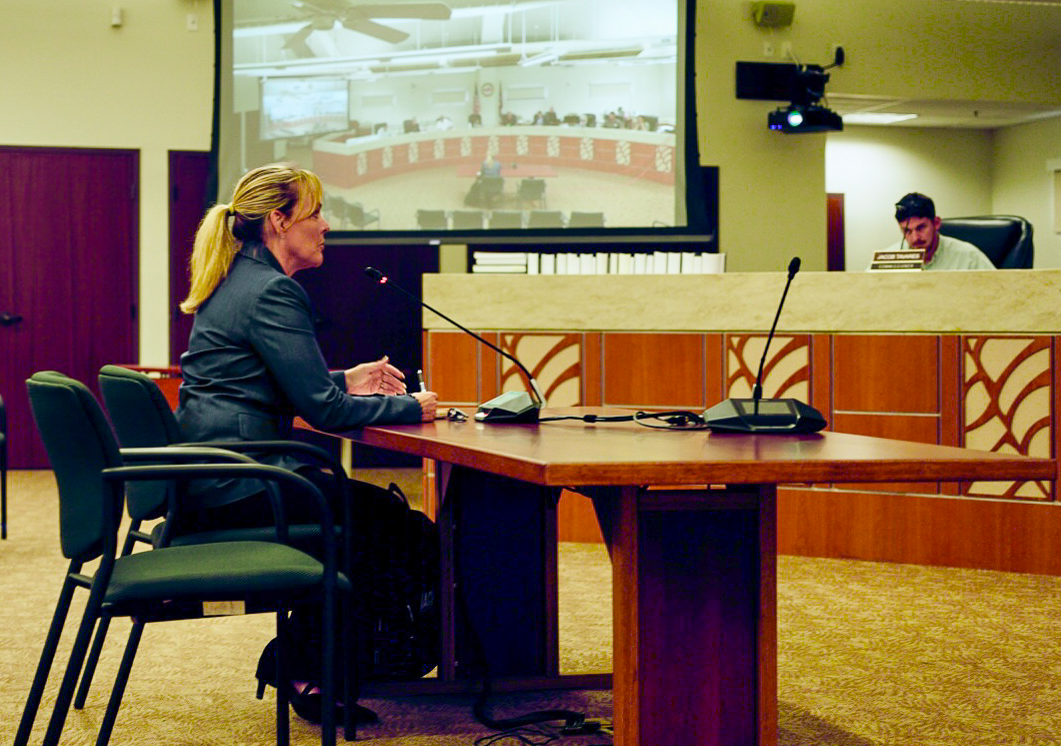
Jennifer Krauss, 53: Assistant Chief, Cheverly Police Department, Maryland
Krauss first came to the Big Island three years ago on vacation.
“From the moment I arrived, there was a peace you feel, and I wanted to stay,” Krauss told Big Island Now, adding she and her husband started looking at houses at that time.
“I want to make this my forever, my family’s forever, and right now is a good time to do that,” she said.
Krauss, the only female finalist, said as chief she would give clear expectations about where she stands and what she’s about with all forms of government, which in Hawai‘i County’s case would be the mayor, county council as well as the community.
“I lead from the front, and I lead by example,” she said. “If I make a mistake, you will know it as a commission first, and I will quickly correct my error. I am 100% transparent.”
Krauss told the commission she’s spent 27 years working at the Prince George’s County Police Department in Maryland in a variety of roles, including the gang unit, homicide and hostage negotiations.
She retired and owned a bakery for three years before being asked to come out of retirement to work as an assistant chief for the Chevelry Police Department. Krauss helped get the department fully staffed and trained.
“It can be done,” she said about recruiting for a department that is understaffed.
With regard to immigration, Krauss said under no circumstance would she allow Hawai‘i County be involved in what is going on nationwide.
“Immigration enforcement is a civil violation that the federal government chooses to enforce,” Krauss said. “Local law enforcement is busy. They have challenges.”
Sponsored Content


Subscribe to our Newsletter
Comments