



Business Monday: New Puna ranch to emphasize keiki education through its island-wide sustainability mission
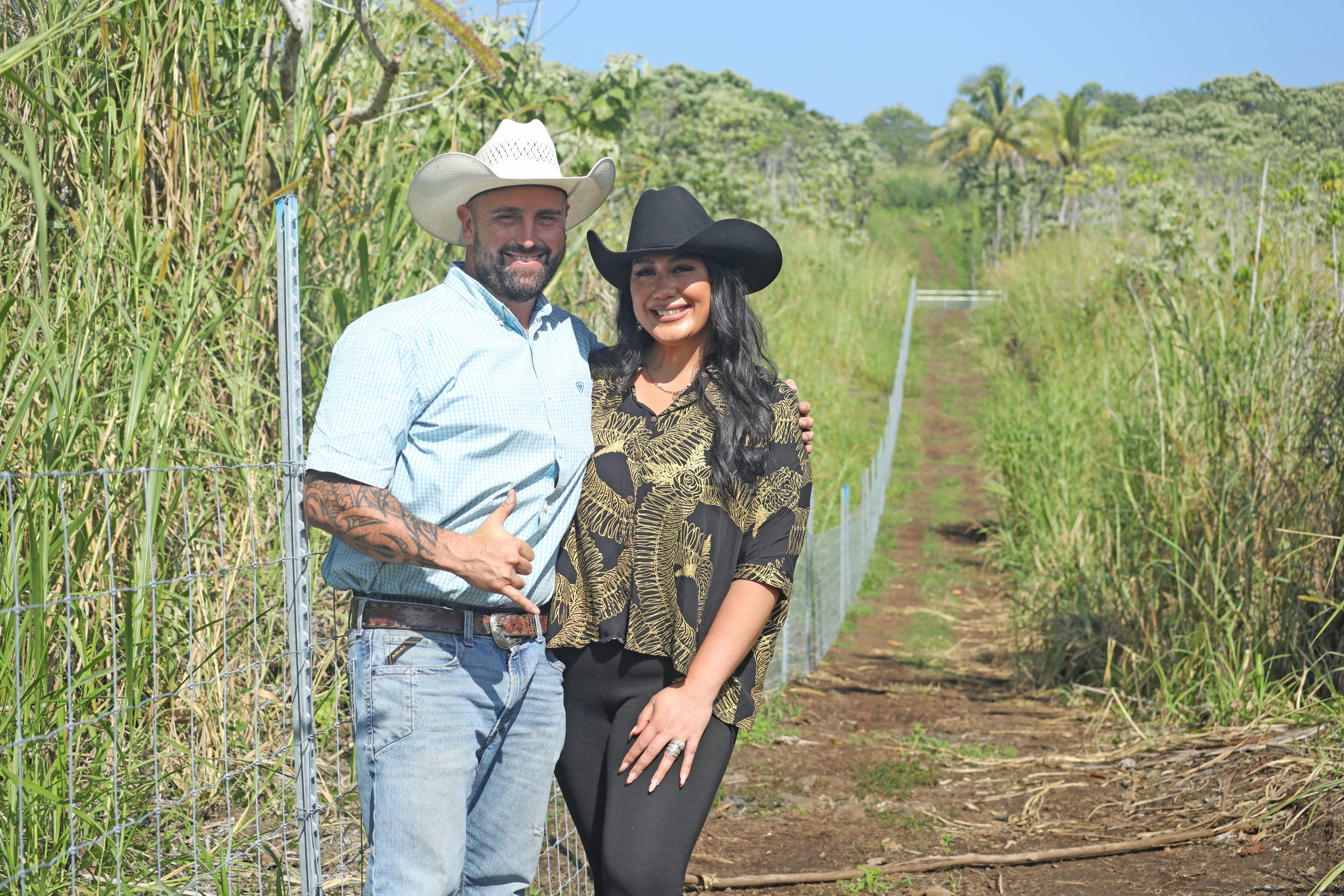
The sun’s rays baked the soil under the feet of Trystan and Nautasha-Cheri Lyman as they walked around the Lyman ʻOhana Ranch, a 300-acre portion of property located among the lava damage from the destructive 2018 Kīlauea eruption.
The couple saw this land as an opportunity for their next chapter of sustainable ranching and community stewardship, while also developing agriculture-based learning opportunities for Hawaiʻi youth.
For more than 100 years, the Lyman family has owned hundreds of acres in Kapoho, Puna, which has been used through the decades for agriculture and ranching. Over time, the family sold portions of the land and by the 1970s, most of the acreage was leased to papaya farmers.
The last papaya farmer left in 2017. The next year came the destructive lava flow. Since then, the land was unused and became overgrown.

While the lava damage affected parts of their land, the Lymans were left with a large parcel of about 300 acres that is now under Trystan Lyman’s care.
He worked as a social worker for several years until he started the Lyman Ohana Ranch venture in March 2025. He grew up helping on his family’s land and has experience through some educational opportunities.
But, he concedes it has been a relearning process.
“We have many friends that are like family to us that are very experienced ranchers and have helped us along this process,” Trystan Lyman said. “I have also been able to hire a ranch hand, whose name is also Tristan, and he has been instrumental in helping me get this fencing up and ready to go.”
While Nautasha-Cheri Lyman does not have the ranching experience, she grew up on the Big Island and is a self-proclaimed tom boy. She recently quit her job as a supervisor at a financial institution and will be using her past experiences to help with the financial and operational side of the ranch.
“The love of our children and the ʻāina, along with the economic situation right now, make it our kuleana to use this land to the best of our ability to give back to the community,” Nautasha-Cheri Lyman said. “With help from family and friends with expertise and knowledge, we want to do our part to keep local local and utilize this untapped resource.”
The Lyman ʻOhana Ranch aims to restore ancestral lands and strengthen local food resilience through sustainable ranching practices.
Every development component, including rotational grazing design, water systems and livestock handling, will be done humanely and sustainably, emphasizing soil regeneration and low-stress cattle management, Trystan Lyman said.

About 4.3 miles of perimeter fencing will be installed to secure a grazing area for cattle, which will be divided into six paddocks allowing the cattle to rotate to different areas. This land management encourages pasture recovery, enhances soil health, and distributes pressure evenly for better regrowth.
“After we complete the fencing, we will begin to build our ʻPaeke,ʻ our corral and livestock sorting center,” Trystan Lyman said. “It will be the central gathering hub. This is where we redirect them to a different area and sort, handle and care for the herd.”
A gravity-fed water system will be supported by a high-elevation storage tank to ensure consistent, reliable water access for each paddock.
Once fencing is completed on two paddocks in the next few weeks, the Lymans will begin leasing land to friends’ cattle to help cut down on overgrown grass. They also will begin to acquire 50 cows.
The Lyman ʻOhana Ranch will maintain a Brangus herd, a hybrid of American Angus and Brahman cattle, supported by a Wagyu bull to produce premium Hawaiʻi-born calves.
“The Brangus is a great breed for Hawaiʻi” because of the heat resistance of Brahman and the beef quality of Angus and Wagyu, Trystan Lyman said. “These calves are born on Puna soil and raised with the intention to sell to Puna and other island communities.”
The Lymans plan to fill a niche in grocery stores for Hawaiʻi Island-grown beef at a good price, keeping Hawaiʻi-born products for the people of Hawaiʻi.
“We are creating another avenue to food for people struggling,” Nautasha-Cheri Lyman said. “Income is necessary, of course, but it’s not what is leading us. We want to do whatever we can with what we have to make things better for everyone.”
Besides beef cattle, the Lymans are also passionate about developing agriculture-based opportunities for Hawaiʻi youth to experience different education outside the traditional classroom.
“I ended up in an alternative learning program through Hilo High School after my freshman year because traditional classes didn’t work for me,” Lyman said. “I worked at a ranch in Papaʻaloa, where I built a fish pond and got hands-on experience for high school credit.
“Degrees are hard to come by, and some jobs require a master’s level. We want to provide an alternative for kids who don’t learn like everyone else.”
The Lyman ʻOhana Ranch hopes to become a venue for hands-on learning for Future Farmers of America chapters, 4-H chapters, agricultural science programs, classrooms and students with special needs. Students will learn:
- Fundamental cattle behavior
- Safe, low-stress livestock handling
- Rotational grazing and forage management
- Soil and water conservation
- Hawaiian stewardship values and cultural responsibility
- Mālama ʻāina
“Educational programming has always been the dream,” Nautasha-Cheri Lyman said. “We want kids to learn about livestock and agriculture, utilizing this land in their lives. The Big Island has always been country, and we don’t want to lose that part of our culture. It’s what will feed us for generations to come.”

The Lymans’ son, Ethan, on the autism spectrum, has inspired the ranch’s mission. While not as interested in cattle, he loves gardening, having created his own garden near the ranch entrance.
“Seeing him take care of his plants, spending quality time outside, and growing something is heartwarming,” Trystan Lyman said. “In a world with rapidly advancing technology, you can’t replace this with machines, which is why we prioritize this mission alongside cattle and beef production.”
“It is all about creating opportunities and ushering in a new generation,” he said.
The Lymans eventually hope to start a scholarship program for high school seniors entering college to support the next generation pursuing agricultural, environmental or entrepreneurial programs.
“Along with food, it is our job to care for the next generation,” Nautasha-Cheri Lyman said.
“What we are building here isn’t just a ranch; it is a legacy project. We want to raise cattle the right way, restore our ʻāina, and give youth in the community a place to grow and connect,” Trystan Lyman continued.
Sponsored Content

_1770333123096.webp)

Subscribe to our Newsletter
Comments