



Hawai‘i unemployment down to 2.5% in September; jobs increase 9,500 from 2024
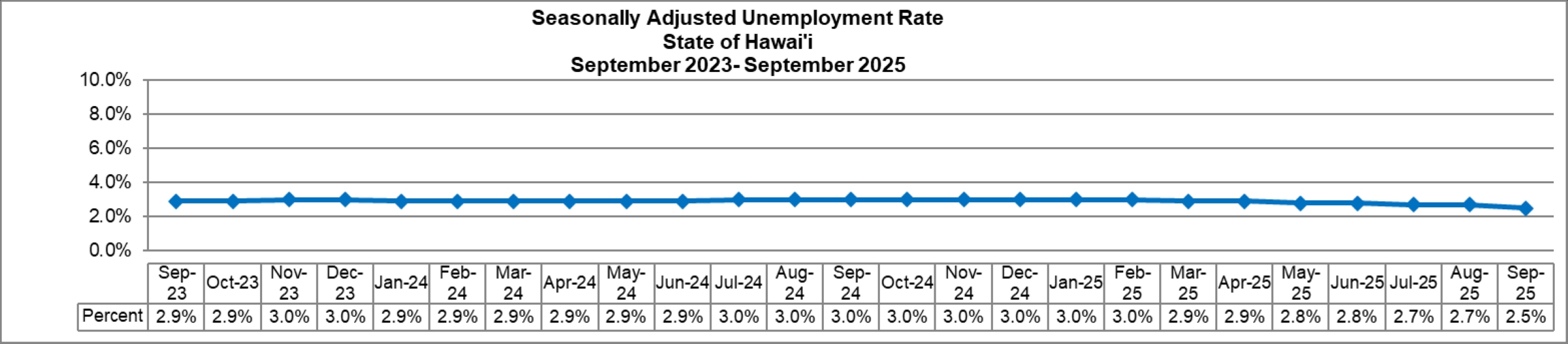
Hawai‘i Department of Business, Economic Development and Tourism announced this week that the seasonally adjusted unemployment rate for the state in September was 2.5% compared with 2.7% in August.
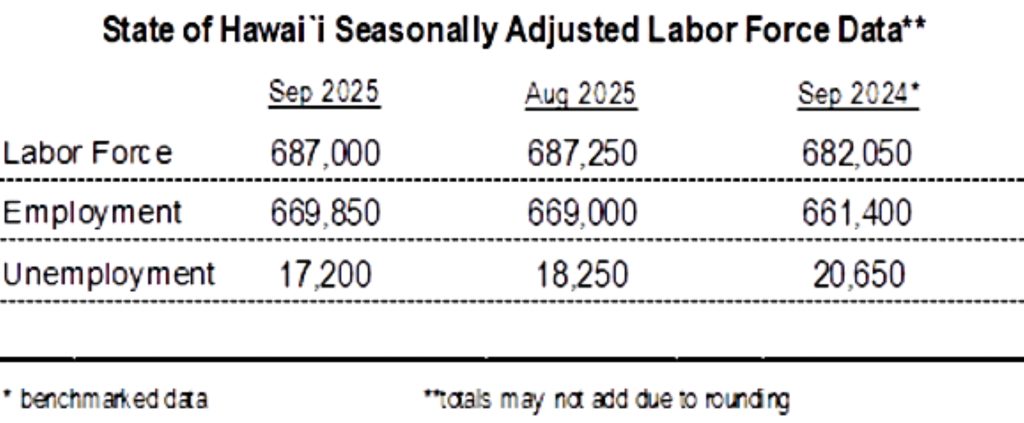
There were 669,850 people employed in September and 17,200 unemployed for a total seasonally adjusted labor force of 687,000 statewide.
Nationally, the seasonally adjusted unemployment rate was 4.4% in September, up from 4.3% in August.
The unemployment rate figures for Hawai‘i and the United States in this release are seasonally adjusted in accordance with U.S. Bureau of Labor Statistics methodology.
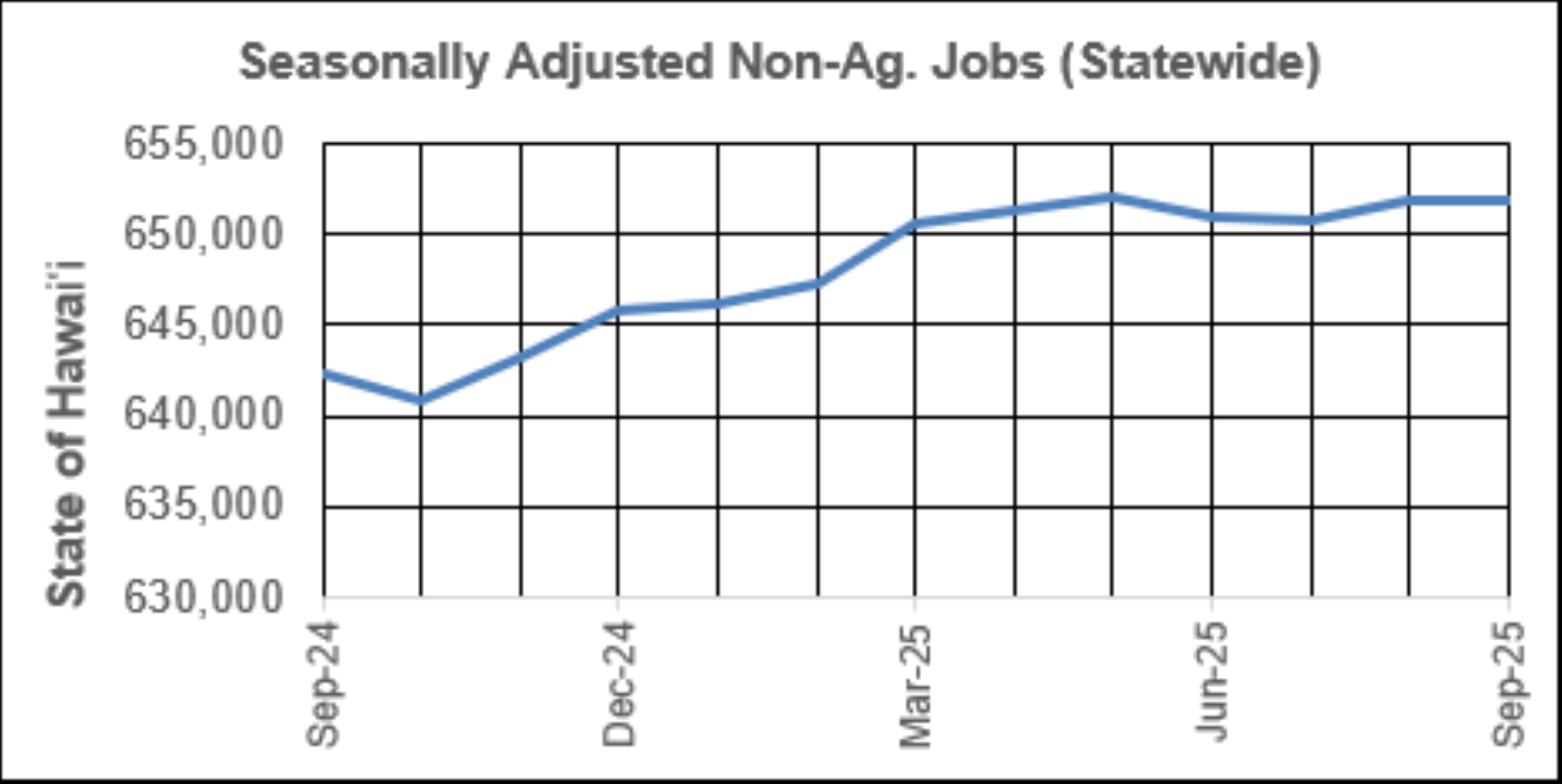
 Graph Courtesy: Hawai‘i Department of Business, Economic Development and Tourism
- Graph Courtesy: Hawai‘i Department of Business, Economic Development and Tourism

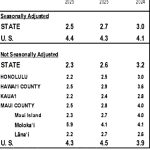
The not-seasonally adjusted unemployment rate for the state was 2.3% in September compared with 2.6% in August.
Industry Payroll Employment (Establishment Survey)
In a separate measure of employment:
- Total nonagricultural jobs decreased by 100 month to month from August to September.
- Job gains were experienced in Leisure and Hospitality (+1,000), Other Services (+500) and Construction (+100). The increase in Leisure and Hospitality was primarily because of a smaller August-September seasonal decline in Food Services and Drinking Places.
- Employment remained unchanged in Manufacturing; Trade, Transportation and Utilities; Information; Financial Activities; and Private Education and Health Services.
- Job losses occurred in Professional and Business Services (-1,100). Most of the contraction was in the Professional, Scientific and Technical Services subsector.
- Government employment decreased by 600 jobs, with the drop exclusively attributed to less seasonal hiring at the Department of Education and University of Hawaiʻi system.
- Nonfarm jobs have increased by 9,500, or 1.5%, year-to-year from 2024.
Seasonal Adjustment
Seasonal fluctuations in the number of employed and unemployed people reflect hiring and layoff patterns that accompany regular events such as the winter holiday season and summer vacation season.
These variations make it difficult to tell whether month-to-month changes in employment and unemployment are because of normal seasonal patterns or changing economic conditions.
Therefore, the U.S. Bureau of Labor Statistics uses a statistical technique called seasonal adjustment to address these issues.
The technique uses the history of labor force data and job count data to identify seasonal movements and calculate the size and direction of these movements.
A seasonal adjustment factor is then developed and applied to the estimates to eliminate the effects of regular seasonal fluctuations on the data.
Seasonally adjusted statistical series enable more meaningful data comparisons between months or with an annual average.
Sponsored Content

_1770333123096.webp)

Subscribe to our Newsletter
Comments