



State’s new crime statistics dashboard replaces Crime in Hawaiʻi print publications
Hawai‘i Department of the Attorney General has launched the new Hawai‘i Crime Dashboard.
The dashboard displays police-level crime statistics produced through Hawaiʻi’s participation in the Federal Bureau of Investigation’s Uniform Crime Reporting Program, using data based on National Incident-Based Reporting System standards.
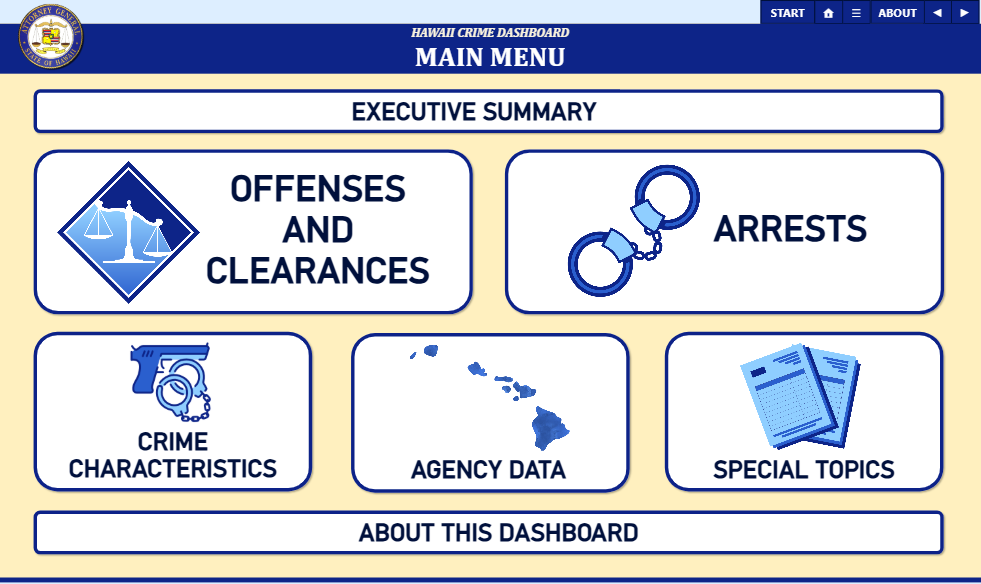
It compiles volumes of complex National Incident-Based Reporting System data and allows users to tailor queries to suit their specific interests.
This online platform replaces the department’s traditional Crime in Hawaiʻi print publications.
“Launching the dashboard is the final major milestone in Hawaiʻi’s decade-long transition to [National Incident-Based Reporting System],” said Hawai‘i Department of the Attorney General Chief and Uniform Crime Reporting Program Director Paul Perrone in a department announcement about the new dashboard. “We believe this new tool will be a helpful resource for all sorts of people and purposes.”
Dashboard features include National Incident-Based Reporting System data on:
- Reported crimes.
- Arrests.
- Clearances.
- Victim/offender demographics.
- Victim injuries, crime locations and times.
- Stolen property types and values.
- Weapon use.
- Gang involvement.
- Police employee statistics.
Special topic sections cover:
- Law enforcement officers killed or assaulted.
- Hate crimes.
- Intimate partner crimes and sex crimes.
Site users can review more than 30 sections of statistical displays and query the data by agency, offense type and reporting year. Additional topic areas will be added later.
The data cover calendar years 2021 through 2024, representing the time period for which complete annual National Incident-Based Reporting System data are available from Hawaiʻi’s four county police departments.
“The Hawaiʻi Crime Dashboard is a major milestone for law enforcement in our state,” said Kauaʻi County Police Chief Kalani Ke in the state announcement. “It puts up-to-date crime data directly in the hands of our residents, provides clear insight into crime trends and keeps our communities informed so they can stay safe.”
Hawai‘i’s Uniform Crime Reporting Program — established in 1975 — is directed by the state Department of the Attorney General’s team of criminologists and data scientists.
Each of the state’s four county police departments — all National Incident-Based Reporting System-certified — have reported Uniform Crime Reporting crime data for longer than the program has existed, contributing data for the Hawaiʻi Crime Dashboard.
“Having additional clear and timely information that the community can access is always appreciated,” said Hawai‘i Police Department Interim Chief Reed Mahuna in the announcement. “We thank the Hawai‘i Department of the Attorney General for all their hard work in getting the Hawai‘i Crime Dashboard operational. We are excited to see it in action.”
Hawai‘i Department of Law Enforcement will be added to the dashboard once it completes National Incident-Based Reporting System certification and reports a complete annual data set.
The Hawai‘i Crime Dashboard will continue to expand and improve as more data and statistical analysis become available.
Compared with the previous version of the nationwide Uniform Crime Reporting Program, which was based on aggregate monthly tallies of reported crimes and arrests — and only reported the single most serious offense in multiple-offense incidents — the National Incident-Based Reporting System uses case-level records and conceptualizes crime events in terms of complete incidents, which can involve multiple offenses, victims, known and unknown offenders and arrestees.
More than 50 data elements can be reported for each crime incident, and nearly 60 offense types are tracked, whereas the old system primarily focused on a set of 10 serious offenses known as Index Crimes.
National Incident-Based Reporting System data require a complex information technology infrastructure and other substantial resource commitments from police departments and their respective state Uniform Crime Reporting programs.
More information about the state Uniform Crime Reporting Program and other work conducted by the state Attorney General Department crime research team is available on the department’s website.
Sponsored Content


Subscribe to our Newsletter
Comments