



$1.25M project merges tech, community design for Hawaiʻi hazard monitoring
University of Hawaiʻi at Mānoa and Georgia Tech researchers secured a $1.25 million National Science Foundation grant to build faster, cheaper, locally made sensors that deliver potentially life-saving data when natural disasters strike.
The goal is to protect the people and ecosystems of the islands from threats such as wildfires, drought, flooding, hurricanes, tsunamis, water contamination and more.
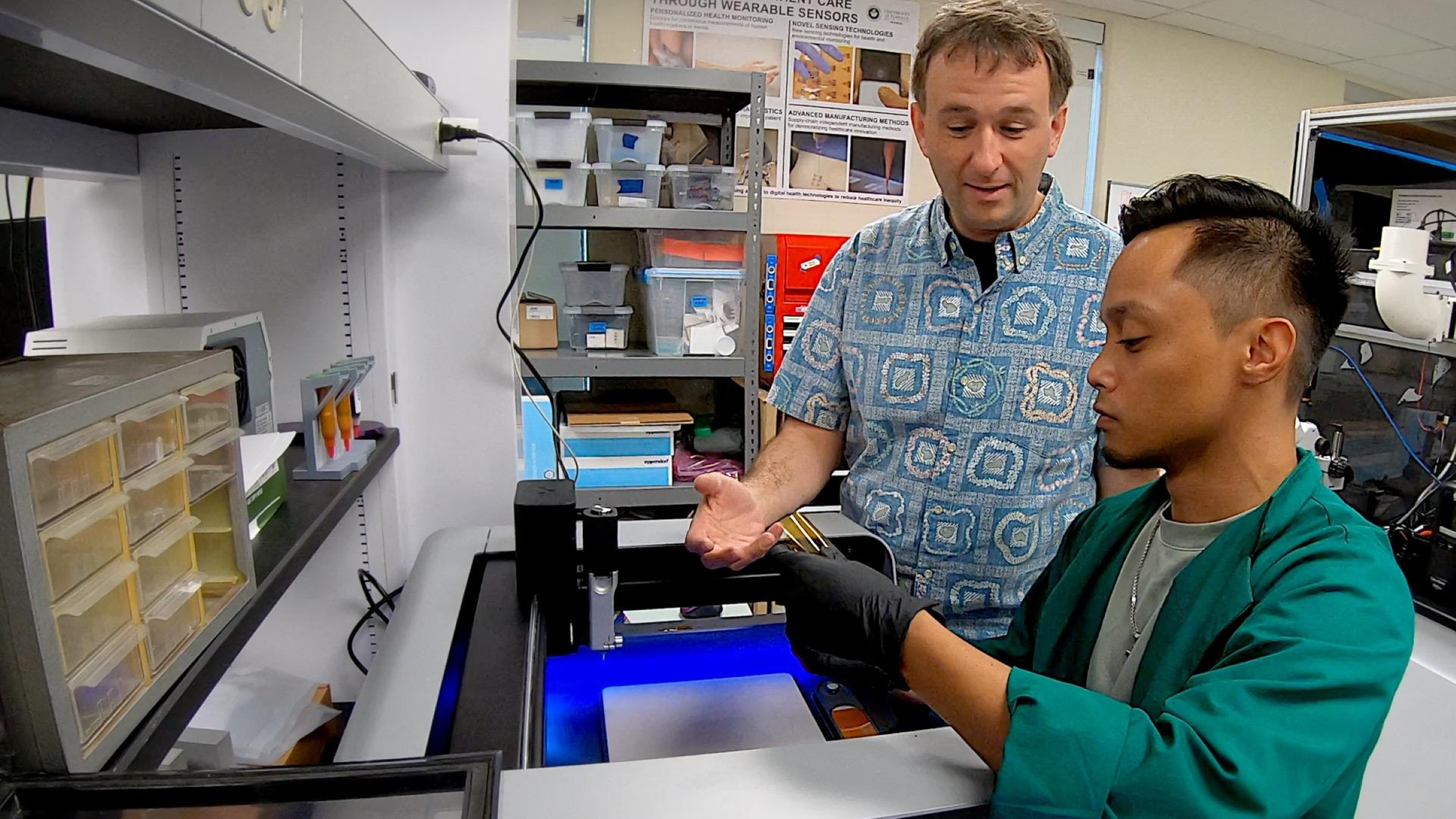
Grant funding will support development of low-cost sensors able to be printed in minutes and deployed the same day to collect actionable data for communities and organizations statewide.
The sensors could measure water quality or soil contamination signals, and then connect to an artificial intelligence-enabled handheld device — smaller than a cellphone — that processes and transmits data to the web in real-time.
Users could then view and interpret the data via a publicly available dashboard.
The tech will be co-designed with groups who have responsibility for communities, land and water throughout Hawaiʻi, including land stewardship organizations, Hawaiian language immersion schools and community colleges to ensure its success.
These ʻāina stewards, kūpuna, residents and kumu will guide priorities, experiment with prototypes and define success criteria.
“We can shorten the path from idea to instrument and build sensors tuned to local priorities without relying on centralized, hard-to-access facilities,” said principal investigator and University of Hawaiʻi at Mānoa College of Engineering associate professor Tyler Ray in a university release about the project. “Our goal is a design-to-deployment pathway that works on-island: robust, affordable and replicable.”
The team is developing the sensors to pair with a small, durable edge device that can harvest and store energy, run machine learning models and work even with limited network connectivity.
An open library of circuits and firmware will allow partners quickly customize sensors for measuring targets, from acidity and turbidity to heavy metals and contaminants.
“This grant recognizes that Hawaiʻi is a key leader in the proper design of disaster and hazard response cyberinfrastructure,” said associate professor of computing at Georgia Tech and Native Hawaiian Josiah Hester in the release. “Deploying [artificial intelligence] devices in austere environments, making [artificial intelligence] interpretable and understandable and providing these capabilities to everyone are key goals we will achieve.”
The project grows from existing relationships throughout Oʻahu, Maui and Kauaʻi, including Hawaiian language immersion schools and stewardship organizations, where residents, educators and resource stewards will guide priorities.
Team members will convene iterative design workshops, peer exchanges between partner sites on Oʻahu and Maui and a capstone gathering to synthesize findings and share open designs.
Data governance will follow established frameworks to support local control and appropriate confidentiality for sensitive results.
“Our approach follows advances in community-centered co-design, where we will design the sensing agenda together with community partners,” added co-principal investigator Aurora Kagawa-Viviani in the release. “Building strong and equitable relationships ensures the technology and the data it produces have lasting value long after the prototype.”
Kagawa-Viviani, an assistant professor at University of Hawaiʻi at Mānoa’s Water Resources Research Center and Department of Geography and Environment in the College of Social Sciences, added that the team’s design process considers who maintains the sensor and how data are stewarded, interpreted and made useful for community decision-making.
The grant will support hands-on training that connects K-12 students, community colleges and research universities with partner sites.
Open hardware, software and design artifacts will be released for others to adapt in island, rural and urban settings facing similar hazards.
“As a Native Hawaiian scientist and technologist, it is my own kuleana to translate these technologies that support stewardship, and we as a team are excited to see this work support our communities,” Hester said.
Sponsored Content

_1770333123096.webp)

Subscribe to our Newsletter
Comments