


Ancestral Hawaiian remains found in museum in Ireland to be reinterred on Hawai‘i Island
A team representing the Office of Hawaiian Affairs and Hui Iwi Kuamoʻo is on its way back to Hawaiʻi after receiving iwi kūpuna (ancestral remains) in formal ceremonies this week from the National Museums of Northern Ireland – Ulster Museum.
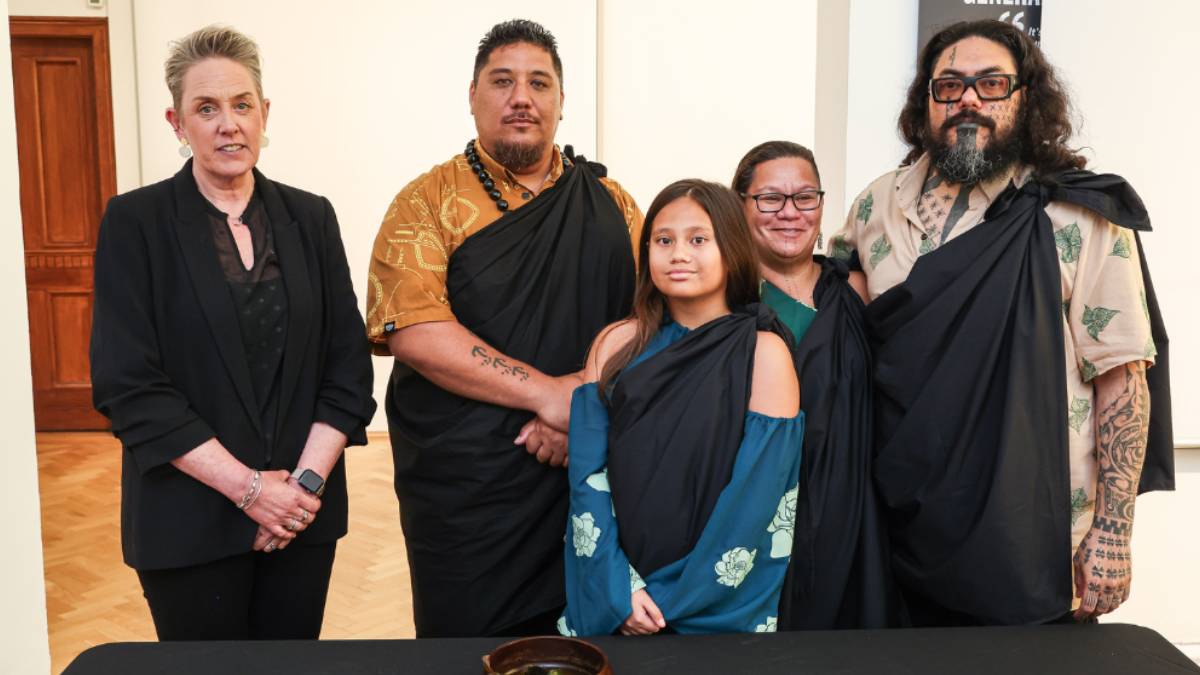
Hui Iwi Kuamoʻo founder Halealoha Ayau said that the removal of the iwi kūpuna from Hawaiʻi was illicit and a form of desecration, adding that the iwi will be reinterred on Hawaiʻi Island.
“With deep humility and reverence, we witness the healing of a long-standing kaumaha (sadness),” said Office of Hawaiian Affairs CEO Stacy Ferreira. “The return of our iwi kūpuna is about restoring dignity, healing generations, and reaffirming the living spirit of our ancestors.”
This repatriation was years in the making. In October 2021, OHA put in a claim for the repatriation of five iwi kūpuna and five mea kapu (sacred objects) believed to be at the museum. Museum staffers could not immediately locate three of the iwi kūpuna. In April 2022, a team from Hawaiʻi traveled to Ireland and retrieved two iwi kūpuna plus the mea kapu.
At the time, there was a clear commitment from the Ulster Museum staff to continue searching. That search came to an end when the three missing iwi kūpuna were located in November 2024.
Upon notification that the iwi kūpuna were found at the museum, Hui Iwi Kuamoʻo and the Office of Hawaiian Affairs collaborated with the museum to make arrangements for a second repatriation.
“We donʻt have to know who these people are; we just have to know they are Hawaiian,” Ayau stated in an interview with BBC News. “The living have a responsibility to bring them back and to replant them into our land. They can continue their journey to decompose, become elemental again, and their spirit(s) allowed to travel on.”
Kathryn Thomson, chief executive of National Museums of Northern Ireland, said that the repatriation represents the museum’s commitment to address past wrongs.
“Whilst the motivation behind the acquisition of ethnological material can appear strange today, it reflected curiosity about the wider world and a desire to represent diverse cultures,” Thomson said. “However, the European bias and power imbalances that often characterized this collecting have left a complex and sensitive legacy for us to address today.”
It is believed that ethnologist Gordon Augustus Thomson of Belfast, Ireland, traveled to Hawaiʻi Island in 1840, found and removed the iwi kūpuna from burial caves and donated them to the Belfast Natural History and Philosophical Society in 1857. The iwi kūpuna and moepū were then included in a 1910 donation to the Belfast Museum and Art Gallery, a precursor to Ulster Museum and National Museums of Northern Ireland.
Sponsored Content



Subscribe to our Newsletter
Comments