


Powerful observations from the ground and space reveal the faint galaxy behind an ancient cosmic signal
Astronomers identified the most distant fast radio burst to date, which offered insights into both the origins of these mysterious bursts and the evolution of the early universe.
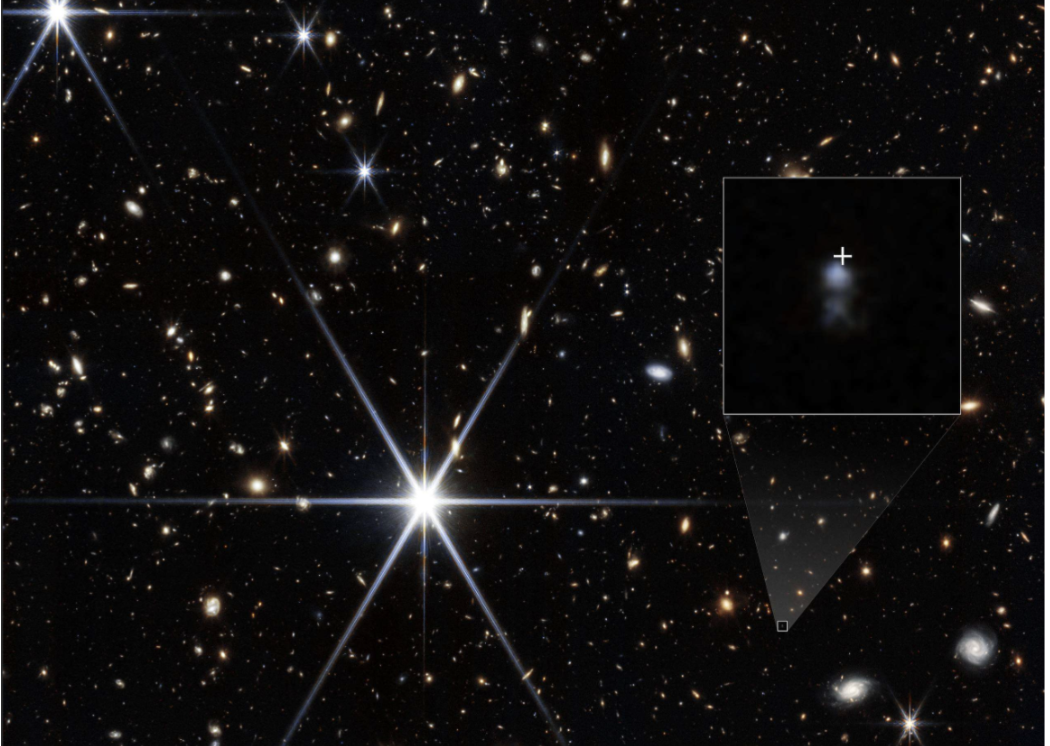
Astronomers ave pinpointed the host galaxy of the most distant fast radio burst (FRB) observed to date, which may provide a clue about the origins of these mysterious bursts.
Fast radio bursts are enigmatic, millisecond-long flashes of radio emission from distant parts of the universe. Their origins remain uncertain, as most are observed only once.
However, the newly discovered FRB 20240304B offers a clue: its host galaxy is unexpectedly small and young, suggesting a delay between when galaxies form stars and when they can generate FRBs. This may imply that FRBs are caused by young neutron stars known as magnetars.
The study, led by the University of Sydney, is published in today’s issue of the journal “Science.”
“What makes fast radio bursts interesting is that we don’t know what generates them. We have theories for what objects produce them, but we don’t have conclusive proof,” said Manisha Caleb, a professor with the University of Sydney and the lead author of the study.
Detected by the South African MeerKAT radio telescope in 2024, the radio data from FRB 20240304B suggested it was extremely distant, potentially the most distant observed. To confirm this distance, astronomers needed to study its host galaxy.
The team consulted J. Xavier Prochaska, a professor with the University of California, Santa Cruz, and a co-author of the study. Prochaska’s team has been using the W. M. Keck Observatory on Maunakea to study post-event host galaxies of FRBs for years.
Prochaska and his team spent one hour imaging with the LRIS instrument on the Keck I telescope. Despite knowing the precise location of the FRB, even the world’s most powerful ground-based telescope could not find the galaxy.
NASA’s James Webb Space Telescope’s NIRCam (Near-Infrared Camera) detected the host galaxy of FRB 20240304B, marking its location with a white cross. It was identified as a small dwarf galaxy actively forming stars.
“The Keck+LRIS combination is as powerful as it gets for finding faint, distant galaxies from the ground. We pointed it right at the location of the FRB and looked as deeply as we could, but there was nothing to see. We immediately concluded: if we wanted to find the source, we had to go to space,” Prochaska said.
Distinguishing the host galaxy required separating an exceptionally faint source from the noise, a challenge beyond conventional optical observations. The team turned to NASA’s James Webb Space Telescope, which operates above Earth’s atmosphere, dramatically reducing background interference.
Under these conditions, faint sources that typically remain hidden can be detected. Webb ultimately observed a galaxy at the FRB’s location.
Webb’s Near-Infrared Spectrograph (NIRSpec) measured the galaxy’s redshift at 2.148, corresponding to a time just 3 billion years after the Big Bang. Most FRBs detected to date occurred billions of years later in cosmic history.
This discovery offers researchers a rare glimpse into the environments hosting FRBs in the universe’s early epochs. The host galaxy of FRB 20240304B was not typical of other galaxies with FRBs. Most FRB host galaxies are massive star-forming systems, but FRB 20240304B’s host was about 1,000 times less massive than galaxies typically associated with FRBs.
The galaxy existed during “cosmic noon”—a period when star formation across the universe peaked. Its significant star-forming activity suggested that most of its stars may have formed within just 30 million years, indicating an exceptionally young stellar population.
This has important implications for the origin of FRBs. One theory suggests FRBs originate from the merger of two neutron stars, which would take billions of years. Thus, FRBs should be linked to older galaxies.
Another theory posits that an FRB can originate from a young, highly magnetic neutron star known as a magnetar, through mechanisms like starquakes. After a massive star explodes as a supernova and leaves behind a magnetar, an FRB might occur relatively quickly.
This would suggest FRBs would also be found in younger galaxies like the host of FRB 20240304B.
Beyond providing clues about the source of FRB 20240304B, the burst serves as a probe of the universe between its host galaxy and Earth.
“A fast radio burst is almost like a cosmic flashlight. It lights up everything along the path. It carries an imprint of everything that it travels through, so you can use it to trace the ‘cosmic web’—the otherwise invisible matter and structures it encounters along the way,” Prochaska said.
The team identified the imprint of two cosmic structures on the FRB’s signal—one previously unknown galaxy cluster at a redshift of 0.3 (about 3.5 billion light-years from Earth), and the nearby Virgo Cluster, about 54 million light-years from Earth.
In the future, the team is eager to discover more distant FRBs. They estimate the MeerKAT telescope could detect and localize several FRBs per year at a redshift greater than 1.0, meaning they existed more than halfway back to the start of the universe.
As new radio facilities and instruments become available, scientists expect the number of distant FRBs to grow rapidly, offering insights into both the origins of these mysterious bursts and the evolution of the early universe.