

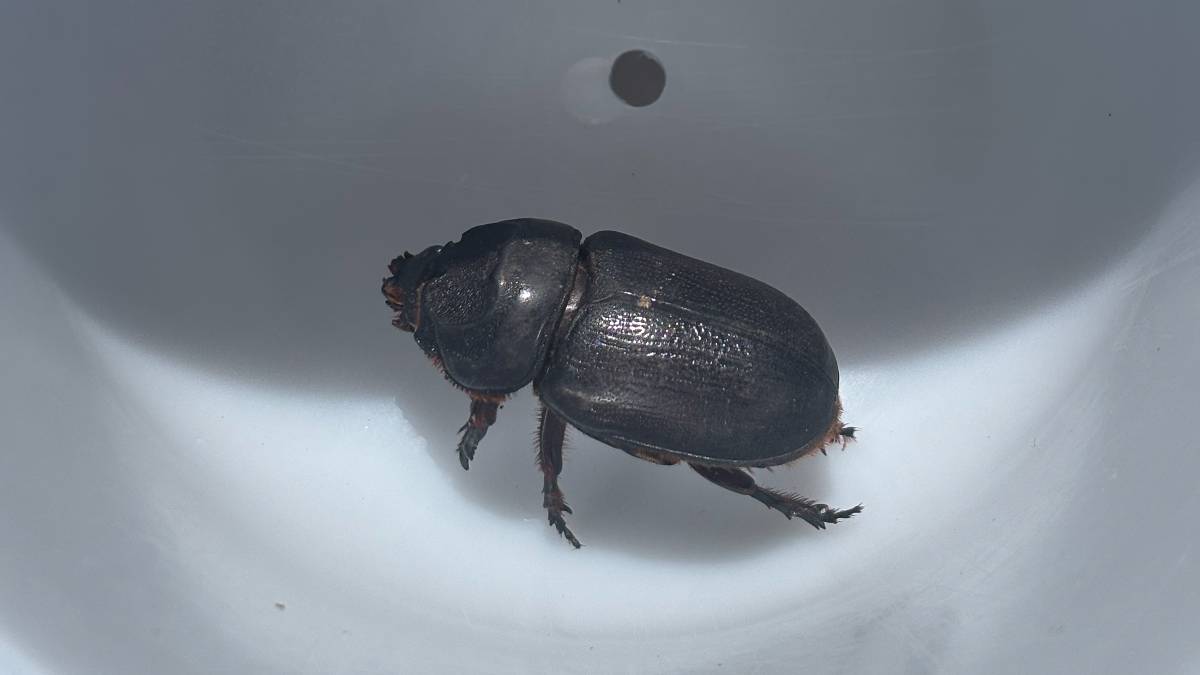
Dead coconut rhinoceros beetle found at Hilo International Airport
A dead coconut rhinoceros beetle was collected from a detection trap at the Hilo International Airport by staff from the Big Island Invasive Species Committee on Monday.
It is believed the insect entered the trap sometime after a previous trap check on June 16, according to a news release from the committee. This is the second detection of CRB in Hilo, after a find last year of a dead beetle in a retail store near a mulch display that was believed to have been shipped dead from Oʻahu.
The nonprofit has been monitoring pest traps at island harbors and airports since 2017 as part of the Hawaiʻi Invasive Species Council’s Ports of Entry Monitoring program. This new detection comes amid previous program detections of the coconut rhinoceros beetle on Maui and Molokaʻi as well as the March 2025 detection at the Ellison Onizuka Kona International Airport, underscoring the ongoing risk of interisland movement.
Follow-up monitoring and the deployment of additional detection traps is underway by BIISC and the Hawaiʻi Department of Agriculture and Biosecurity. The County of Hawaiʻi, in collaboration with
BIISC and Hawaiʻi Detection Dogs, will be engaging in surveys of mulch and green waste near the find over the next week.
This is a multi-agency response with County Departments of Research and Development, Environmental Management, Public Works and Parks & Recreation.
Island-wide coordination with HDAB, Hawaiʻi Department of Transportation and CRB Response continues.
CRB is one of Hawaiʻi’s most destructive invasive insect pests. Adult beetles damage palms by boring into the crown to feed on emerging fronds. Repeated feeding events can weaken and eventually kill host plants.
CRB is known to target coconut, native loulu palms, date palms, hala, banana, and other host species. The beetle spends most of its life in its larval form, developing in decaying plant material. Adult beetles emerge to feed on palm trees before returning to decaying organic material to reproduce.
Unmanaged piles of green waste, mulch, and other decomposing plant material provide ideal breeding conditions for CRB and should not be allowed to accumulate. Residents, businesses, and land managers should reduce breeding habitat by taking green waste to a County green waste facility, where material is properly managed and heated to kill invasive pests like CRB.
Early detection is critical for rapid response efforts. Here’s what you can do:
- Turn compost piles and search for CRB larvae: Collect any suspect larvae in a sealed container, such as a glass jar, take photos and immediately report it to BIISC. Images can be submitted via email at biisc@hawaii.edu, through the BIISC pages on Facebook or Instagram, or at 643Pest.org.
- Be vigilant when purchasing or transporting mulch, compost, and soil products: Avoid bags with tears or holes in the packaging, as they may be infested with CRB.
- Check palms for signs of feeding damage: It can take several months for CRB-damaged fronds to be visible. Report signs of palm damage to BIISC.
BIISC is asking for community members in Keaukaha, Panaʻewa, and the general Hilo area who are interested in assisting with CRB detection to host a CRB panel trap on their property. Contact BIISC at 808-933-3340 or biisc@hawaii.edu.