


Kaʻū community rallies to save public access to Punaluʻu Black Sand Beach Park
Hawaiʻi County has secured a two-month lease extension until Sept. 1 from Black Sand Beach LLC to continue discussions about the future of the beach that is a natural and cultural treasure.
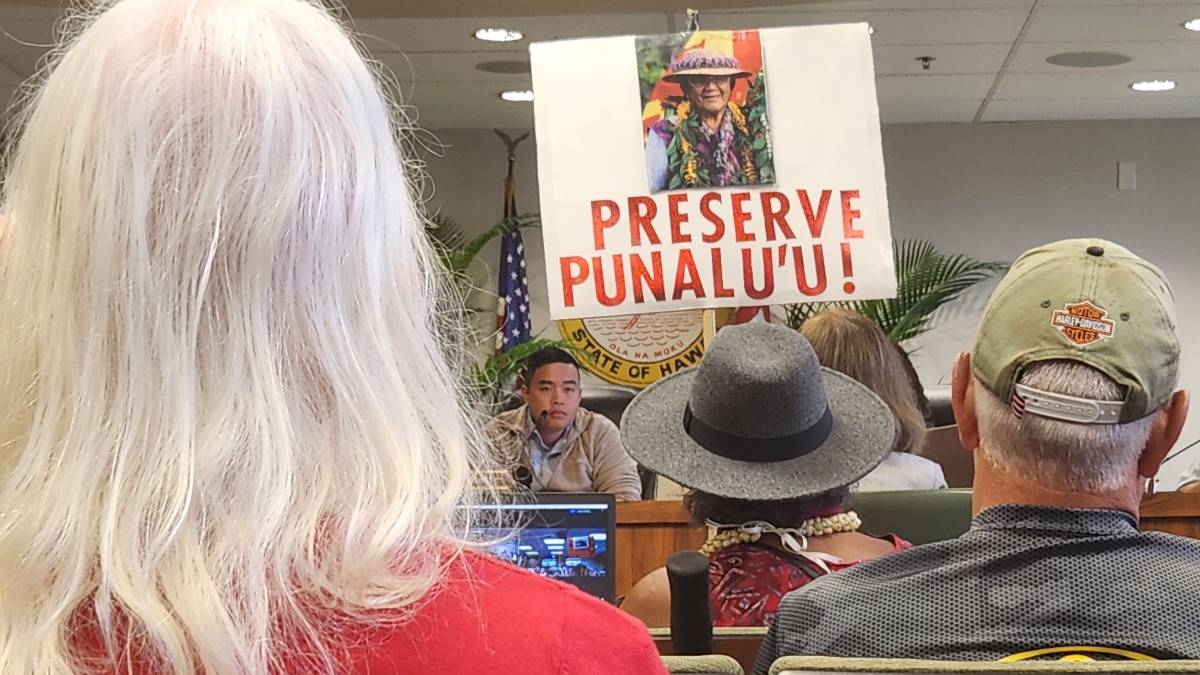
For generations, Punaluʻu Black Sand Beach Park in the rural Kaʻū district of the Big Island has been a gathering place for the community and tourists, drawn to its freshwater springs, brackish ponds, heiau (ancient temples), petroglyphs and burial sites.
The ocean there supports a wealth of sea life, including critically endangered hawksbill turtles, threatened green sea turtles, endangered Hawaiian monk seals, spinner dolphins and humpback whales.
But while discussing significantly higher water bills with the County of Hawaiʻi, Kaʻū resident and community organizer Guy Enriques inadvertently learned a lease agreement between the county and the private landowner of the park, Black Sand Beach LLC, was set to end on June 30.
The would have blocked the public’s access to the park for the first time since 1954.
The community came together to show the importance of this area to past, present and future generations of Kaʻū residents, and announced a rally at the park on Sunday to oppose the private ownership of the natural treasure.
“Kaʻū is in jeopardy of losing this park that means so much to all of us,” Enriques said.
On Friday afternoon, the community got a some good news. The County of Hawaiʻi announced it had reached an agreement with the private landowner to extend the lease for Punaluʻu Black Sand Beach Park until Sept. 1 to continue ongoing discussions regarding its future.
“Since taking office, my administration has engaged with the landowner to reach an agreement that preserves and perpetuates public access in this unique and special part of our island,” Mayor Kimo Alameda said in a press release. “As negotiations continue, we are hopeful that we can find a resolution that works for the long-term benefit of everyone, especially our community.”
The county’s current lease agreement was executed in 1998 for $1 between SM Investments and the county. It covers about 6.8 acres, including parking, pavilions, bathrooms and campgrounds.
The extension of the lease by two months allows both parties to work toward a mutually beneficial arrangement that best serves the community, residents and visitors, the county said.
“Black Sand Beach LLC remains committed to preserving and enhancing Punaluʻu Black Sand Beach Park as an important cultural, recreational and community asset,” the company said in a press release. “The company appreciates the continued engagement of the county and recognizes the importance of collaboration in achieving a positive outcome.”
According to Enriques, Black Sand Beach LLC was going to increase the lease rate to $150,000 per year.
“Ever since I can remember, every developer has given the county the park except this one,” Enriques said. “When you do something like this, it speaks to the dollar sign, not the community.”
The county began negotiating for other solutions, such as purchasing the Punaluʻu Black Sand Beach Park by through funding from the Public Access, Open Space, and Natural Resources Preservation program, Enriques said.
As of May 11, parts of Punaluʻu Black Sand Beach Park are on the preservationʻs fund list of properties with council resolutions. It originally was put on a priority list of the fund around 2007.
The county program uses a portion of local property taxes to acquire and permanently protect culturally, historically and environmentally significant lands for public benefit. Before using the funding, the county must obtain an appraisal of the land to determine fair market value in order to offer a fair purchase price to willing landowners. The lease extension would give them the time to complete an appraisal.
Big Island Now asked the county if it did have plans to pursue funding from Public Access, Open Space, and Natural Resources Preservation program for Punaluʻu, but did not get a response.
In 2019, Black Sand Beach LLC, owned by Eva Liu, purchased 147 acres around Punaluʻu Black Sand Beach Park, about 6 miles southwest of Pāhala. The 2024 proposal by Black Sand Beach LLC said it would build 225 residential units about one-fifth of a mile from the shore. The plan would not allow cars to park near the beach. The company also said it would create its own conservation plan to preserve the shoreline for public use.
In Hawaiʻi, private landowners, resorts, or developers cannot legally deny public access to the shoreline, but at Punaluʻu, most advocates are more concerned with how development around the shoreline will affect the culturally and environmentally-significant area.
There are three pre-contact heiau within the immediate vicinity of Punaluʻu, which is one of the last places in Hawaiʻi where there are unaltered views from one heiau to the next.
Punaluʻu also is a common resting area for he hawksbill turtle, which is a federally listed endangered species and is the rarest sea turtle in the Pacific Ocean. It is also one of the only places on Hawaiʻi Island to find ʻopeʻapeʻa, the endangered Hawaiian hoary bat.
As part of the land purchase, Black Sand Beach LLC also acquired Punaluʻu Water and Sanitation, which is a water and wastewater treatment plant that serves 76 condo units, 14 single-family homes and the park.
However, when Liu was at a Planning Commission hearing for the special management permit application in 2024, hundreds of residents spent at least two days testifying against the development.
Jeff Silva, who owns a condo in the Colony 1 Condominiums and serves as the president of the Association of Apartment Owners of Colony 1 at Sea Mountain, is a licensed water operator in Hawaiʻi and testified at the hearing.
“During that meeting, our board took a stand that we weren’t interested in talking for or against the development,” Silva said. “We wanted to talk about the water, sewer and fire suppression, for which Black Sand Beach LLC is doing a horrible job.”
Last year, the treatment plant applied for a temporary rate increase with the Hawaiʻi Public Utilities Commission to help with repairs, maintenance and other expenses, which was accepted and has been extended for at least a year.
“This was a very sharp, very large spike in our water rates in May of last year,” Silva said. “Currently, our owners are paying just short of $500 a month for water, and the worst part is that there have been no repairs made since this temporary increase began.”
Although the water system is a separate issue from the ownership of Punaluʻu Beach Park, Silva feels they are connected because Liu is allegedly trying to profit through a lease agreement with the County of Hawaiʻi for attorney fees and other expenses.
Big Island Now was unable to reach Liu, or her attorneys.
“My personal worries are if Liu makes a bunch of money from the county, she’ll use it as a war chest against us,” Silva said. “She will keep using her attorneys to fight tooth and nail and not repair the water system.
“We thought we fought hard at the special management use permit hearing, but we still have to keep trying. I want to see Punaluʻu saved, and I don’t know what it will look like, but anything not involving Liu is better.”
The rally, planned for noon on Sunday at the park’s Punaluʻu big pavilion, is still going on as planned despite Black Sand Beach LLC extending the lease for the county for two months. Those interested in attending are encouraged to wear blue and bring signs.
“For us, this rally is about showing these private entities that we are willing to do whatever it takes to keep these spaces in the hands of the public,” Enriques said. “Every family that has lived here has had an event down there. It is a place of celebrations for locals and for visitors, too.
“We want to support the county in its next steps, not just for us who have deep memories attached to the beach, but more so to protect public access for future generations in Kaʻū.”