


Amount of jobs in Hawaiʻi decrease by 1,700 on average each year
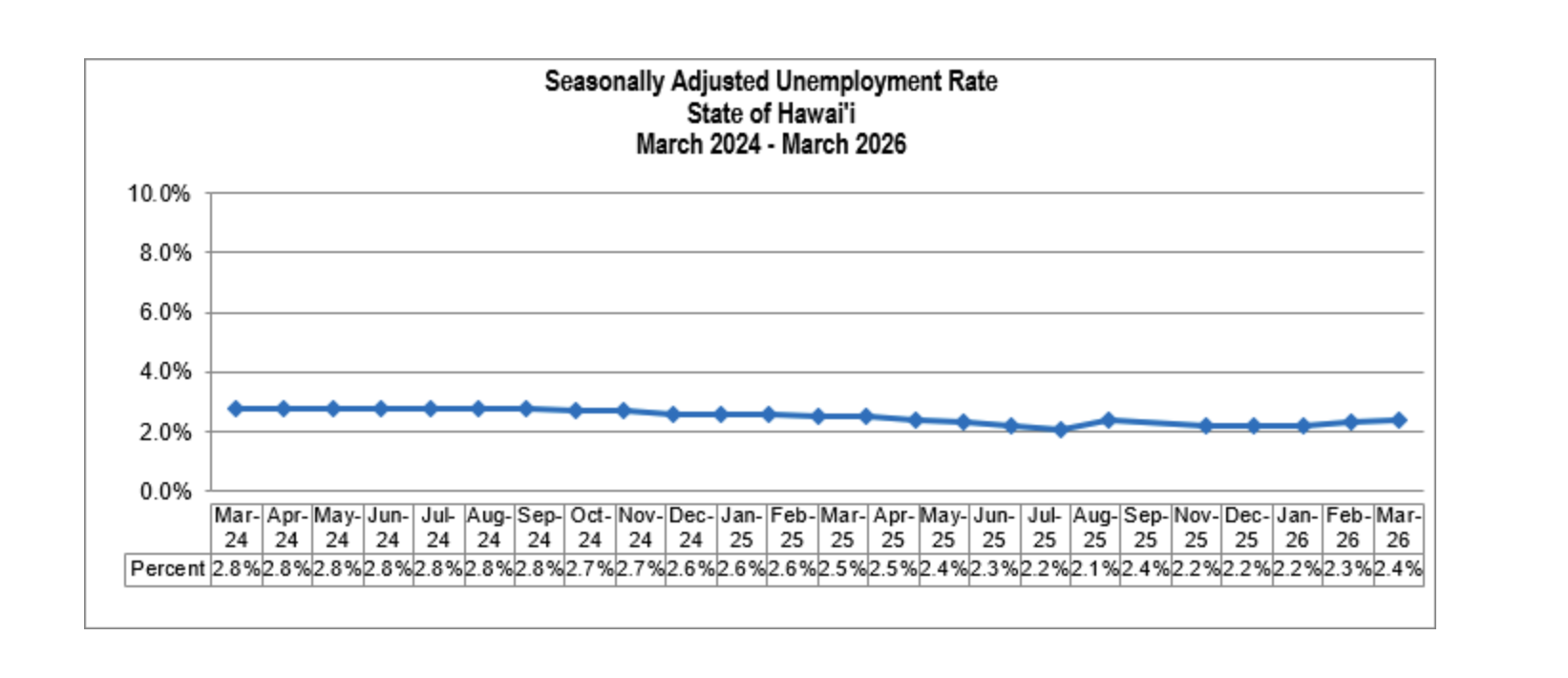
In March, 671,150 people were employed, and 16,200 were unemployed, for a total seasonally adjusted labor force of 687,350 statewide, according to the Hawaiʻi State Department of Business, Economic Development and Tourism.
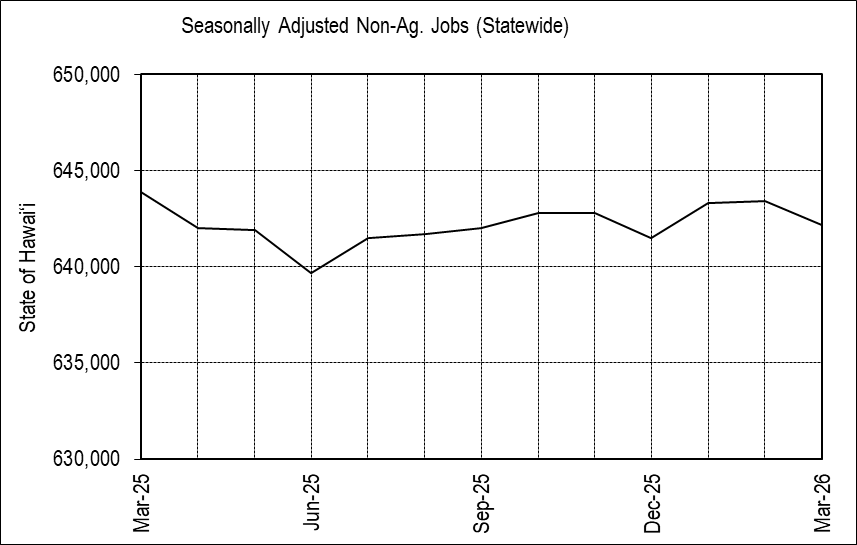
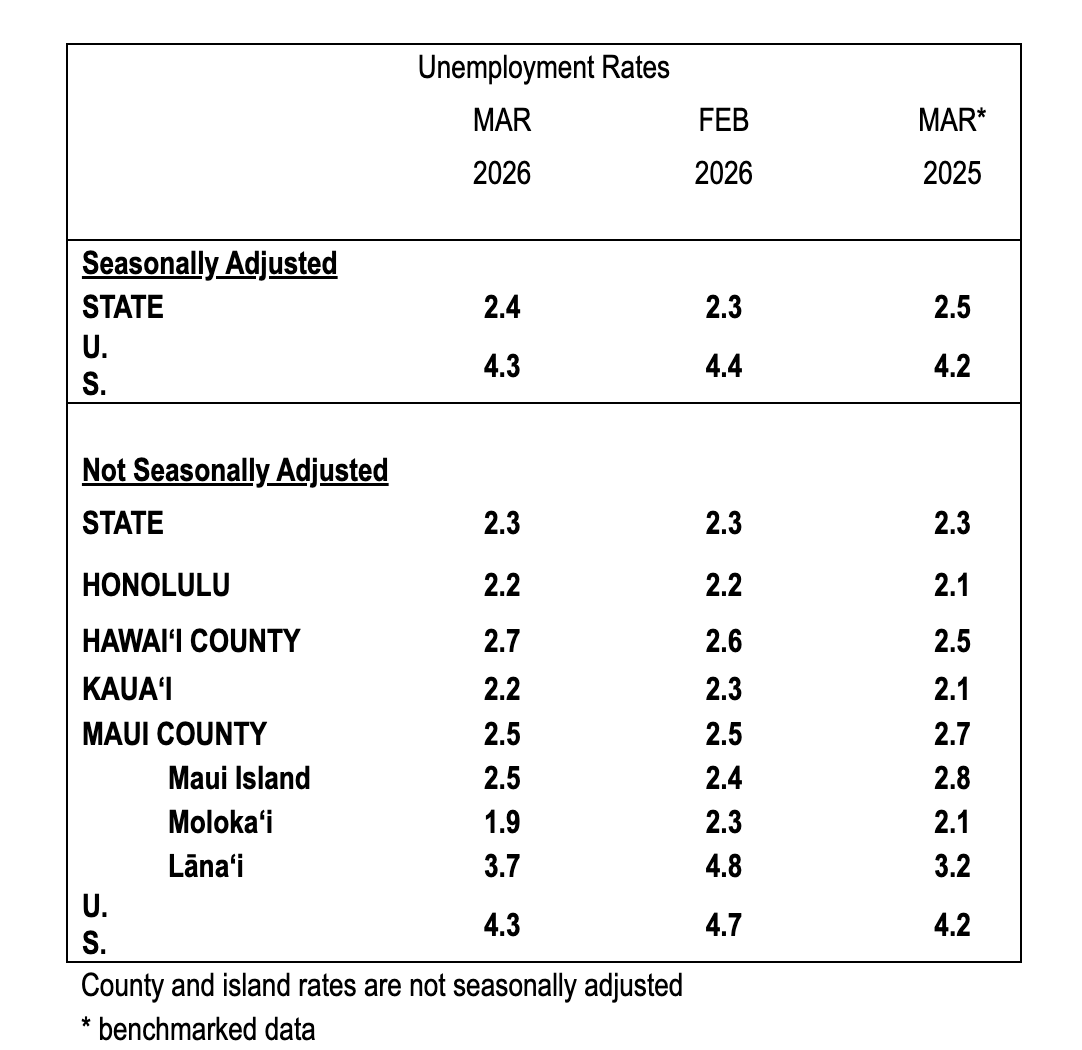
Following seasonally adjusted data, which removes predictable fluctuations like holidays, in accordance with the U.S. Bureau of Labor Statistics methodology, the state’s unemployment rate for March was 2.4%, compared to 2.3% in February. Nationally, the unemployment rate was 4.3%, down from 4.4% in February.
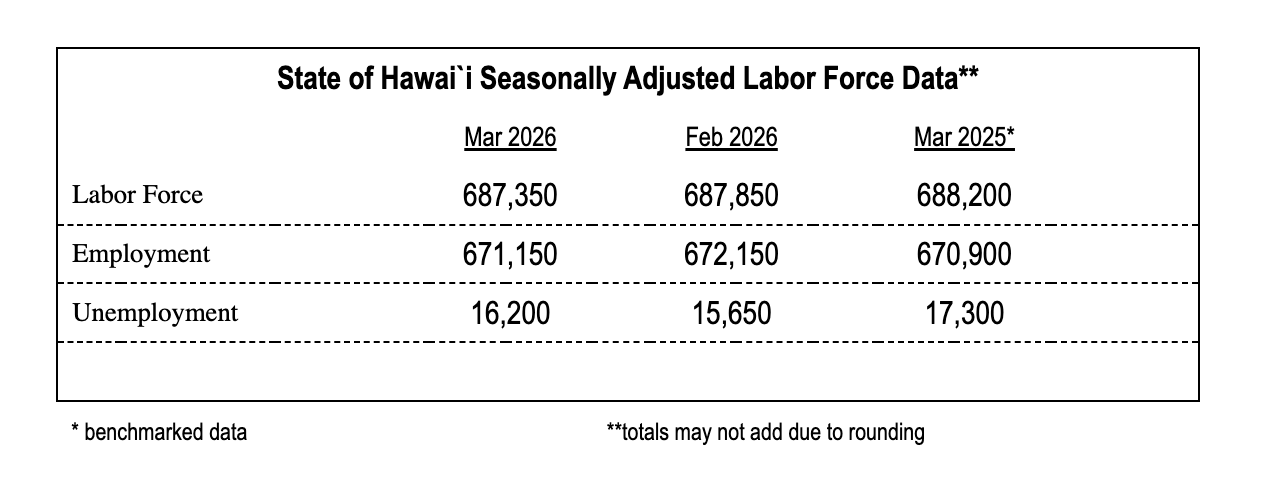
For Hawaiʻi, nonfarm jobs have gone down by 1,700, or 0.3% year-over-year.
In a separate measure of employment, total nonagricultural jobs decreased by 1,200 month over month, from February 2026 to March 2026. Other job losses include:
- Information: Loss of 100 jobs
- Other services: Loss of 300 jobs
- Professional and business services: Loss of 400 jobs
- Construction: Loss of 500 jobs
- Government: Loss of 300 jobs
Job gains were experienced in:
- Private education and health services: Gain of 200 jobs
- Manufacturing: Gain of 100 jobs
- Trade, transportation, and utilities: Gain of 100 jobs
Employment remained unchanged for:
- Financial activities
- Leisure and hospitality
The concepts and definitions used by the Local Area Unemployment Statistics program are the same as those used in the Current Population Survey for the national labor force data:
- Reference week: The week that includes the 12th day of each month, in which data is collected through a survey for employment status to generate the unemployment rate statistics.
- Civilian labor force: All people in the civilian noninstitutional population ages 16 and older classified as either employed or unemployed.
During the reference week, employed people are considered:
- Those who did any work as paid employees
- Worked in their own business or profession or on their own farm
- Worked 15 hours or more as unpaid workers in an enterprise operated by a member of their family
- Were not working, but had jobs from which they were temporarily absent, whether or not they were paid for the time off or were seeking other jobs
Each employed person is counted only once, even if they hold more than one job. Unemployed persons include:
- All people who had no employment during the reference week, but were available for work, except for temporary illness, and had made specific efforts to find employment sometime during the four-week period ending with the reference week.
- People who were waiting to be recalled to a job from which they had been laid off need not have been looking for work to be classified as unemployed.
A survey conducted for employment status in the week that includes the 12th day of each month generates the unemployment rate statistics, which is a separate survey from the Establishment Survey that yields the industry job counts.
The Current Population Survey contacts approximately 1,000 households in Hawaiʻi to determine an individual’s current employment status. Employed people consist of:
- All people who did any work for pay or profit during the survey reference week
- All people who did at least 15 hours of unpaid work in a family-owned enterprise operated by someone in their household
- All people who were temporarily absent from their regular jobs, whether they were paid or not
People considered unemployed are those who do not have a job and have actively looked for work in the prior four weeks and are available for work. Temporarily laid-off workers are counted as unemployed. People not in the labor force are those who are not classified as employed or unemployed during the survey reference week.
Statewide and sub-state data for 2024 to 2025 have revised inputs and 2016-2025 have been re-estimated to reflect revised population controls and model re-estimation.
For years, analysts with the State of Hawaiʻi Department of Labor and Industrial Relations Research and Statistics Office have developed monthly employment estimates for Hawaiʻi and its metropolitan areas. These estimates were based on a monthly survey of Hawaiʻi businesses and analysts’ knowledge about our local economies.
Beginning with the production of preliminary estimates for March 2011, responsibility for the production of state and metropolitan area estimates transitioned from individual state agencies to the U.S. Bureau of Labor Statistics.
For Hawaiʻi, this means the transition of statewide, Honolulu, and Kahului-Wailuku metropolitan area estimates for both the seasonally adjusted and not seasonally adjusted areas are produced by the U.S. Bureau of Labor Statistics.
State agencies will continue to provide the U.S. Bureau of Labor Statistics with information on local events that may affect the estimates, such as strikes or large layoffs/hiring at businesses not covered by the survey and to disseminate and analyze the Current Employment Statistics estimates for local data users.
The BLS feels this change is designed to improve the cost efficiency of the Current Employment Statistics program and to reduce the potential bias in state and area estimates.
A portion of the cost savings generated by this change is slated to be directed toward raising survey response rates in future years, which will decrease the level of statistical error in the Current Employment Statistics estimates. Until then, state analysts feel this change could result in increased month-to-month variability for the industry employment numbers, particularly for Hawaiʻi’s counties and islands.
The BLS can be reached at 202-691-6555 for any questions about these estimates.
The not seasonally adjusted job estimates for Hawaiʻi County, Kauaʻi County, Maui, Molokaʻi, and Lānaʻi are produced by the State of Hawaiʻi Department of Business, Economic Development and Tourism.