


Largest survey of exoplanets with Mauna Kea observatory confirms new spin on planet formation
The largest survey of exoplanets using an observatory atop Mauna Kea on the Big Island confirms a long-predicted relationship between planetary mass and rotation — putting a new spin on planet formation.
Astronomers using the W. M. Keck Observatory measured the rotation rates of a large sample of directly imaged extrasolar planets and more massive brown dwarf companions. They discovered that gas giant planets spin faster than more massive counterparts when accounting for their mass, size and age.
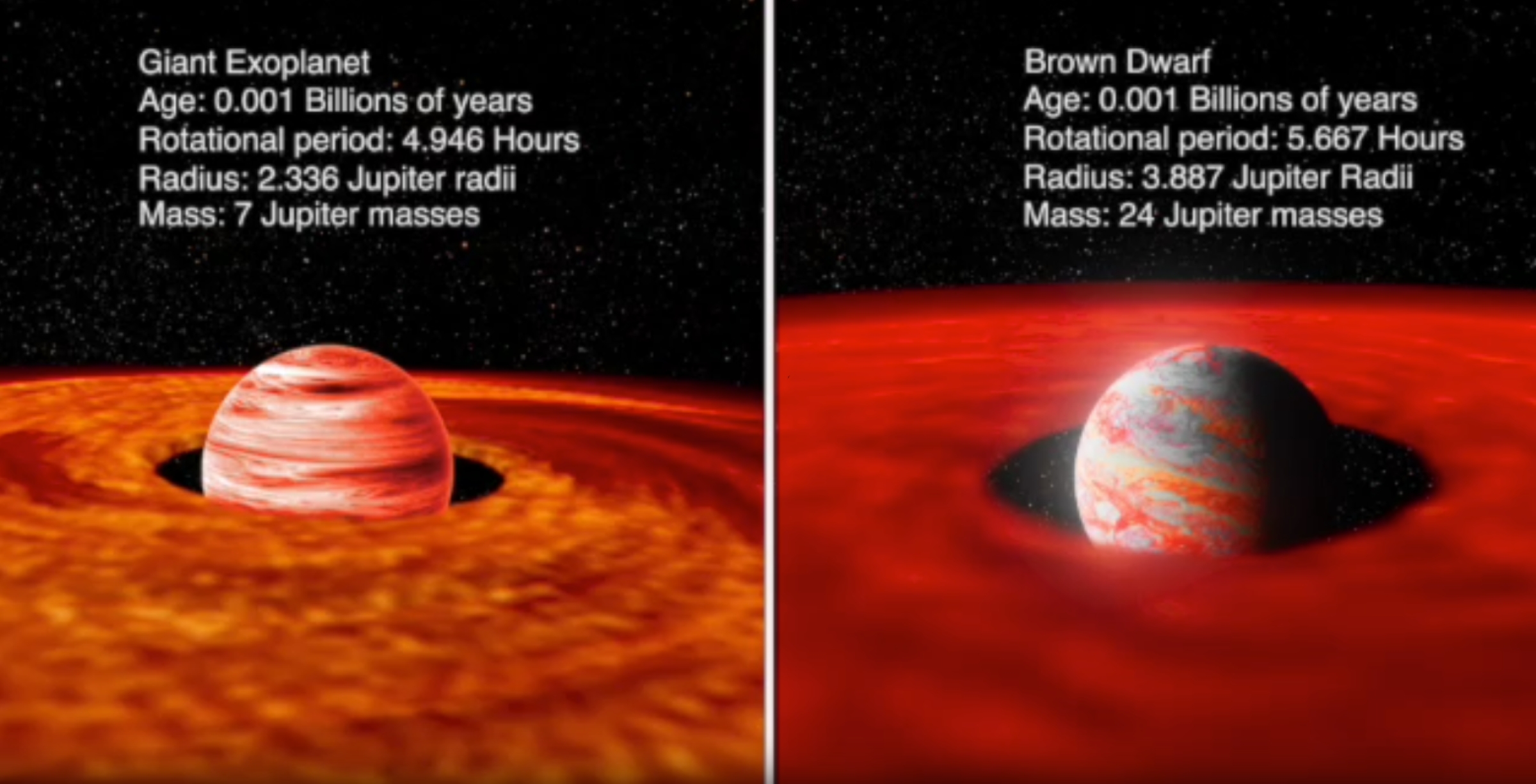
The result confirms a long-standing theoretical prediction and represents the largest survey of spin measurements for directly imaged companions to date.
“Spin is a fossil record of how a planet formed,” said study lead author and researcher at Northwestern University Dino Chih-Chun Hsu in an announcement about the discovery. “By measuring how quickly these worlds rotate, we can start to piece together the physical processes that shaped them tens to hundreds of millions of years ago.”
The study, led by Northwestern University, is published in The Astronomical Journal.
The team used the Keck Planet Imager and Characterizer to measure fine details in the atmospheres and isolating light from faint planets orbiting far from their host stars.
Features in their spectra broaden as these distant worlds rotate. Scientists can determine how quickly a planet is spinning by analyzing those broadened features.
“With [Keck Planet Imager and Characterizer], we can detect these tiny signals that reveal a planet’s rotation around other nearby stars,” Hsu said.
New window into planet formation
Many of the planets studied orbit far from their stars — tens to hundreds of times farther than Earth is from the sun. Astronomers are still debating how such distant worlds form.
Some could grow gradually within a disk of gas and dust surrounding a young star, while others might form more like miniature stars through gravitational collapse.
The newly identified spin trend provides an important clue.
“Our results suggest that both the planet’s mass and the ratio between the planet’s mass and its star’s mass influence how fast the planet ultimately spins,” Hsu said. “That helps us narrow down the physics of how these systems form.”
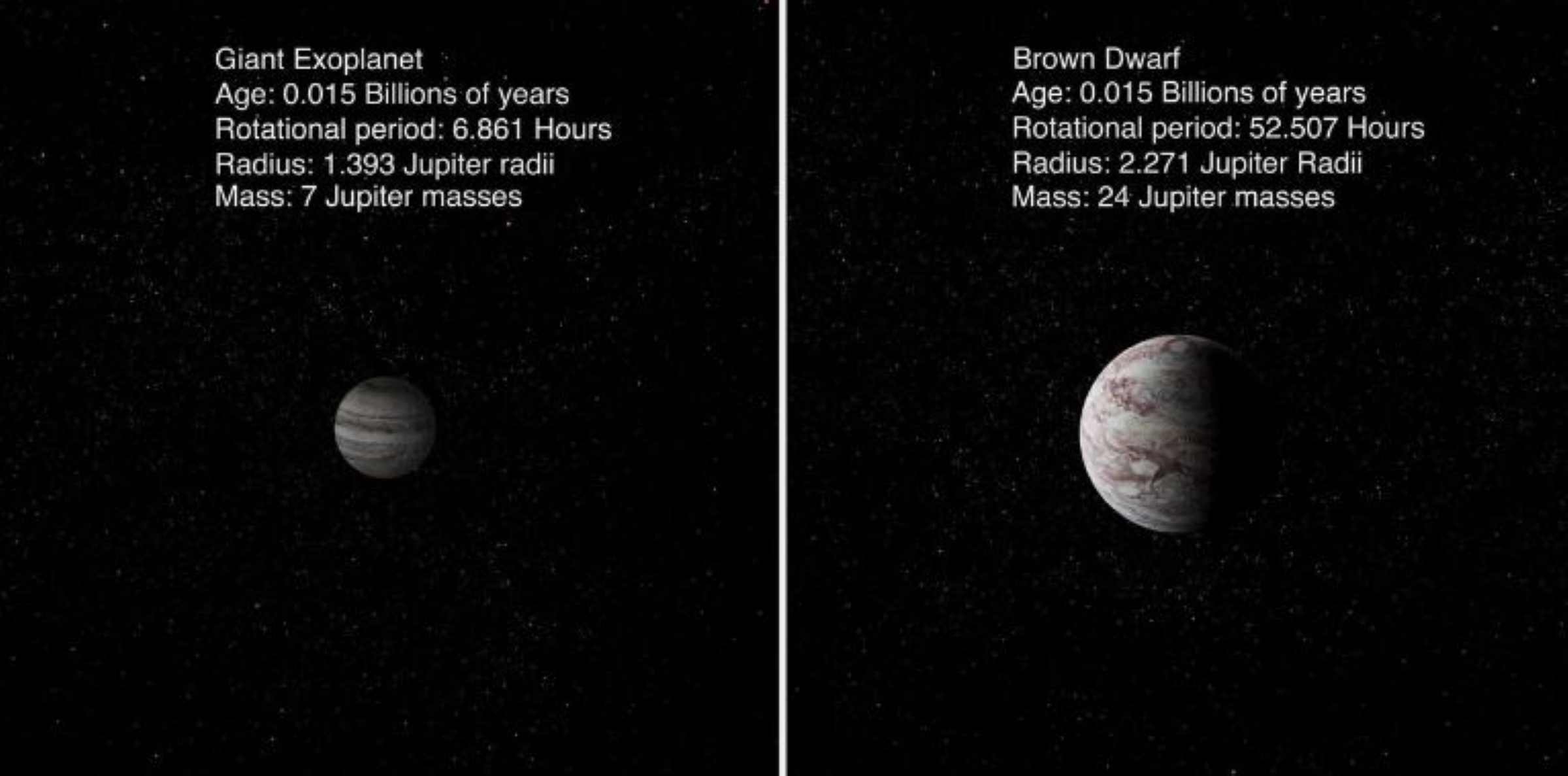
One planet and one brown dwarf in the study illustrate this complexity: One of the infamous planets in HR 8799, roughly 7 times the mass of Jupiter, spins unusually fast for its mass compared with a brown dwarf companion of 24 times the mass of Jupiter.
This implies that the brown dwarf ended up spinning 6 times slower than the planet.
This can be understood as the planet underwent braking by its magnetic field interaction with the disk around the planet during its infancy. The spin of a more massive companion was slowed down significantly more due to a stronger magnetic field.
What it means for our solar system
Understanding how giant planets spin also helps scientists understand the history of our own solar system.
Jupiter and Saturn rotate rapidly, each completing a rotation in roughly 10 hours. Because Jupiter is so massive, it stores a large fraction of the solar system’s rotational energy.
“The way that angular momentum is distributed among planets influences the overall architecture of a planetary system,” Hsu said. “Even Earth’s rotation and magnetic field ultimately connect to how that spin budget was divided when the solar system formed.”
Legacy of one instrument and bright future of another
Most of the spin measurements in the study were obtained using Keck Planet Imager and Characterizer, which was specifically designed to pair Keck’s adaptive optics system with high-resolution spectroscopy.
The instrument recently completed its final observations in January, marking the end of a highly productive run.
“[Keck Planet Imager and Characterizer] is the first instrument of its kind, opening an entirely new way to study exoplanets,” Hsu said. “It allowed us to measure properties like spin that were previously almost impossible to detect.”
The research team plans to expand its studies by examining the spins of free-floating planetary-mass objects — worlds that drift through space without a host star — as well as investigating the chemical composition of planetary atmospheres.
“We’re just beginning to explore what planetary spin can tell us,” Hsu said. “With future instruments and larger telescopes, we’ll be able to measure spins for even more worlds and connect rotation, chemistry and formation history across entire planetary systems.”
Advanced future instrumentation — including Keck Observatory’s upcoming High-resolution Infrared Spectrograph for Exoplanet Characterization — is coming online in 2027 and will extend these measurements to even smaller and more distant worlds.
“We took the lessons learned from [Keck Planet Imager and Characterizer] and put them into [High-resolution Infrared Spectrograph for Exoplanet Characterization], which will have better sensitivity, higher spectral resolution and wider wavelength coverage”, said study co-author and Northwestern assistant professor Jason Wang in the discovery announcement. “With [High resolution Infrared Spectrograph for Exoplanet Characterization], we will be able to drastically increase the number of planets that we can measure spins of, and in particular, we can study planets closer to our own Jupiter in nature to see if our own Jupiter is typical.”