


Reed Mahuna’s journey to become Hawaiʻi Island police chief like his dad, but without special help
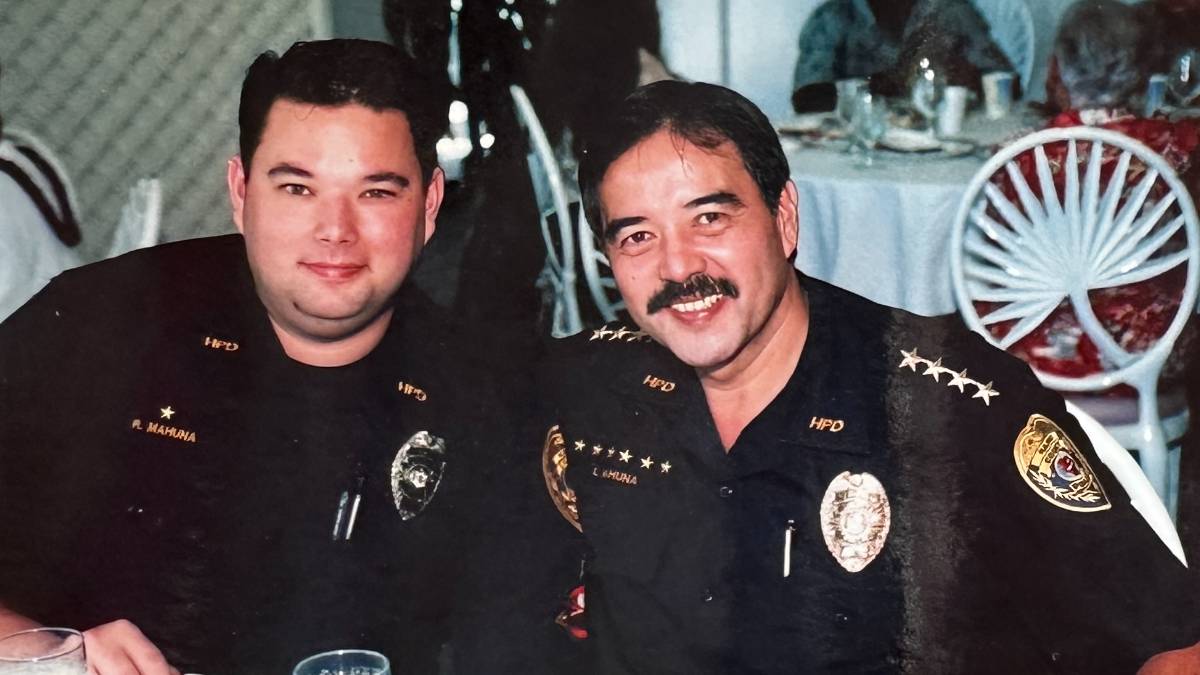
Growing up in Hilo, a young Reed Mahuna always looked up to his dad, Lawrence, an officer with the Hawaiʻi Island Police Department who rose through the ranks to become chief.
When he was just out of high school or a freshman in college, Mahuna asked his dad if he could take him on a ride-along in his district of South Kohala.
“For whatever reason in my brain, I thought that my dad was going to take me,” Mahuna said. “I thought he was going to put on a uniform and we were going to go cruise around and see what it was like to be a police officer.”
But that’s not what happened. Instead, the younger Mahuna cruised around with another officer, who was a family friend. The shift wasn’t busy, maybe one or two traffic stops. But the veteran officer used some of the down time to explain candidly what being a police officer was all about and why he did it.
While Mahuna canʻt describe the exact conversation of three decades ago, he remembers “coming back from that and telling my dad, ‘I want to be a police officer.'” And he did, serving his home island for the past 28 years.
Now, at age 49, Reed Mahuna is the second in the family to rise through the ranks to become chief of the department. The Hawaiʻi County Police Commission selected him on Jan. 30 from a pool of 42 original candidates and a strong field of eight finalists, including six from the mainland.
Those who know the younger Mahuna say he has always been his own man, carving out his own path and not advancing on the coattails of his father, who retired in 2008 after serving as chief since 2002.
“It was clear to me that he wasn’t resting on the laurels of being the son of a high-ranking officer,” said retired Hawai‘i County Police Capt. Randy Medeiros, who had supervised the younger Mahuna. “He did not receive anything free. He worked hard for everything that he accomplished.”
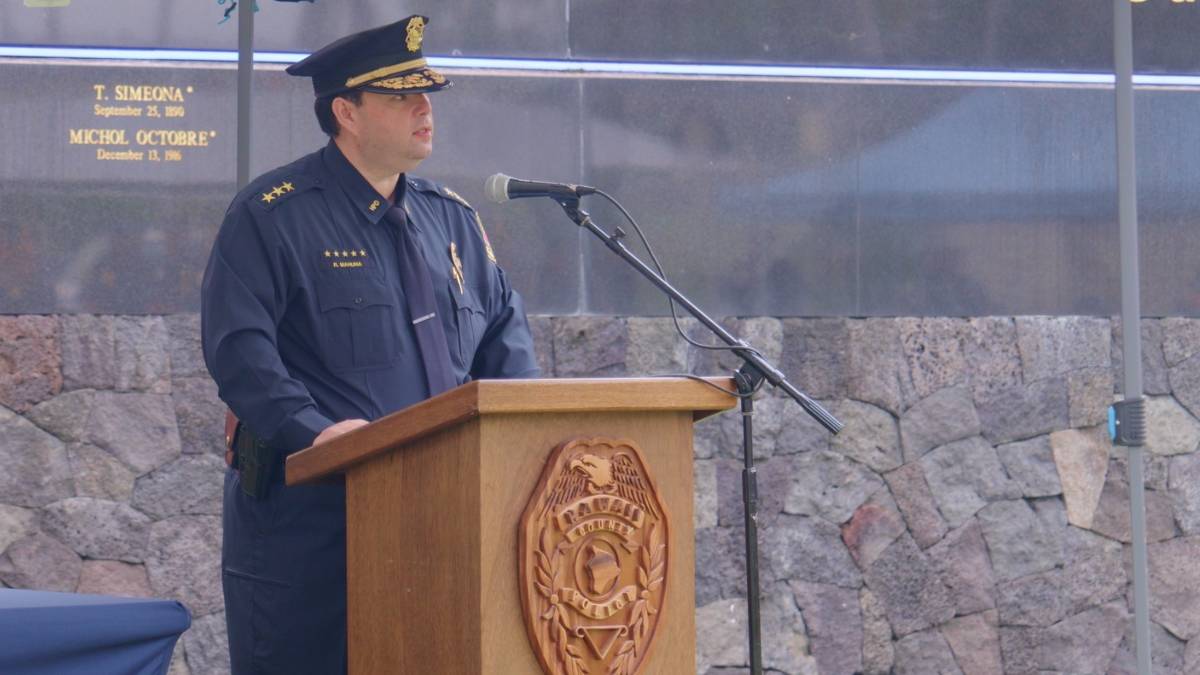
Medeiros described Mahuna as a go-getter when he first met him working in traffic enforcement years ago. And when Mahuna came to work under him in the criminal investigation section as a detective, Medeiros said he knew there was something special about him due to his work ethic, compassion and intelligence conducting investigations.
Medeiros said one case that sticks out is the report of a suicide in ʻĀinaloa. Mahuna and his lieutenant responded. The lieutenant agreed with the person reporting at the scene that the death looked like a suicide and advised Mahuna to treat it as such.
“He wasn’t comfortable with that,” Medeiros said. “And after his lieutenant left, he called me and explained to me what was going on at the scene and what advice he was given.”
Medeiros agreed with Mahuna, saying: “The circumstances were obvious.”
Medeiros also responded to the scene, and a criminal investigation was conducted, with an arrest and successful prosecution to follow.
Mahuna showed backbone by going over his lieutenant’s head, Medeiros said. He added that while it caused a rift between the two, Mahuna recognized the gravity of what was happening and couldn’t ignore his training.
As Reed Mahuna rose through the ranks, Medeiros watched how Mahuna supervised his personnel and interacted with other agencies and the public, telling him: “You will be in that corner office in building A one day.”
“It was clear to me at that time that he’s got what it takes,” Medeiros said.
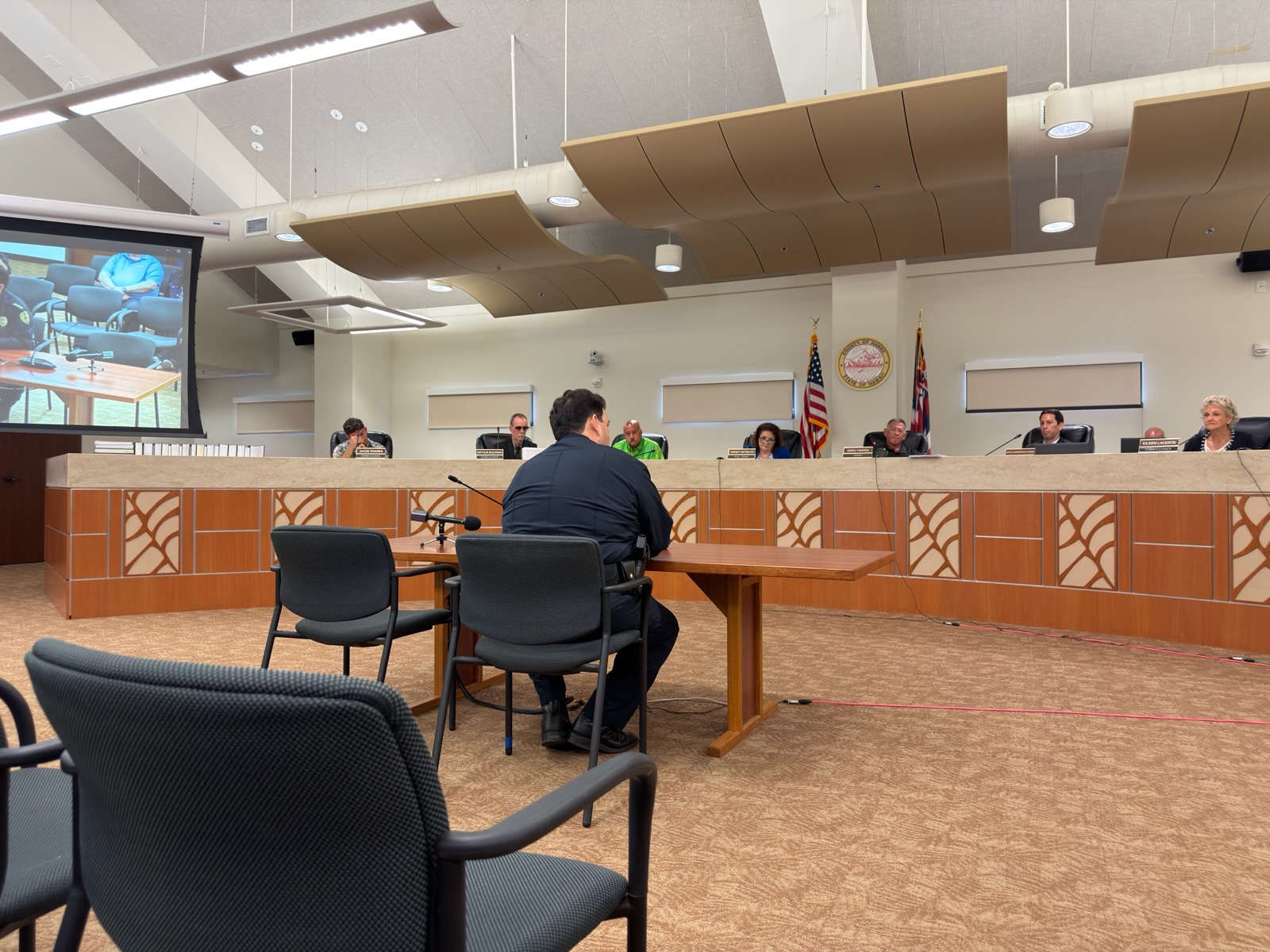
Over the years, Mahuna built goodwill around the island. When the Police Commission interviewed the finalists at two public meetings in Kona, many people, including the union, attended to support Mahuna, who had been serving as interim chief since the resignation of former chief Ben Mozskowicz took effect Aug. 31.
When Mahuna joined the force at age 21, his dad was working as a major in technical services and had just made 25 years with the department. While in field training, Mahuna said his dad was promoted to assistant chief in administration.
Mahuna said he didn’t realize at the time just how much scrutiny it would bring.
“If your dad is chief, then a lot of people assume that somehow you either represent him or they have an idea of who you are based on who he is,” Mahuna said. “These are people that don’t know me very well from within the department.”
When he responded to calls, people would connect the relationship due to his unique last name.
“Some people will be extra hard on you or give you an extra hard time because your dad is the chief,” Mahuna said. “The good part is that my dad knew this, I think. And so he made sure that he didn’t do anything that was unfair to help me. So I was a better person for it.”
As time went on, Mahuna gained his own reputation, and people came to know him as an individual.
Retired Hawai‘i Island police Maj. Randy Apele also worked for and with the Mahunas. He described Lawrence Mahuna as a strong leader and someone he could easily follow. He was fiery and old school, “and I say that all in a positive way.”
“He held you accountable,” Apele said. “He was a tough guy, but a very easy, very nice guy and easy to communicate with.”
Apele said Reed Mahuna’s demeanor is different from his dad.
“His strengths lie in the fact that he’s even-keeled and level-headed,” Apele said. “He doesn’t get excited. He’s very calm.”
Apele said these attributes will help Mahuna lead a younger force. He is adaptive to the new generation of police officers and the direction they need.
Early on, Apele said Mahuna displayed a high understanding of administrative roles and was a productive and highly motivated officer.
He singled out the new chief’s response to Tropical Storm Iselle in 2014, which was the first cyclone to make landfall in the State of Hawai‘i since 1992.
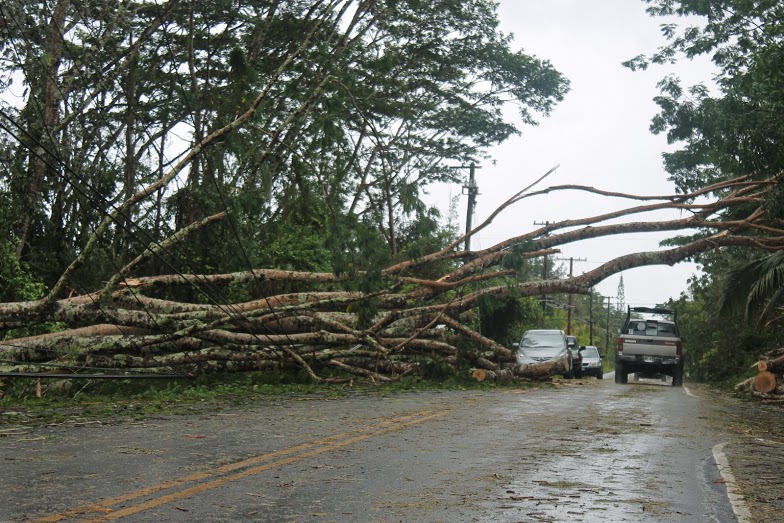
Mahuna was a patrol lieutenant in the Puna District at the time, but was filling in as acting captain when the storm hit.
With a natural disaster as expansive as Iselle, Apele said it required an active and community-oriented response.
“Reed handled such a tough situation in a very professional and outstanding way,” Apele said.
While Iselle caused problems throughout the state, damage was focused along the east and southeast portions of the Big Island, where 11 homes were destroyed, and 50 homes suffered some degree of damage, according to a NOAA report.
The monetary loss statewide ranged between $148 million and $325 million.
According to NOAA, the significant damage was attributed to strong winds toppling several large albizia trees. At the peak of the storm, more than 33,000 customers were without power, and more than 1,000 customers remained without power for more than two weeks.
Apele said Mahuna was responsible for coordinating the police response as well as working with other county and federal agencies to address community needs.
This included little things like scheduling to ensure there was enough manpower while also ensuring officers were getting rest. Apele said Mahuna was responsible for allocating resources to the areas most in need and making sure the community requests are being responded to.
This included establishing shelters, providing evacuation if needed in certain areas, and doing damage assessments. “It’s endless,” Apele said.
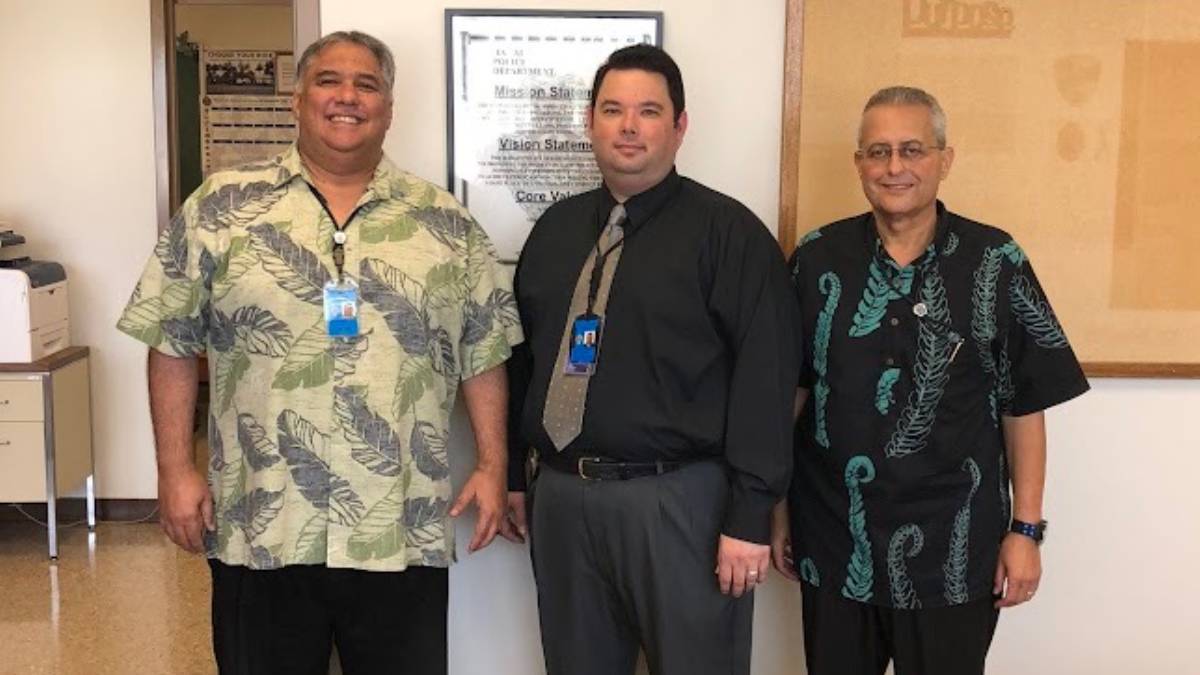
“He handled everything calmly, efficiently, and it went as well as it could go from our standpoint,” Apele said, noting the unique geographical challenges of the Puna District because it is large and expansive.
When Mahuna looked back on his career so far, it was his time as a detective for both West Hawai‘i and East Hawai‘i that stuck out to him.
“That was something that I was pretty good at,” Mahuna said.
But it also was during a period when he dealt with his most difficult case, the murder of a young girl in Hilo.
“At the time, one of my own children was having a first birthday party and I had a week off of vacation,” Mahuna said.
His captain called him on a Sunday, saying he was needed for the case.
“My wife, she understood, and she had to get ready for this birthday party by herself,” Mahuna said. “My wife is 100% supportive of me, and I am extremely lucky to be married to her.”
Mahuna worked the case and got an arrest, with the suspect being charged.
“What people don’t understand about police work is that there are things that you do and things that you see that forever change who you are,” Mahuna said. “I’ll always remember that little girl.”
Retired Hawai‘i Island police major John Briski was part of Mahuna’s recruit class. They became friends and he was the best man at Mahuna’s wedding.
“If I need someone I give him a call, and if he needs something he gives me a call, and that’s a rare thing to have,” Briski said.
Outside of police work, Briski and Medeiros spoke about Mahuna’s passion for cars.
“He was always the go-to person to talk cars, look at cars…” Briski said.
Medeiros said Mahuna told him that his retirement plan was to work at a car lot, which the new chief confirmed.
“My favorite car is the Ford Mustang and I currently drive a Ram 1500 truck,” Mahuna said.
But before he enters his second career, Mahuna has a police department to run.
Medeiros expects great things from Mahuna and believes he will ensure improvements, whatever they might be, are made in the department.
Briski also thinks Mahuna is the right chief for the this time.
“Different times call for different people and different kinds of communication,” Briski said. “During our current state in our community and country, he has the correct demeanor to address all the issues in our community.”
Since he was chosen, Mahuna said he’s been thanking people.
“It was really humbling to sit there and listen to people who, a lot of them had to drive a significant distance to say kind words about me,” Mahuna said.
He also talked with his dad, who congratulated him and said: “You know about your parents. They always think you are capable of anything.”
And his dad also told him: “I knew you were going to get it, son.”
Reed Mahuna also took some time on the weekend to spend it with family. His daughter, now 19, is an art major at University of Hawai‘i. His son is 17 and wants to be a firefighter.
“Both my grandfathers, John Mahuna and Marion “Sonny” Tavares were retired firefighters, so my family has a history as firefighters as well,” Mahuna said.
When Mahuna isn’t working, he said he spends time with his family.
“As my children get older, I know my time is limited, and before I know it, they will have families of their own,” he said, “So I spend time with my wife and kids now every chance I get.”