


Volcano Watch: A look back at recent Kīlauea eruptions and intrusions
Scientists say Kīlauea since 2018 has been busy with eruptions and intrusions, which is part of the normal dynamic behavior at the volcano.
Editor’s Note: Volcano Watch is a weekly article and activity update written by scientists and affiliates with the U.S. Geological Survey’s Hawaiian Volcano Observatory.
Amidst the ongoing episodic lava fountaining eruption at Kīlauea summit, a caldera intrusion from Sept. 30 to Oct. 1 has a lot of people wondering what will come next.
Eruptions and magmatic intrusions are not unusual, and Kīlauea has experienced many of these in the summit region and along the rift zones over the past few years.
A magmatic intrusion is a body of intrusive igneous rock formed when molten magma squeezes into pre-existing underground rock layers and cools slowly beneath the Earth’s surface.
Following the 2018 lower East Rift Zone eruption and summit collapse, Kīlauea summit earthquake rates were higher overall compared to before the 2018 eruption.
In March 2019, the summit magma chamber began inflating again, and in July, water appeared at the bottom of the Halema‘uma‘u crater collapse pit, which grew into a lake over the next year and a half. But this break from eruptions and intrusions at Kīlauea was relatively short, lasting just over two years.
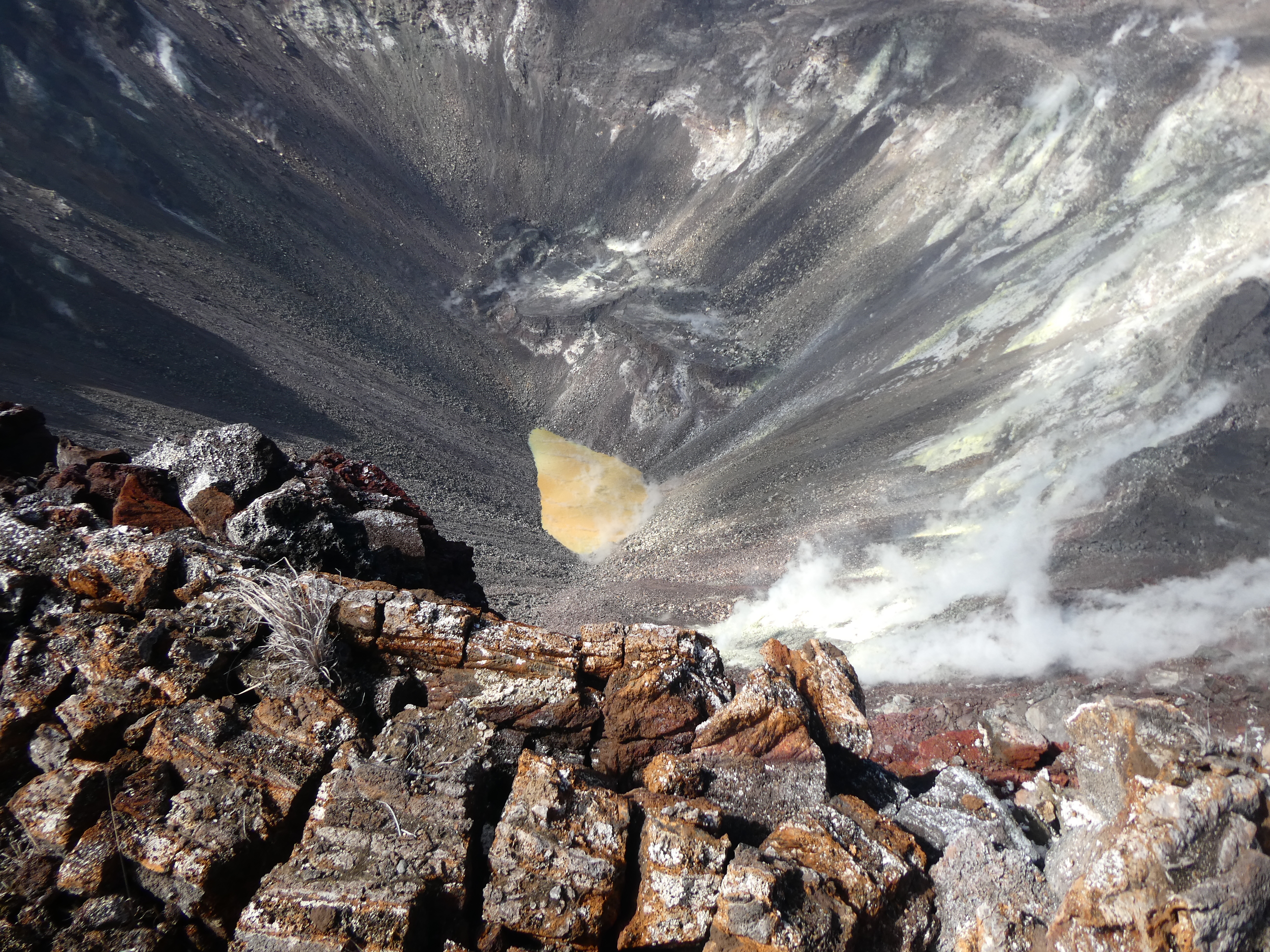
On Dec. 2, 2020, the U.S. Geological Survey’s Hawaiian Volcano Observatory monitoring network began recording signs of an intrusion under the southern part of Kaluapele (Kīlauea’s modern summit caldera) with increased earthquakes and ground deformation.
This was the first sign of magma intruding into shallow depths at Kīlauea since the 2018 eruption ended. Several weeks after the intrusion, on Dec. 20, an eruption began at Kīlauea summit for the first time since 2018. The vents opened on the wall of the Halema‘uma‘u crater collapse pit and quickly boiled off the water lake. The eruption continued for about 5 months and ended on May 23, 2021.
Then on Aug. 23, 2021, another intrusion occurred in the south caldera region (southern portion of historic caldera), which lasted about a week. A second eruption within Halema‘uma‘u crater began about a month later, on Sept. 29, and lasted for over a year before it ended on Dec. 9, 2022. During that eruption, another small intrusion took place on Sept. 20, 2022, along the west side of Halema‘uma‘u.
The repose period between summit eruptions was short-lived as another started on Jan. 5, 2023. After three months, the eruption ceased on March 7. There were two additional summit eruptions in 2023, one in Halema‘uma‘u from June 7 to 19 and the other on the 2018 down-dropped block (immediately east of Halema‘uma‘u) from Sept.10 to 16.

Starting on Oct. 4, 2023, an intrusion began to the southwest of Kaluapele, in Kīlauea’s south caldera region; in the same area as the August 2021 intrusion. Pulses of seismic swarms and increased rates of deformation continued throughout the month. Two other intrusions were recorded southwest of the summit on Dec. 29, 2023, and Jan. 27–Feb. 3, 2024; however, seismicity and deformation rates remained high in the region even between these intrusive episodes. During these several months, earthquake rates peaked at over 250 per day and the Sandhill tiltmeter recorded about 200 microradians of total inflation.
There was another intrusion to the southwest of Kīlauea on June 2, 2024, with elevated ground deformation rates and some larger shallow earthquakes including a magnitude 4.0 and 4.1 that were widely felt in the area and triggered rockfalls. This increased activity prompted the Hawaiian Volcano Observatory to raise the volcano alert level and aviation color code from advisory/yellow to watch/orange. The next day, a small and short-lived Southwest Rift Zone eruption occurred for about 9 hours.
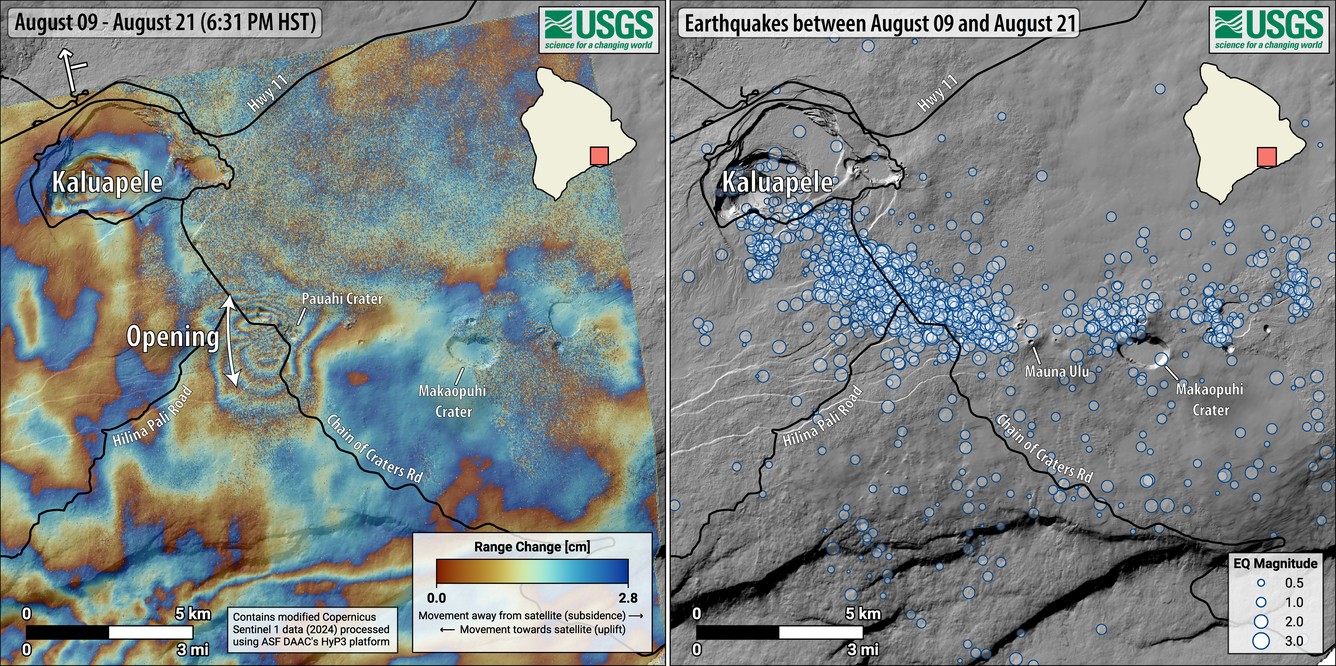
Intrusive activity at Kīlauea then shifted to the upper East Rift Zone on July 22 to 25, and Aug. 19 and 20. During the July intrusion, more than 1,700 earthquakes occurred along with about 60 microradians of tilt recorded at the Escape Road tiltmeter near Maunaulu. The seismicity and ground deformation from these intrusions caused ground cracking and some uplift along portions of Chain of Craters Road and the Maunaulu parking lot.
Then, on Sept. 14, 2024, a third intrusion into the East Rift Zone, near Makaopuhi Crater, occurred. On the following day, an eruption on the East Rift Zone commenced at Nāpau Crater and lasted from Sept.15 to 20, 2024.

After only a few months, Kīlauea summit began the episodic lava fountaining eruption on Dec. 23, 2024. That leads us to the most recent intrusion, which occurred a few weeks ago from Sept. 30 to Oct. 1, followed by the 55th fountaining episode on Oct. 17, 2026.
Kīlauea volcano has been busy with eruptions and intrusions following 2018. This activity is part of the normal dynamic behavior at Kīlauea. By closely monitoring this activity, HVO continues to learn about the patterns of change at Kīlauea, which can unfold quickly.
Current Kīlauea volcano alert level: Advisory
Kīlauea has been erupting episodically within the summit caldera since Dec. 23, 2024. The Halema’uma’u eruption of Kīlauea is currently paused after episode 55 fountaining ended on Oct. 17. Summit reinflation continues and the preliminary forecast for episode 56 fountaining is Oct. 29-Nov. 5. Sulfur dioxide emissions are in the range of 1,000 to 5,000 tonnes per day. No unusual activity has been noted along Kīlauea’s East Rift Zone or Southwest Rift Zone.
Current Mauna Loa volcano alert level: Normal
Mauna Loa is not erupting. One earthquake was reported felt in the Hawaiian Islands during the past week: a M3.0 earthquake 14 km (8 mi) NNW of Wai‘ōhinu at -1 km (0 mi) depth on Oct. 18 at 10:19 a.m. HST.
Visit the Hawaiian Volcano Observatory website for past “Volcano Watch” articles, Kīlauea and Mauna Loa updates, volcano photos, maps, recent earthquake information, and more. Email questions to askHVO@usgs.gov.