


Mysterious manta rays from Kona Coast’s small familial group captivate 80,000 annually
"Lefty" was the first identified manta ray living off the Kona Coast, in 1979, and since then researchers and divers have identified only about 317 more of the creatures who rarely leave the area.
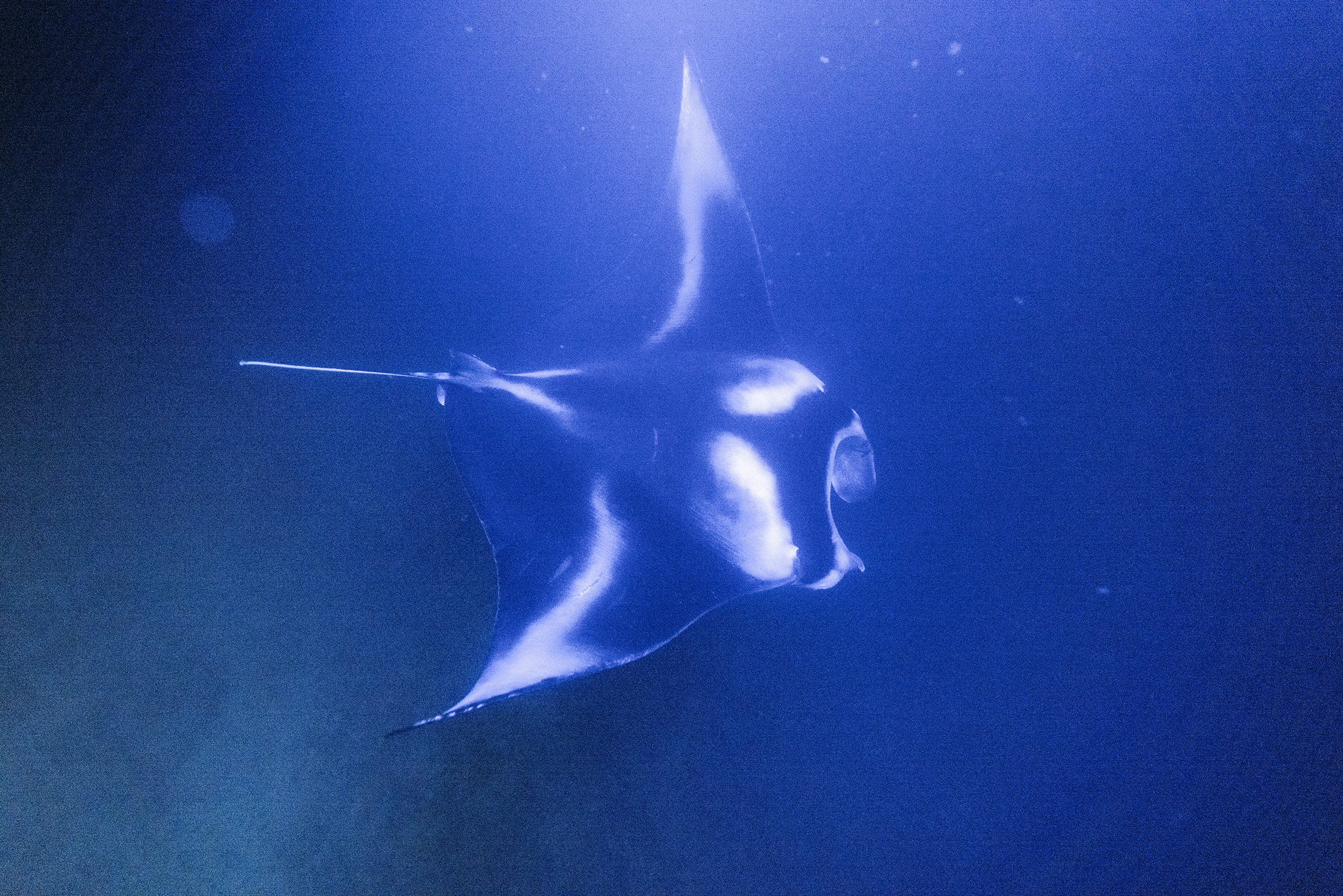
On most nights in Kailua-Kona, big spotlights attract plankton, which then lure the reef manta rays from the deep, dark corners along the Kona coast.
Two congregations of mantas get together to feed in Garden Eel Cove and off the shore occupied by the Outrigger Kona Resort and Spa in Keauhou.
Some 80,000 people a year come to see the unique Big Island tourist attraction, getting there by boats run by several manta ray tour companies.
For the past 5 years, Outrigger Kona Resort and Spa has celebrated Kona’s manta rays with the annual World Manta Day Celebration. It’s a free, family-friendly event that is dedicated to the world of manta rays through marine science, culture and conservation.
This year’s celebration on Sept. 12 featured presentations from leading manta researchers and the world premiere of a new educational manta ray segment produced by Polu Kai Media.
“Since the Outrigger acquired the property in 2022, there has been an active effort to deepen the public understanding of manta rays and the importance of protecting our oceans,” General Manager Geoff Pearson said. “The resort is one of the best places to see manta rays in the world, so it feels necessary to celebrate these magnificent animals while inspiring meaningful action to protect them for generations to come.”
Throughout the afternoon, respected local, national and international experts shared the latest discoveries in manta ray research and marine conservation, including Keller Laros, chair and co-founder of the Manta Pacific Research Foundation.
Laros presented current research being done to understand the resident population of manta rays off of the Kona coast. Researchers are currently analyzing DNA from manta rays across the islands to learn more about the population genetics and piece together family trees.
Laros says one question researchers are exploring is whether squadrons of manta rays have a social hierarchy, including an “alpha” male or female.
“Despite being able to see manta rays nearly every night, they remain mysterious in many ways,” Laros said. “What we do know is that they have largest brain-to-body ratio of any fish and may even be capable of recognizing themselves in a mirror.”
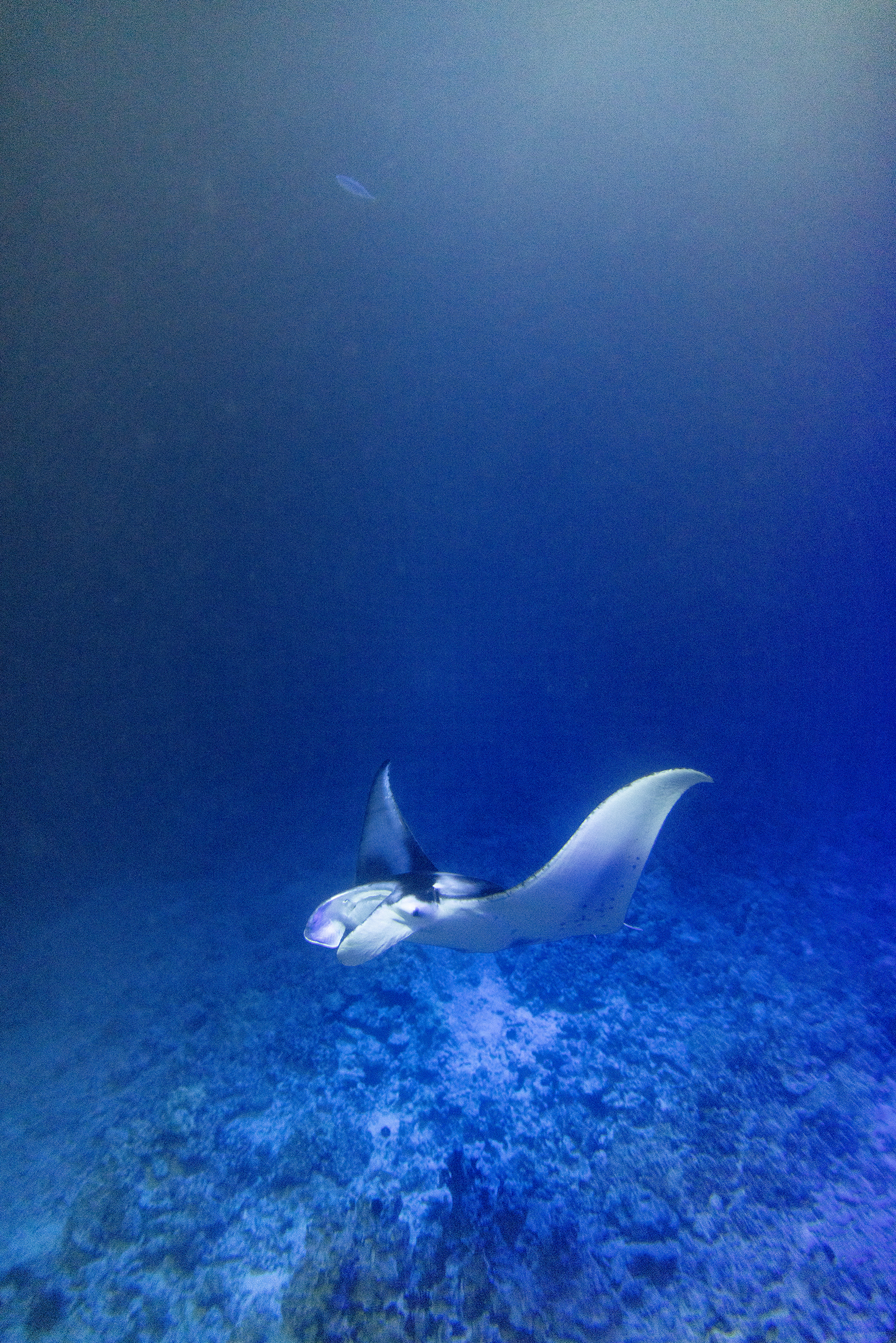
Laros also explains that each manta ray has a distinct pattern of spots on its belly, which helps researchers identify individuals. As of Tuesday, the Manta Pacific Research Foundation has identified only 318 unique individuals around Hawaiʻi Island since 1979, and about 600 unique individuals in Maui Nui since 2005.
The first genetic study of reef manta rays in Hawaiʻi was conducted by NOAA’s Pacific Islands Fisheries Science Center, the Hawai‘i Association for Marine Education and Research, and the University of Miami revealed that reef manta rays stay close to home and rarely cross the deep channels between islands.
They found that females only reproduce at the island where they were born. Migration rates are equivalent to one female moving between island groups every 1,300 years and one male only about every 64 years.
“We use the unique spot patterns on their ventral side (underside) to accurately identify individuals and to date, no photo-ID has been matched between the two populations in Maui and Hawaiʻi,” Laros said. “This confirms that there are social relationships and a strong attachment to physical location, which is what we want to know more about.”
For many years, the Kona Manta Rays have been photographed and identified using their unique spot pattern, which is why Laros and his wife, Wendy, started the Manta Identification Project in 1991. The project became a photo logbook of the individual mantas that were seen each evening at the dive site in Keauhou.
“The first manta ray ever identified was Lefty,” Laros said. “She has a broken left cepahlic fin so she is easy to be differentiated from the others, but Lefty also has a spot pattern on her abdomen that is unique to her.”
Lefty already was a mature female when she was first identified in 1979 and she is still alive today.
“We like to say she is the oldest known manta ray,” Laros said.
The Manta Pacific Research Foundation continues to identify and track the manta rays throughout the Islands, maintaining catalogs for Hawai‘i Island, Maui and O‘ahu.
Eka Canoe Adventures in Keauhou is one of the most unique ways to snorkel with manta rays along the Kona Coast –– on a 40 foot Hawaiian double-hulled sailing canoe.
According to the company’s owner, Kalani Nakoa, using the sailing canoe is less of a disruption to the natural patterns of the manta rays and the act also honors Hawaiian culture and history.
“The manta rays are family. We call them by name, respect their space, and educate our visitors,” Nakoa said.
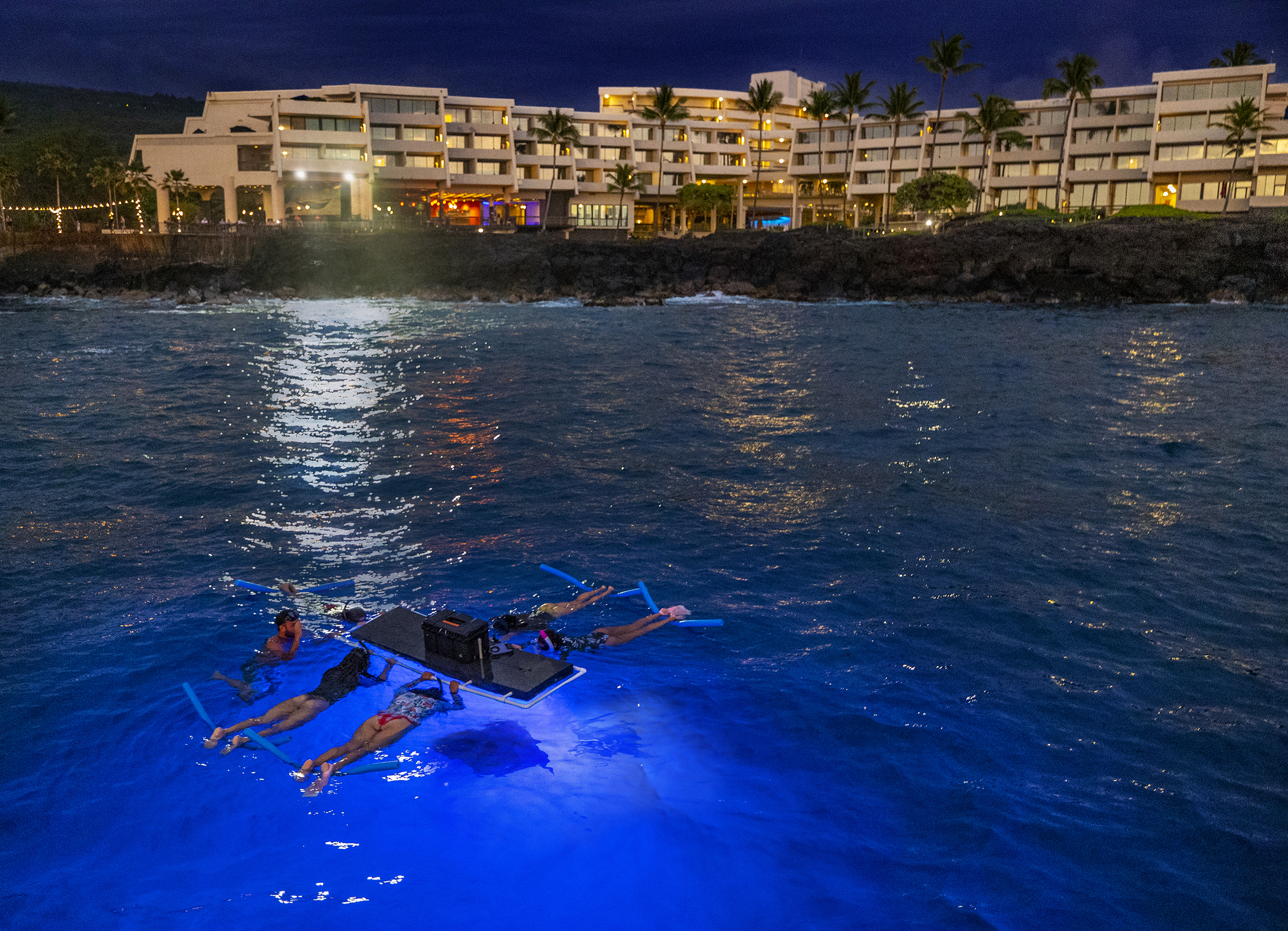
To snorkel with the manta ray, guests take the canoe for the 5 to 10 minute ride to the snorkel site near the mouth of Keauhou Bay. After getting a safety briefing, instructions on snorkel gear and a wet suit, guests are guided in the water and positioned along the perimeter of a light board.
The guests hang on to the handles of the board and effortlessly float, face down, with the help of the provided floatation devices. The powerful lights attract photosynthetic plankton toward the group, and the manta rays come in search of the plankton.
Hannah Sturtecky visited Hawaiʻi Island last year and was in awe of the size of the manta rays as some of them weight more than 1,000 pounds.
“Snorkeling was a thrilling experience, especially since you are in ocean after dark,” Sturtecky said. “The way the glided in the water and came so close to us to eat the plankton was incredible. It seems like they are perpetually at peace.”
Manta rays, or hāhālua in ʻŌlelo Hawaiʻi, are culturally significant to Native Hawaiians and revered in Hawaiian culture. They are regarded by some families as ʻaumakua (ancestral guardians), and are believed to provide protection and guidance.
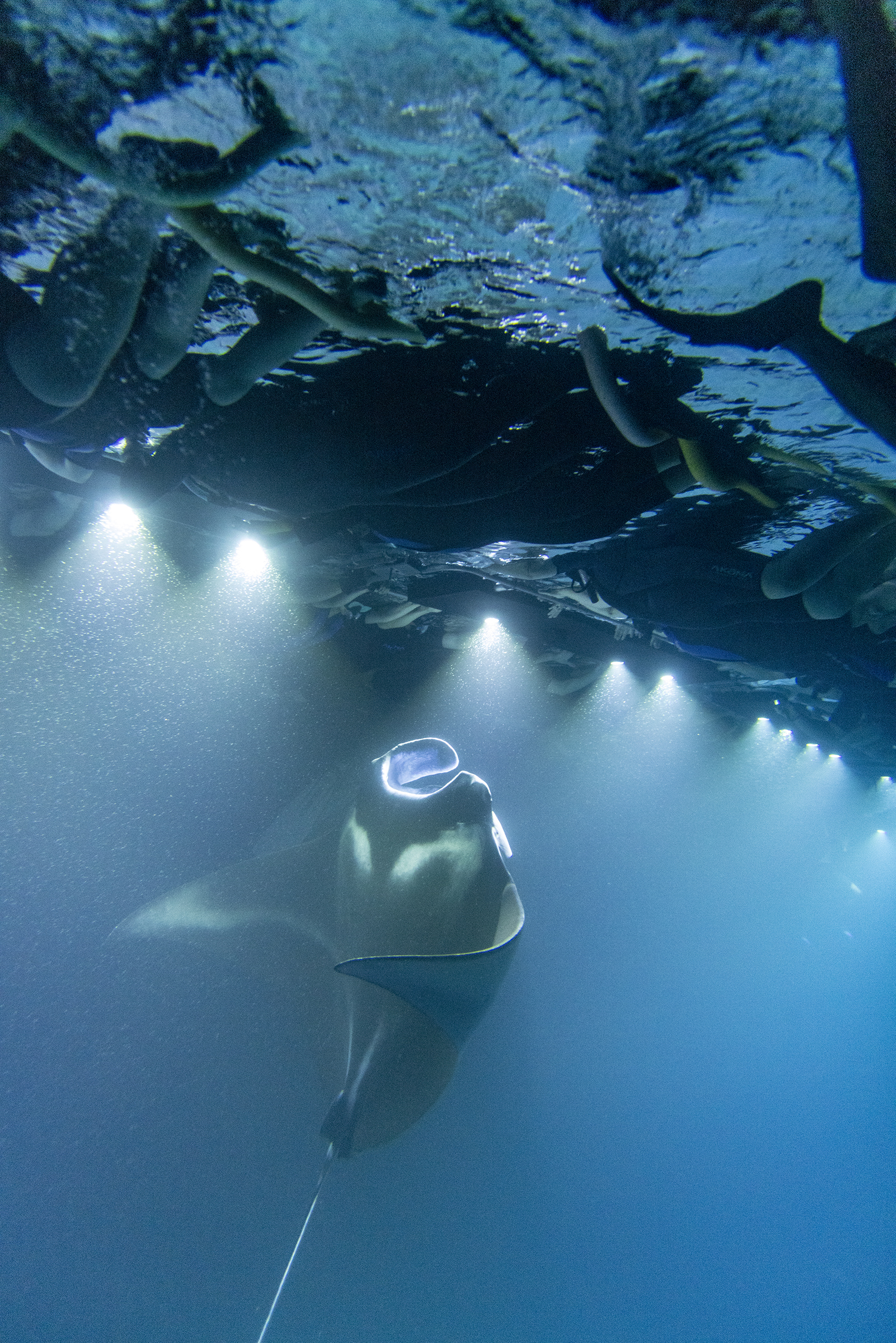
In 2009, Hawai‘i made it illegal to kill or capture manta rays, but the isolated populations are vulnerable to human impact. Some threats to reef manta rays include boat strike, habitat loss from coastal development and fishing line entanglement, which can often be seen as scars on the manta rays.
Additionally, manta rays grow slowly, mature late, and have few pups. Mature females produce only a single pup every 1 to 7 years. If populations decline, these traits can hinder their potential recovery.
“The vulnerability of these populations is why we continue to do research and advocate for them,” Laros said. “It is now known that they have made the Kona Coast their home and will not be leaving for presumably hundreds of years.”
The Manta Ray Identification Project is online with the identified individual manta rays of West Hawaiʻi. For information on research, education and conservation visit the Manta Pacific Research Foundation website.