


3 candidates running for open Kona District County Council seat talk housing, parks, infrastructure
Mark Henriques, Edgar "Eddie O" Ombac and Manu Powers are vying for the open seat now occupied by Rebecca Villegas, who is not able to run for re-election due to term limits.
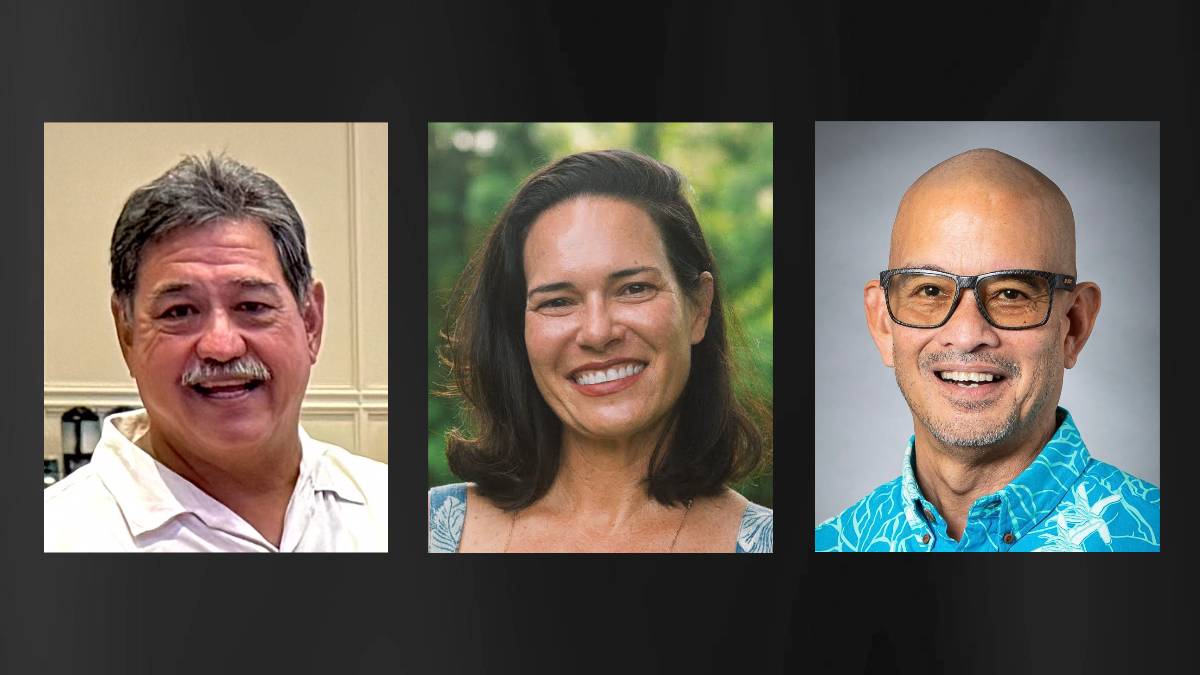
With Council Member Rebecca Villegas unable to run for re-election due to term limits, there are three political newcomers vying for the open seat to represent the Kona District.
Candidates Mark Henriques, Edgar “Eddie O” Ombac and Manu Powers all say affordability is a priority as they battle in the primary election on Aug. 8.
When it comes to affordable housing, the trio have different approaches.
Henriques wants to address housing for the middle class, who don’t qualify for low-income housing assistance. Ombac is hoping to create conversations between developers and realtors to establish more affordable homes. And Powers thinks the focus needs to be on upgrading the district’s aging wastewater and solid waste infrastructure before the county can think about building more houses.
The Kona District, also known as District 7, spans north of Trousseau Road by Teshima’s restaurant until Nani Kailua Drive and then west of State Route 11 until Luhia Street. It also covers northeast of Kona Belt Road until Old Mauka Government Trail, including Honalo, Kahalu‘u-Keauhou, Holualoa and part of Kailua.
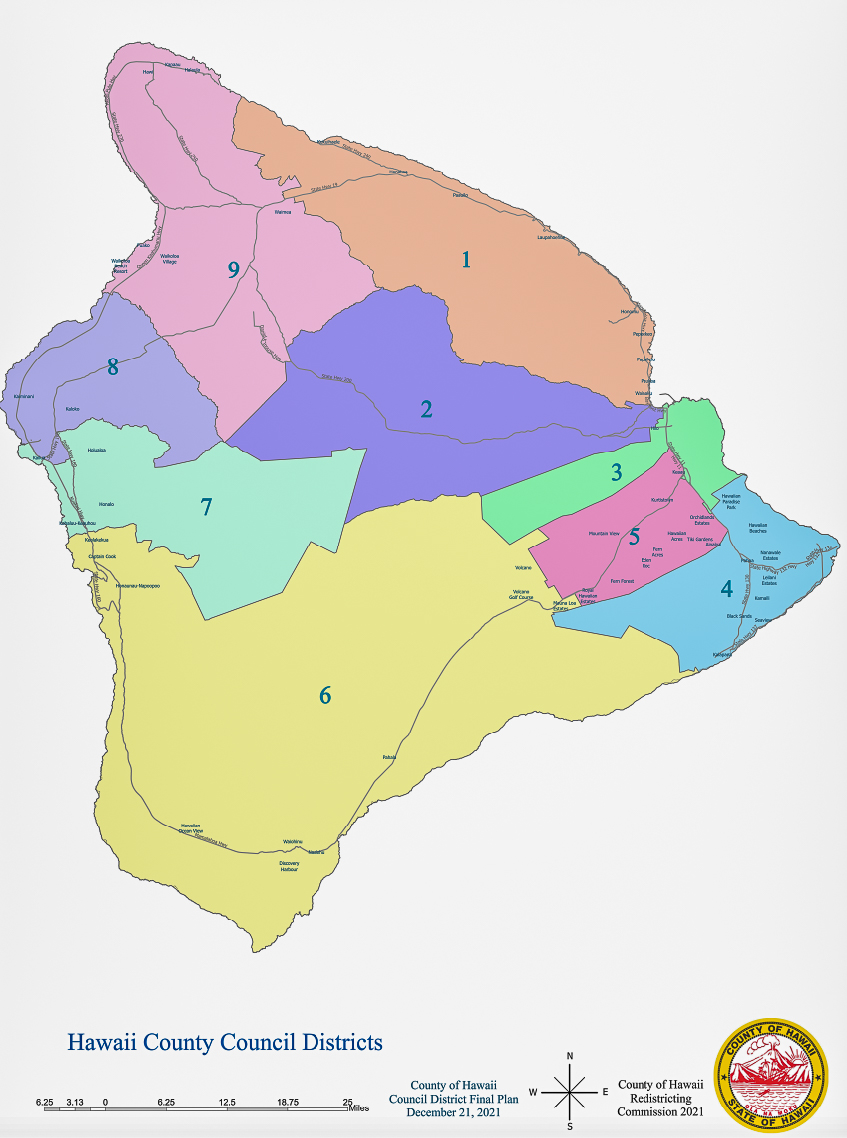
If a candidate receives 50% plus one of the vote in the primary, the candidate will win the race. If no candidate meets that threshold, the top two vote-getters head to a runoff in the November 3 general election.
For information about voting, click here.
Here’s a look at the candidates in alphabetical order:
Mark Henriques
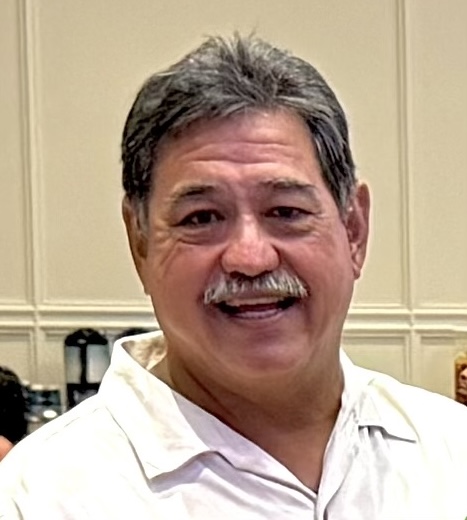
Henriques, 63, is a union electrician and fourth-generation resident of Hawai‘i Island. He said there is a lot of low-income housing available, but his daughter, who makes around $30 an hour, can’t afford a studio in Kona.
That drove him to think about concentrating affordable housing efforts on the middle-income residents of Hawai‘i Island. In addressing affordable housing for the middle class, he would like to see the return of Act 105, which was instituted by the Hawai‘i State Legislature in the 1970s to combat a housing crisis at that time.
Henriques explained someone, if they met the requirements in the act, could buy a home that was relatively inexpensive, but would be required to live in it for 10 years before they could sell it.
Henriques said he would stipulate that the home couldn’t be rented out during that time and the homeowner would have to be a current resident or born in Hawai‘i to participate in the program.
Henriques said he also is concerned about parks and gathering spaces in West Hawai‘i, specifically noting that the Kona Imin Center in Hōlualoa has sliding doors that haven’t opened for years. He also would like to tear down the pavilion at Kahalu‘u Beach Park.
“It’s just a rust bucket over there. It’s just terrible,” Henriques said, adding that the roof is rusted out and water from the ocean encroaches up on the corner of the pavilion.
Parking has been a hot topic in the Kona community after paid parking — which some people call predatory because of the high rates — came into Kailua Village in full force in 2019, causing business to decline.
For years, Villegas led attempts to address this issue. Earlier this year, a county bill she introduced that would put a cap on prices failed to pass.
But earlier this month, the Hawai‘i County Council unanimously passed an ordinance that requires operators of paid parking lots to clearly post their rates.
Villegas, along with Council Member Holeka Inaba, also drafted Bill 154, which is currently before Hawai‘i County’s Leeward Planning Commission. The legislation would prohibit the creation of any future paid parking lots in the county.
Henriques said he would like the county to buy the parking lot next to Hale Halawai and open it up to public parking and potentially pave the grass on the northside of the pavilion to add additional free stalls.
Henriques, who grows a handful of his own vegetables in raised beds at his home, would like to help families do the same to cut their grocery bills.
Edgar “Eddie” O. Ombac

Ombac, 59, has been in radio broadcasting for 30 years – most recently with Pacific Media Group’s KBIG-FM. (Pacific Media Group owns Big Island Now.)
He resigned from the station to run for County Council.
Ombac also is a branding specialist for Nutrex Hawai‘i, makers of bioastin and pure Hawaiian spirulina, where he promotes the microalgae product at running races, triathlons and other local events.
Ombac recently became a grandfather after his daughter Katrina gave birth to her first baby, Luca, on July 21, at Hilo Medical Center.
With Villegas terming out, Ombac said a friend who works in the county asked him if he ever thought about getting into politics, considering he is always at community events.
Ombac said his friend told him he would be a “good voice for the people.” He said that’s how he came up with his campaign’s slogan: “The People’s Voice.”
“We just got a hui (group) together, and started talking … and then it just snowballed from there,” Ombac said.
An avid athlete and supporter of triathlons and marathon races, including the Ironman World Championship, Ombac decided to run because he noticed a lot of overgrowth of elephant grass on county-maintained roads like Kuakini Highway used by cyclists and runners.
Ombac said it’s the county’s responsibility to ensure the areas are safe for athletes, walkers and families. He added there needs to be more park bathrooms, specifically citing Laupāhoehoe Beach Park, which currently has porta-potties on-site.
When he first started campaigning, Ombac was approached about fixing lights at Old Kona Airport Beach Park by the roller rink and the skate park.
But bigger issues for him include the need for attainable housing people can afford.
Ombac used his daughter, Skye, who has a master’s degree and works as an elementary school teacher, and her fiancé, an EMT, as an example. Although their combined incomes is more than $100,000, Ombac said there is still no way the pair an afford to buy a house in Kona.
“They could afford a condo, but they don’t want a condo,” Ombac said. “They want a starter home, a multifamily home to start a family.”
Ombac said he’s confident he could get people together, like realtors and developers, to figure out a way to create housing that kama‘aina can own.
Ombac supports lowering property taxes. He also has changed his mind on only allowing AirBnBs in tourist areas, saying that a lot of local families rely on renting out parts of their home to pay for their mortgage.
“I’ve met people that say that’s the only way they can afford a roof over their head is to be in that kind of situation,” Ombac said, adding he supports it as long as residents also are living on the property.
Ombac said the parking issue in Kona Village is a land-tax issue between the private lot owners and the county, but it needs to be solved: “I met one restaurant owner and he said it’s almost like the days of COVID. And that’s just sad and scary.”
Ombac, who also has a small mobile barbershop business, said he supports find parking solutions to get people to return to the business district.
Ombac also supports finding ways to address homelessness. After visiting Hope Services Hawai‘i and learning about the 808 Homeless Task Force and their work to find housing for those living on the streets and reunification of families, he said: “It’s a slow process. And those nonprofits could use more funding.”
Manu Powers
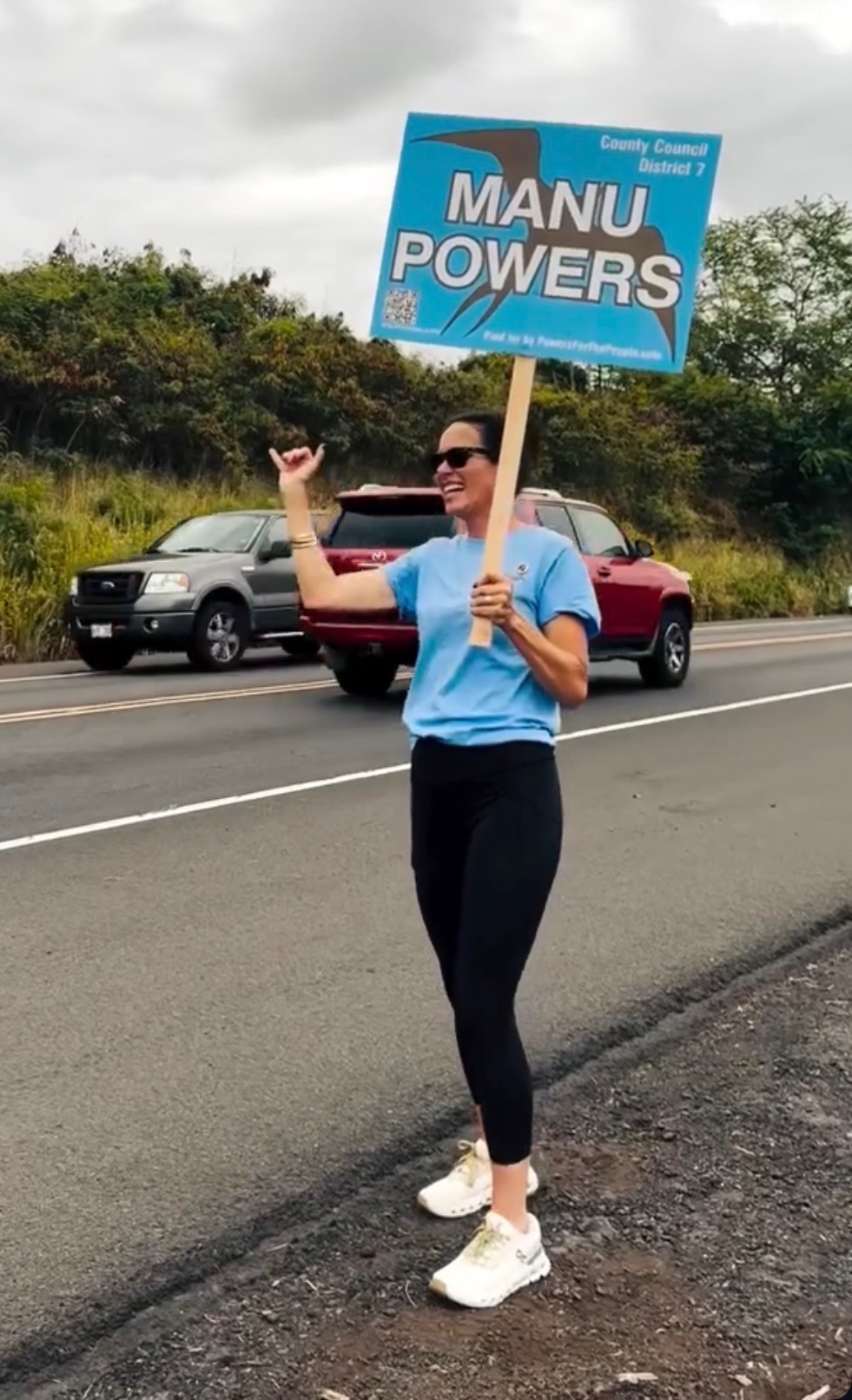
Powers, 50, was born and raised in Kalapana on the eastside of the island and graduated from Pāhoa High School. She is the co-owner and operator of the tour company Sequest Hawai‘i and the president of the Daughters of Hawai‘i, a volunteer organization that is responsible for maintaining the state’s royal palaces, including Hulihe‘e, the summer home of Hawai‘i Kingdom’s royalty, located on Ali‘i Drive.
Powers is running for council because she wants to keep kanaka (Native Hawaiians) and kama‘aina in Hawai‘i. She said there had been a lot of signs for her to run for council as she became more involved with community organizations by supporting nonprofits from the funder’s side.
She serves on the executive committee of the Healy Foundation, which was started by Cameron Healy, the founder of Kona Brewing Company, Kettle Chips and Pacific Biodiesel.
“Whenever he’d sell a company, he’d take the money and he’d put it into this fund,” she said. “And we, as the board, specifically now the executive committee, we deploy the funding into the community.”
After working on the foundation for the past five years, Powers said she’s realized there are large-scale, complex problems in the Kona District that have been kicked down the road for multiple reasons. She also realized there are organizations in the community already working on solutions.
“We need to really amplify those voices and invest in those groups and those people, and I realized that I had that unique perspective,” Powers said.
If elected, she would help accelerate that work on a government level and on a public-private partnership level.
She cited the Kealakehe Wastewater Treatment Facility and how it is out of compliance with the Clean Water Act.
Earthjustice filed a civil lawsuit in 2023 on behalf of the community group Hui Mālama Honokōhau accusing the county of violating federal laws by discharging treated sewage from its Kealakehe plant to waters around Honokōhau Bay through groundwater. While an agreement was reached last year to begin work in March this year to upgrade the facility, the county was forced to reopen a request for proposals after receiving a formal protest from Hensel Phelps, a construction company that applied for the contract but wasn’t awarded the job.
While keeping the island affordable for kama‘aina and kanaka for generations to come, she said: “We have to lock in what’s happening with our wastewater and what’s happening with our freshwater.”
“Everybody’s walking around saying we need affordable housing, we need affordable housing … but we will not be able to build more housing inventory, which is what is going to make housing affordable, unless we address our wastewater and our freshwater problems,” Powers said. “So we have to find ways to generate more freshwater, to treat wastewater, and how we view the system holistically.”
Powers said she also would tackle infrastructure issues, agriculture, workforce development, education and healthcare, working with organizations that have expertise in those topics.
Powers pointed to the Ulupono Initiative’s Wastewater Alternative Innovations project that is addressing wastewater and Hana Hou Recycling that is working on solid waste.
When it comes to parking in the village, Powers said she has felt the decline in visitors because Hulihe‘e is on Ali‘i Drive. While the Daughters of Hawai‘i is a nonprofit, the palace is based on admissions, donations and event rentals.
It’s even hit the older members of the nonprofit. When they plan gatherings, Powers said they call her and ask what they’re going to do about parking because they can’t carry their ukulele and chair from far away or pay the $15 to $20 an hour after the two free hours runs out.
Powers said she would vote for Bill 154, legislation that would prohibit the creation of any future paid parking lots in the county.
See previous Big Island Now election stories below:
Who is running for Hawai‘i County Council? 29 candidates meet Tuesday filing deadline