


Wave of ancient quasars from dawn of universe discovered by astronomers
Astronomers using W. M. Keck Observatory atop Mauna Kea on the Big Island confirmed two-thirds — or 21 of 31 — of the most ancient quasars identified by the European Space Agency’s Euclid mission, including two of the most distant ever observed.
Quasars — extremely luminous distant galactic cores powered by supermassive black holes — represent a brief phase in a galaxy’s life when large amounts of material spiral into the gargantuan black hole at its center, releasing enormous amounts of energy.
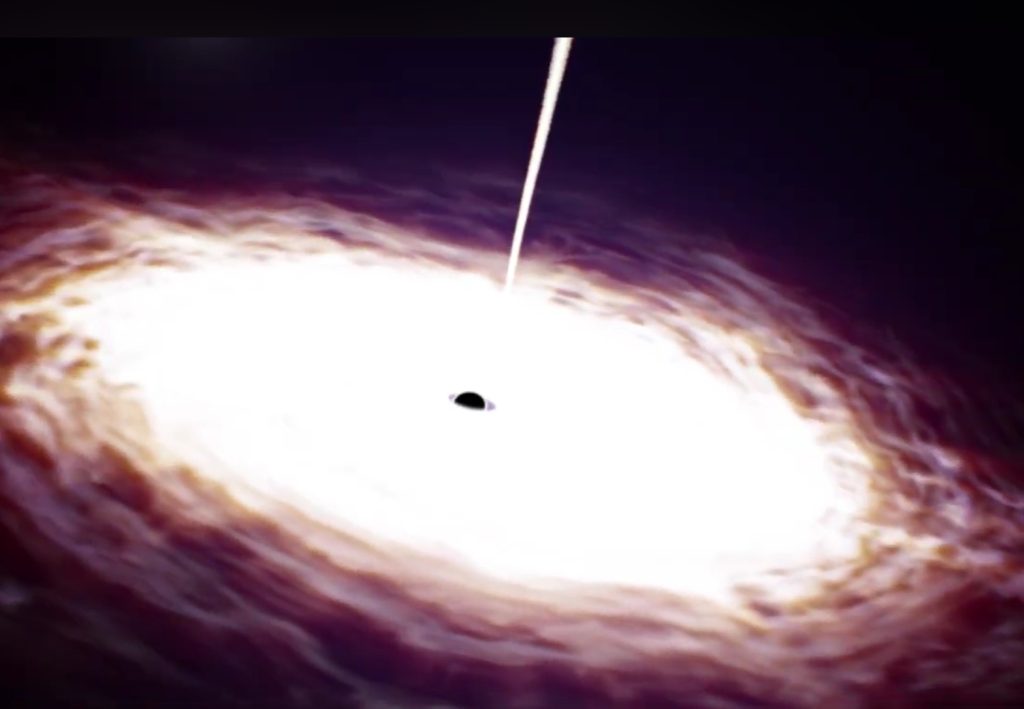
The galaxy’s core during this phase can become one of the brightest persistent sources in the universe.
These ancient celestial archives — hunted for decades by astronomers — reveal conditions in the earliest days of the cosmos, including how the first supermassive black holes and galaxies took shape.
But accessing them isn’t easy.
Quasars from this era are difficult to find. They are elusive, as few galaxies had time to grow large enough, and their light traveled for more than 13 billion years to reach Earth, arriving faint and stretched into infrared wavelengths where it can resemble nearby cool stars.
“We see these quasars as they were during the universe’s infancy,” said graduate student at Leiden University in the Netherlands and lead author of the new research Daming Yang in a W. M. Keck Observatory release. “By finding and studying them, we can better understand how these enormous systems formed and grew so quickly — one of the greatest mysteries in astrophysics.”
An international team in the Euclid consortium led the study, which was published in Astronomy & Astrophysics.
The 31 quasars reported were selected from the Euclid Wide Survey. More than one-third of the total sky will be covered by the survey once complete.
Confirming the promising identified ancient quasar candidates — which span redshifts from 6.5 and beyond — required follow-up spectroscopy.
That’s where W. M. Keck Observatory comes in to play.
Finding more and pushing farther into the early universe is extraordinarily challenging for several reasons, including their incredible faintness and very few galaxies that early in the universe’s history able to grow large enough to power them.
Then, that light had to travel 13-plus billion years to reach Earth, and during that vast journey it was stretched into infrared wavelengths that are invisible to traditional optical telescopes.
So detecting these ancient quasars requires a combination of highly sensitive instruments and light-gathering capability of the world’s largest ground-based telescopes, such as W. M. Keck.
The research team was able to cover a broad wavelength range using three of the Big Island observatory’s instruments:
- Multi-Object Spectrograph for Infrared Exploration.
- Low Resolution Imaging Spectrometer.
- Keck Cosmic Web Imager.
Astronomers analyzed light from more than 100 candidates in the northern sky, searching each one for a telltale signature — the sharp drop in brightness known as the Lyman-alpha break. This cutoff is imprinted by hydrogen gas that pervaded the early universe, absorbing a quasar’s light at specific wavelengths.
The precise location of that sharp drop in brightness confirms the object as a genuine quasar and pins down its distance.
Only a handful of quasars at redshift 7 or higher, corresponding to the first 770 million years after the Big Bang, were identified before Euclid, which has already uncovered 12 new quasars above redshift 7, more than doubling the known population.
Astronomers now for the first time have a large enough sample to study these ancient quasars not as individual curiosities but as a population, building the first statistical picture of how supermassive black holes formed and grew in the universe’s earliest epochs.
The two most ancient of the batch — EUCL J172902.75+641018.1 and EUCL J125308.55+705432.3 — have redshifts of 7.77 and 7.69, respectively, setting a new record for the most ancient quasars ever found.
Both are farther than 13 billion light-years away and emerged during the universe’s first 670 million years.
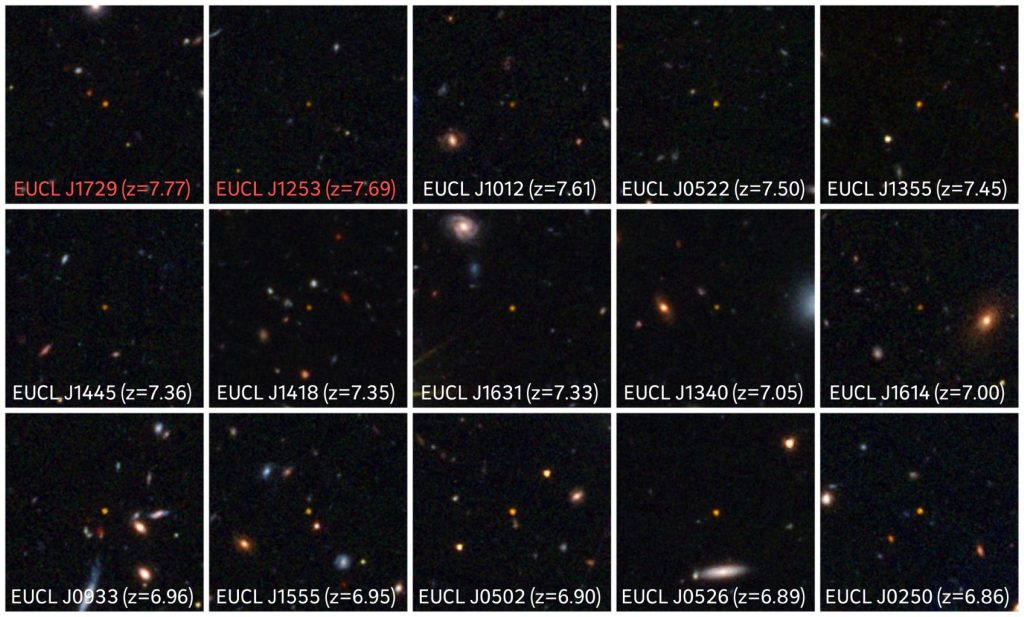
A multi-wavelength follow-up study of all high redshift quasars is underway, using a collection of ground and space-based telescopes. The research team is constructing a quasar chronicle that will trace how supermassive black holes and their host galaxies evolved during the first billion years of cosmic history — and how reionization unfolded.
“We can finally start answering the questions that were unanswerable before,” Yang said.
Probability of finding the first quasars beyond redshift 8 increases as the Euclid space telescope continues to scan the sky. A redshift 8 quasar would be shining when the universe was younger than about 630 million years old and place the strongest direct constraints yet on how early supermassive black holes could form and grow.
“Every one of these 31 quasars is a new sightline into the early universe, and the follow-up science is just beginning” added University of California, Santa Barbara, professor and study co-author Joseph Hennawi in the W. M. Keck Observatory release.