


Hawaiʻi County property tax rates set for upcoming 2026-27 fiscal year
The Hawai‘i County Council has adopted property tax rates for the upcoming fiscal year 2026-27 that include a 20-cent reduction per $1,000 of net taxable value for affordable rental housing and primary residences.
Resolution 574-26 passed with eight yes votes and one member absent during a special county meeting on Thursday, May 21.
The council also had first readings on the nearly $1 billion operating budget, and the capital budget. Both passed and will be heard for a second and final time on June 4.
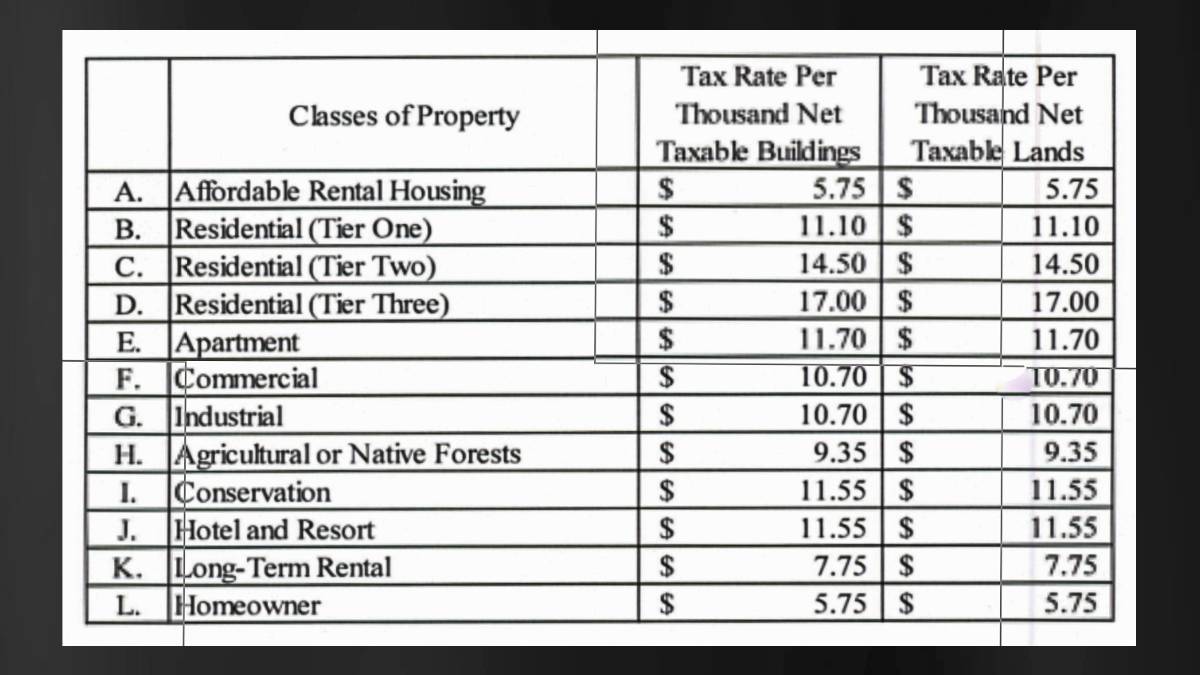
The property tax rate for affordable rental housing and primary residences will be lowered from $5.95 to $5.75 per $1,000.
The affordable rental program is meant to incentivize residents with housing to rent to people at a reduced cost. If the criteria are met by the homeowners in the program, the county provides the homeowner with a lower property tax rate.
The Tier Two tax rate now will cover second homes valued between $2 million and $4 million, with the first $2 million taxed the same as last year at $11.10, but the portion over $2 million will increase from $13.60 to $14.50.
The newly created tier three for second homes worth more than $4 million was set at $17 for portions over $4 million.
Additionally, the long-term rental tax rate classification was set at $7.75.
Council Members Jennifer Kagiwada and Michelle Galimba worked together in 2024 to introduce and pass Bill 104, which established a long-term rental tax classification for properties occupied under a lease for 6 consecutive months or more to the same tenant.
These rates are based on $1,000 of net valuation for buildings and land.
Hawai‘i County Council Member Holeka Inaba introduced Resolution 574-26 during Thursday’s special meeting, saying the reduction in the affordable rental and homeowner tax classes was intentional to help homeowners facing a potential 3% assessment increase due to rising property values.
With the new tier three and long-term rental tax rate, Inaba said the county is estimated to receive approximately $17 million in increased revenue.
Other rates include: $11.70 for apartments, $10.70 for commercial, $10.70 for industrial, $9.35 for agricultural or native forests, $11.55 for conservation and $11.55 for hotel and resort, which all are the same as the current fiscal year.
Inaba told his colleagues he thinks what’s before the council is a balanced approach that takes care of homeowners.
Mayor Kimo Alameda’s proposed Hawaiʻi County operating budget (Bill 135) asked for a 1.4% increase of $13.47 million to fund priorities that include public safety, infrastructure and recreation.
Alameda’s proposed capital budget (Bill 136) is $358.7 million, of which $42 million is intended to be funded by federal grants, $23 million by state funding and $8.5 million with private money.
During Thursday’s meeting, council members took the opportunity to talk with different department heads to ask about specific funding positions or projects.
Hawai‘i County Council Member James Hustace asked Deputy Chief Sherry Bird about the increased monthly car allowance for police officers.
Bird said those conversations are still ongoing, but the goal is to raise the rate from approximately $600 to $800.
“Our officers are required to get vehicles in which a subsidy is paid,” Bird said, adding the proposed increase is consistent with other counties.
Council Member Matthew Kaneali‘i-Kleinfelder asked about repairs to the 21 transfer stations throughout Hawai‘i County.
Craig Kawaguchi, Deputy Director of Environmental Management, said the county tries to do repairs one or two a year and noted there is funding in the Capital Improvement Projects budget of $2 million for station rehabilitation.
Read more about previous budget stories below:
- Hawai‘i County Council begins budget discussions for upcoming fiscal year
- This is what Hawaiʻi County public safety departments proposed for their new budgets
- Hawaiʻi County Department of Environmental Management outlines its budget for council
- Hawai‘i County proposed budget bills move forward; first readings in May