


Episode 47 of the Kīlauea eruption ended early Friday morning
UPDATE May 15, 6:45 a.m.:
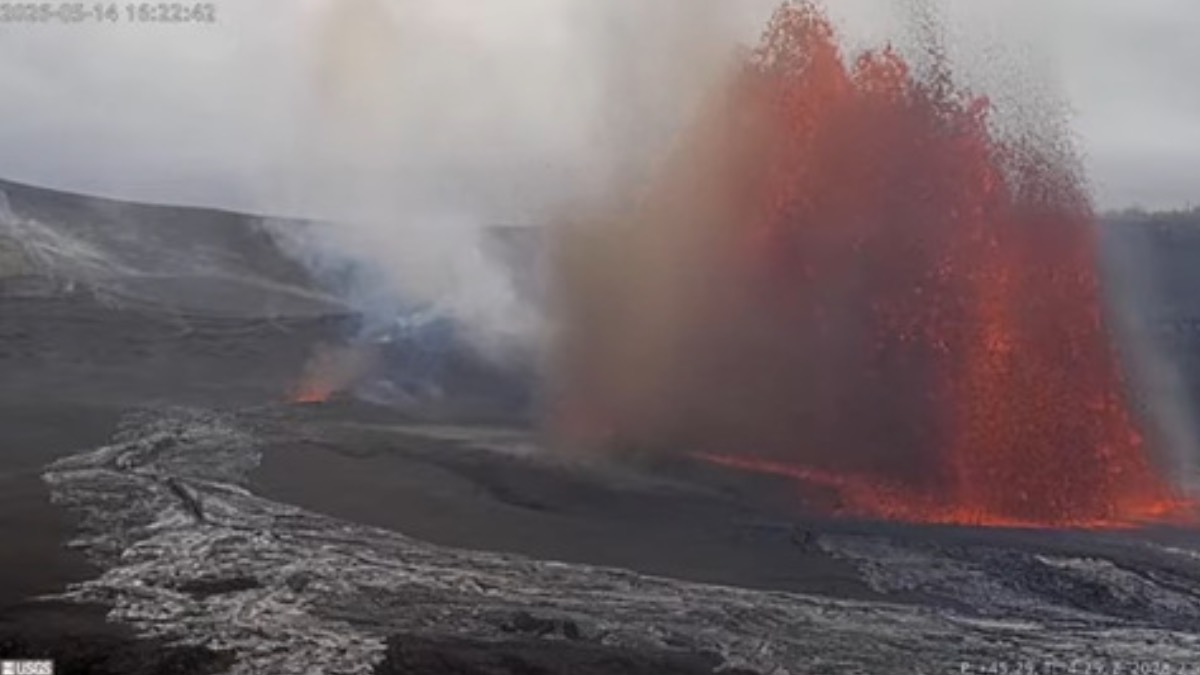
Episode 47 of the ongoing eruption at Kīlauea summit ended abruptly at 12:27 a.m. on Friday, May 15, after 9 hours of continuous lava fountaining from the north vent, according to the Hawaiian Volcano Observatory.
Most tephra (volcanic debris) fell within the closed area of Hawaiʻi Volcanoes National Park, but sparse particles up to 3 inches in size fell at both the Uēkahuna and Keanakākoʻi overlooks.
Fine ash and Peleʻs hair fell outside Hawaiʻi Volcanoes National Park in communities to the northeast, including Mauna Loa Estates, ʻŌhiʻa Estates, Volcano village and Royal Hawaiian Estates.
The last minute of this episode was marked by strong gas jetting and large flames from both eruptive vents that continued after the eruption ended. The south vent never fountained during this episode, but it periodically spattered in the early hours of north vent activity.
The instantaneous effusion rate peaked somewhere between 360 and 390 cubic yards per second around 5 p.m. Thursday. An estimated 6.8 million cubic yards of lava erupted and covered about 30 to 40% of the Halemaʻumaʻu crater floor.
This episode of spewing lava began about 3:30 p.m. on Thursday with fountaining from the north vent in Halema’uma’u crater.
The eruption began with low-level fountaining observed shortly afterward, officials said.
The Hawaiian Volcano Observatory reported that the north vent was the primary source of fountaining, while the south vent had intermittent overflows.
Information from original post:
Trade winds blowing from the northeast are expected to carry volcanic gas emissions, fine ash, and Pele’s hair toward areas southwest of the summit, including portions of Ka’ū. Residents in downwind communities may experience elevated gas levels and falling volcanic material and are advised to reduce exposure and take proper precautions.
Officials added that tephra, including volcanic ash, is most heavily concentrated within three miles of the eruptic vents, although lighter ash asn Pele’s hair may travel greater distances.
There are currently no reported road closures.
Three Kīlauea summit livestream videos that show eruptive lava fountains are available here: https://www.youtube.com/@usgs/streams
Summit eruption webcams: https://www.usgs.gov/volcanoes/kilauea/summit-webcams
Learn more about gas pistons in a Volcano Watch article here: https://www.usgs.gov/observatories/hvo/news/volcano-watch-so-what-earth-or-least-kilauea-a-gas-piston