


Volcano Watch: Kīlauea summit eruptions outside Halemaʻumaʻu Crater
Volcano Watch is a weekly article and activity update written by U.S. Geological Survey Hawaiian Volcano Observatory scientists and affiliates.
We are used to seeing eruptions from the summit region of Kīlauea contained to the region referred to as Halemaʻumaʻu.
Halemaʻumaʻu Crater, home of ancient Hawaiian lava and volcano goddess Pele, is situated within larger, steep-walled Kaluapele, the caldera at the summit of Kīlauea. While eruptions at the summit most frequently occur within Halemaʻumaʻu, they can occur outside the modern caldera as well.
Kīlauea summit eruptions in the past several decades have been confined to Halemaʻumaʻu.
Starting in 2008, a decade-long lava lake formed within Halemaʻumaʻu that drained during the 2018 caldera collapse. This was replaced for a year and a half by a water lake, which in turn was destroyed during the December 2020 eruption, and since then there have been multiple Halemaʻumaʻu eruptions of which the ongoing lava fountaining just reached Episode 45 on April 23.
But further back in time, many eruptions at Kīlauea’s summit occurred outside Halemaʻumaʻu.
The earliest written documentation of summit eruptions outside the caldera occurred in 1832 and 1868, both of which were to the east of Kaluapele.
The best documented and observed summit eruption to not occur within Halemaʻumaʻu is the episodic lava fountaining eruption in 1959 at Kīlauea Iki that formed Puʻupuaʻi — the prominent cone visible from Devastation Trail. This eruption occurred to the east of the Kaluapele boundary, and was the subject of a Jan. 6 “Volcano Watch.”
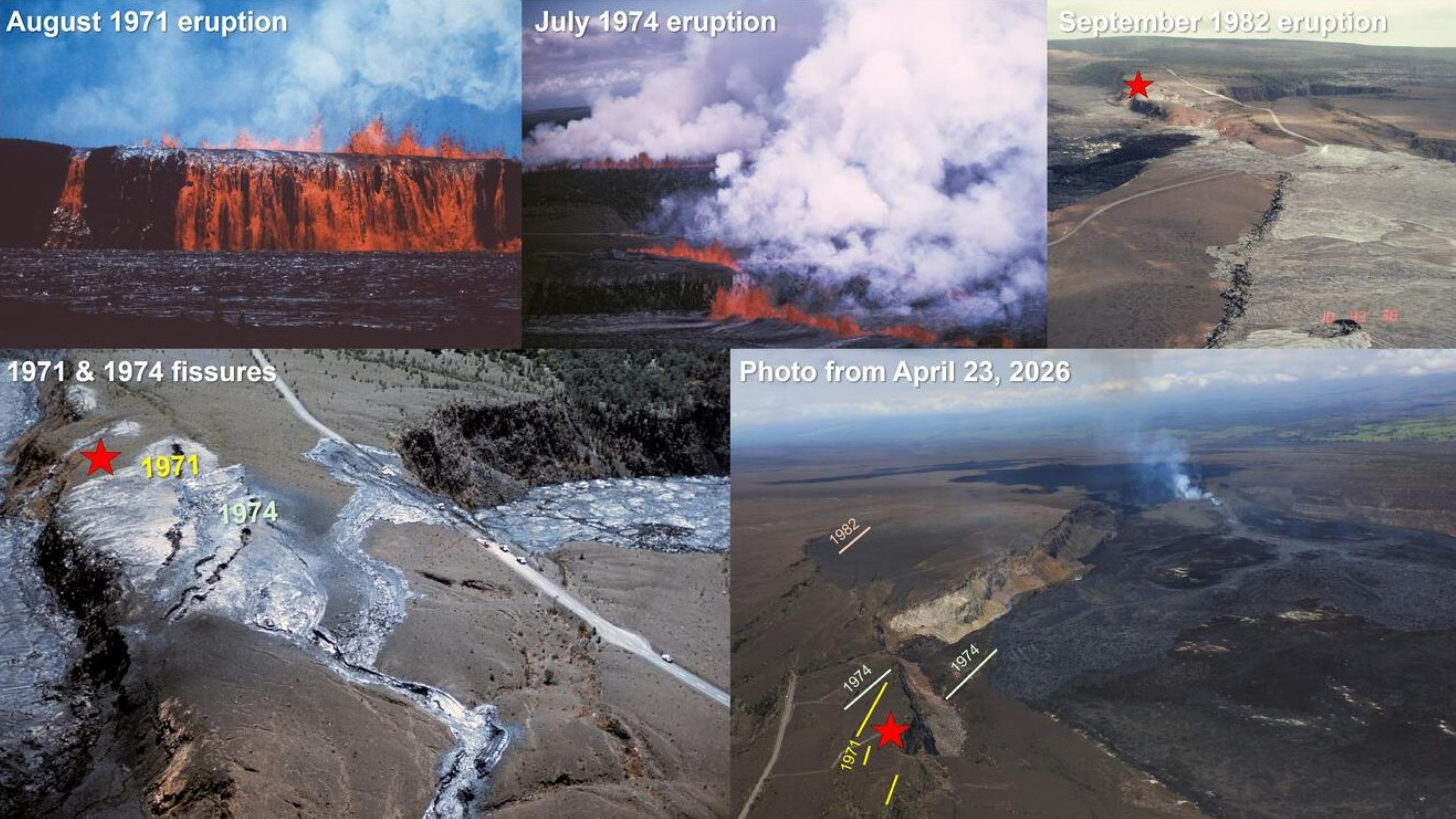
Eruptions in August 1971, July 1974 and September 1982 occurred south of the caldera rim. In fact, for those familiar with the Keanakākoʻi overlook that provides spectacular viewing of the ongoing episodic lava fountaining events, spatter and lava that erupted from the fissure systems during the August 1971 and July 1974 eruptions are right at this location.
Hawaiʻi Volcanoes National Park has interpretative signs here that date back to when Crater Rim Drive in this area was still open to motorists.
The Aug. 14, 1971, eruption near Keanakākoʻi lasted for about 10 hours and its lava flow cascaded over the caldera rim and flowed to below Volcano House. The July 19-22, 1974, eruption lava flows also cascaded over the caldera rim before solidifying below Volcano House.
However, a lobe of this lava flow also cascaded into the bottom of Keanakākoʻi Crater and continued to flow farther south and east before the eruption ceased.
The Sept. 25, 1982, eruption lasted for about 15 hours. This eruption’s fissure system is located in the south caldera region about a mile from the Keanakākoʻi overlook within a part of the national park that is closed as a result of the high volcanic hazard.
Its associated lava flow reaches to within 700 yards of the Keanakākoʻi overlook, but is also within the closed, high hazard part of the national park; this lava flow also cascaded over the caldera rim.
Each of the fissure systems that fed these eruptions spanned hundreds of yards, with lava fountains themselves remaining relatively low. Portions of both fissures from the August 1971 and July 1974 eruptions were lowered along with the caldera floor during the 2018 collapse.
Despite subsiding, these fissures remained relatively intact. However, the recent lava fountaining episodes that started Dec. 23, 2024, continue to generate lava flows that cover this area intermittently. This resulted in new lava flows completely covering the August 1971 fissure and portions of the July 1974 fissure on the crater floor.
The remaining parts of the August 1971 and July 1974 fissures and their associated lava flows are visible around the Keanakākoʻi viewing area, with interpretative signs along the trail on the side of the road opposite of Keanakākoʻi Crater.
These past eruptions outside Halemaʻumaʻu are evidence that such eruptions could also occur in the future.
Most eruptions in new locations are preceded by an increase in shallow seismicity related to magma movement. While not analogous to the precursory seismic activity from the 1970s and 1980s, there has been recent shallow earthquake activity and ground deformation along the south rim of Halemaʻumaʻu — highlighted in an April 23 “Volcano Watch.”
The ongoing earthquakes beneath Kīlauea’s summit are not indicative of an imminent eruption along the south rim of Halemaʻumaʻu, but they are a reminder that the area is dynamic and can experience a variety of volcanic hazards.
Hawaiian Volcano Observatory continues to closely monitor Kīlauea — a very active volcano, where changes can occur quickly throughout the summit region and beyond.
VOLCANO ACTIVITY UPDATES
KĪLAUEA volcano
VOLCANO ALERT LEVEL: Advisory
Kīlauea has erupted episodically since Dec. 23, 2024, within the summit caldera. Episode 45 of summit lava fountaining happened throughout 8.5 hours April 23. No unusual activity has been noted along Kīlauea’s East Rift Zone or Southwest Rift Zone.
WHAT’S NEXT: Summit region inflation since the end of Episode 45 indicates another fountaining episode is possible; current models suggest Episode 46 could start between Tuesday, May 5, and Saturday, May 9.
MAUNA LOA volcano
VOLCANO ALERT LEVEL: Normal
Mauna Loa is not erupting. Read more about the current status of Mauna Loa at the Hawaiian Volcano Observatory website.
Hawaiian Volcano Observatory continues to closely monitor Kīlauea and Mauna Loa.
EARTHQUAKES
One earthquake was reported felt in the Hawaiian Islands during the past week:
- MAGNITUDE-3.5 earthquake at 9:26 a.m. located west-southwest of Pāhala at a depth of 19 miles.
Visit the Hawaiian Volcano Observatory website for past “Volcano Watch” articles, Kīlauea and Mauna Loa updates, volcano photos, maps, recent earthquake information and more. Email questions to askHVO@usgs.gov.