



Hawaiʻi Transportation Department updating master plan for Kona airport

When the Ellison Onizuka Kona International Airport was built in 1970, it only served interisland travel. Over the decades, travel to and from the Big Island has grown, with 4.1 million passengers arriving and departing at the airport in 2025.
Now, the Hawai‘i Department of Transportation is in the midst of a 20-year update of the airport master plan that will take into account the Federal Aviation Administration’s forecasted aviation growth of 1 million more passengers arriving and 1 million more passengers departing the airport by 2044.
The work on the updated plan, which began in January 2025, could include a potential second runway, a hotel and a training center for airport firefighters.
Within the framework of the plan are eight key objectives that include:
- Identifying measures to enhance safety for both fixed-wing and rotary-wing activities at the airport.
- Evaluating travel paths, improving wayfinding, and modernizing the terminal with enhanced amenities while preserving the airport’s unique feel and sense of place.
- Integrating a second “right-sized” runway into the airport’s airside infrastructure to boost resiliency, operational capacity and efficiency.
- Enhancing landside connectivity by providing additional airport access, reducing congestion and improving traffic flow.
- Ensuring a reliable supply of power and jet fuel to support future airport operations.
- Pursuing the development of airport lands and facilities in accordance with grant assurances, leveraging non-aeronautical developments (e.g., hotels and commercial buildings) to generate additional revenue.
- Creating a phased implementation plan that prioritizes key projects while balancing long-term goals, near-term plans (i.e., terminal Improvements), cost-effectiveness and funding availability.
- Ensuring the master plan supplements the regional development goals illustrated in the Kona Community Development Plan, reflecting community values and priorities through effective stakeholder engagement.
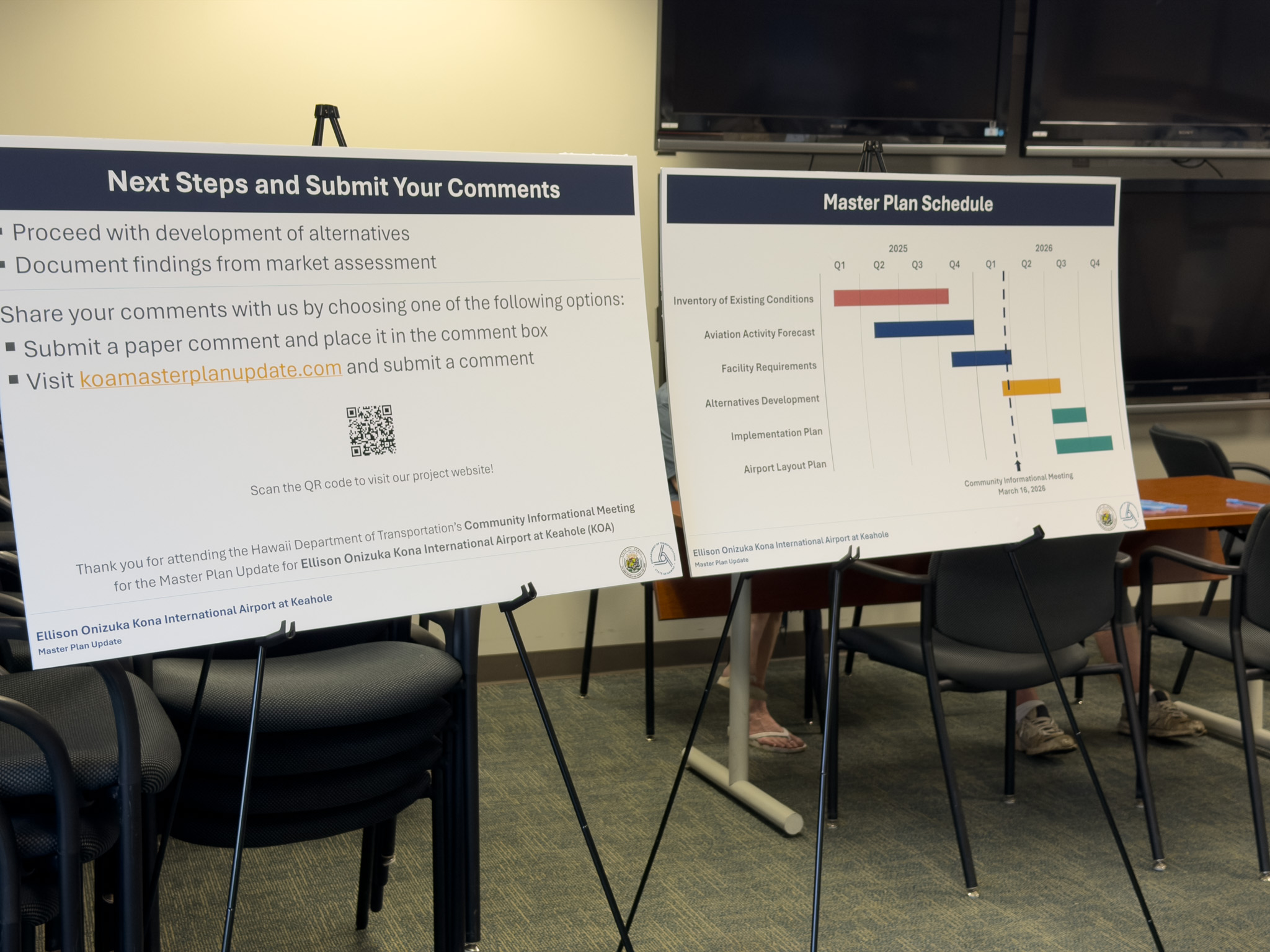
The work on the updated Kona airport plan was presented during the second public meeting on Monday at the West Hawai‘i Civic Center. There will be more community meetings with the final updated plan expected to be completed in November.
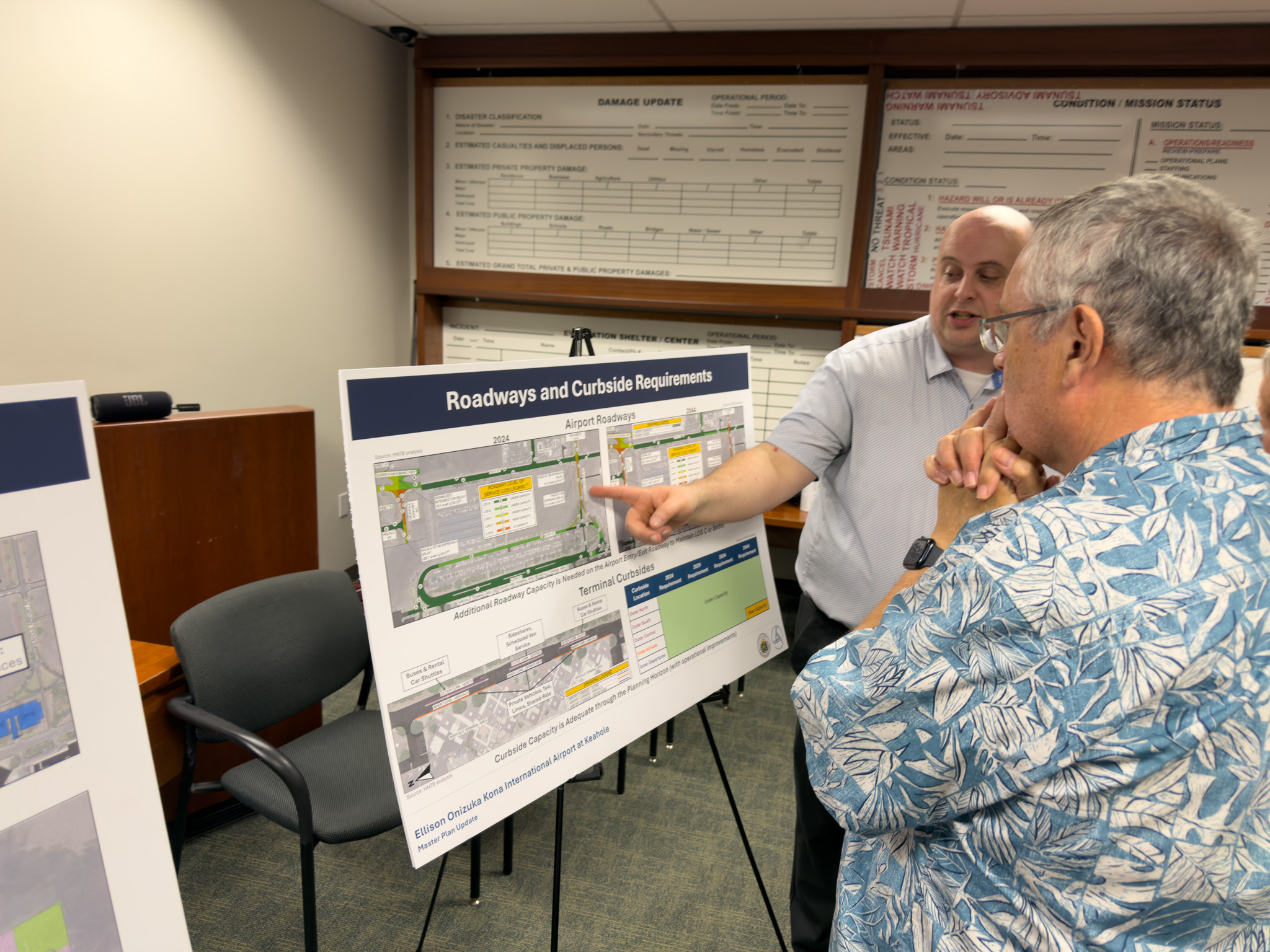
Poster boards were set up detailing the current capacity of the space, parking and the roadways.
Curt Otaguro, deputy director for the Hawai‘i Department of Transportation, and members of the project’s consulting firm HNTB, were at the meeting to answer questions.
The Kona airport occupies 4,200 acres of land about seven miles northwest of Kailua-Kona on the island of Hawaii at an elevation of 47 feet with a 11,00-foot runway. The airport accommodates domestic, overseas, international, interisland, commuter/air taxi and general aviation activities.
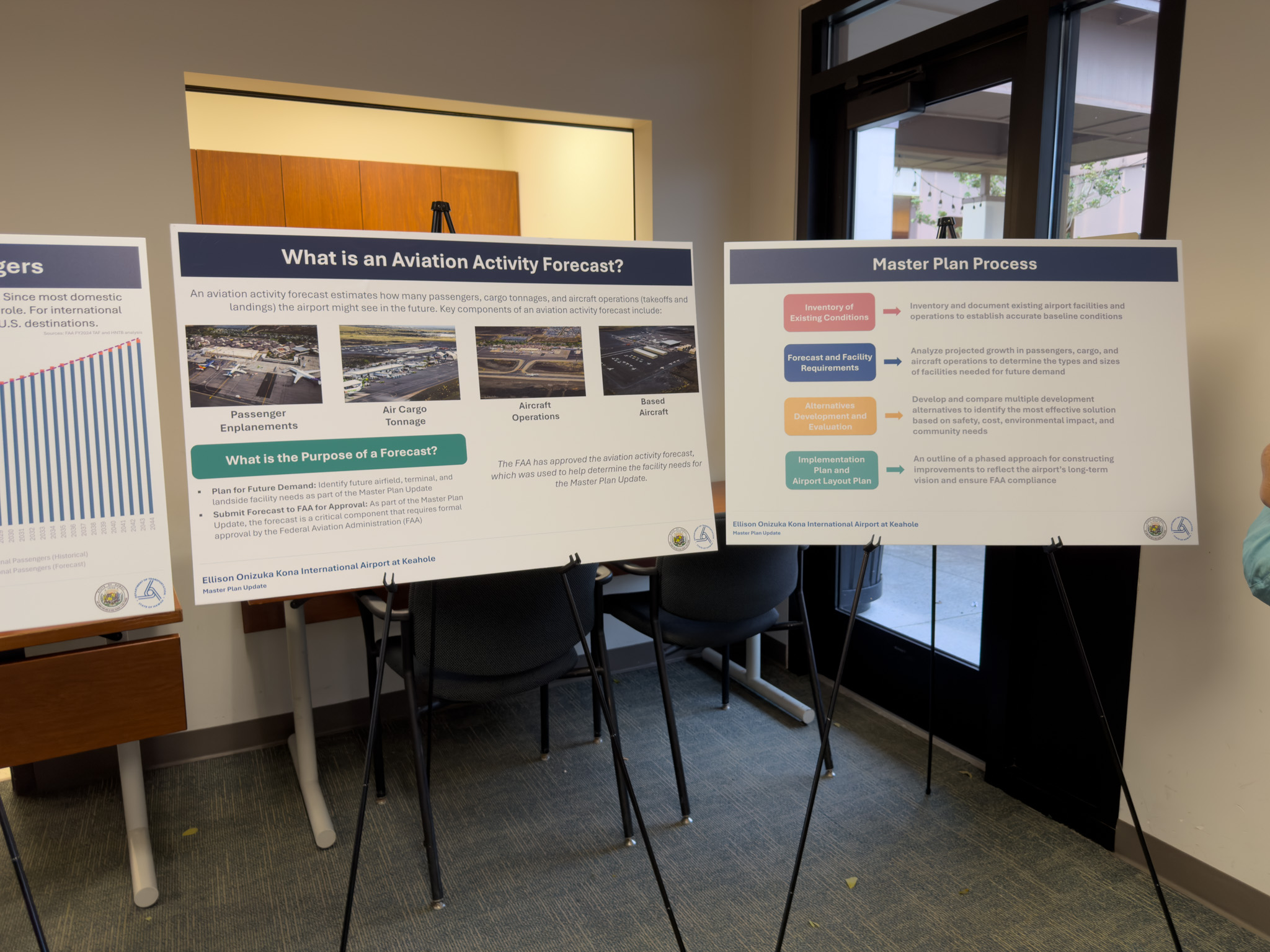
“Outside of COVID, Kona has had moderate and manageable growth,” Otaguro said.
The master plan process establishes a framework for the airport’s future development and ensures that the state has ample infrastructure and facilities to align with the projected aviation demand.
“We also want to invest with our landside facilities within the terminal to help streamline security screening, baggage claim and more comfortable hold room/gate seating,” Otaguro said. “We are working with our food and beverage concessionaire to add additional dining options.”
For the past 12 months, there were 38,384 flights in and out of KOA. The breakdown of the flights departing Kona:
- Domestic: 6,614 (34.5%)
- Interisland: 12,376 (64.4%)
- International: 202 (01.1%). They were primarily flights to Canada.
The Department of Transportation will put a plan together, incorporating community feedback. That plan will be presented to the FAA to review and conduct required sound and environmental assessment studies.
“We’re not going to overbuild something, but we certainly want to make sure that what we do will support the needs of this community,” Otaguro said. “We will not do anything underhanded or behind the back. It will come down to prioritizing the most critical needs and aligning them with the availability of funding.”
At the meeting, Cindy Freitas, a Kona resident and Native Hawaiian, gave state officials a typed three-page document outlining her opposition to growth at the airport.
Freitas said increased tourism capacity without safeguards may exacerbate housing shortages, increase the cost of living and burden infrastructure.
Freitas said expanding the airport for increased tourism may conflict with the state’s obligation to protect finite resources such as land, water and shoreline access.
Also, the area where the airport is built is the resting place for Native Hawaiians.
“Any failure to engage Native Hawaiian practitioners early and substantively may invalidate approvals,” Freitas stated.
Others who attended weren’t opposed to growth but were concerned about the community not having a voice and the possibility of more noise that could come with more flights.
“If what this island needs is more growth, fantastic,” said Kona resident Landon Marsh. “But it needs to be a coordinated effort between the FAA, ground operations and the community.”
Kona resident Stoney Gamble said with a lack of extensive medical facilities and doctors on the Big Island, he supports growth that would help in other facets of the community.
“We know too many people in just the four years we’ve lived here that have had to sell their homes, move back to the mainland, because they’ve been diagnosed with an illness that cannot be accommodated here,” Gamble said. “So we’re good for the growth because that in and of itself should bring more vets, more health care, more, you know, things that make the world go round.”
Scott Reagan, who owns a local company that does architectural fabrication and hydraulic hangar doors, said: “We could be useful in the growth of the airport and the facilities there.”
Reagan said he’s noticed a lot of growth in higher-end tourism and tourism volume in general.
“It’s great to feel that we have an ecosystem here in Hawai‘i that can support that growth between vendors and suppliers, designers, facilities, management, things like that,” Reagan said. “It looks like a good plan, and we hope to be more a part of it.”
Reagan added that there’s always going to be people who want to keep things quiet and simple, and those who want things to grow.
“I think if we want more of the youth to be able to stay here and be able to prosper in the future, we need to look at supporting that growth, supporting younger folks in being able to have jobs, have lives, be able to travel in and out, tourism,” Reagan said. “Until we can really grow the agricultural side of the island, we still have to rely a lot on tourism.”
A third community meeting will take place later this year. Click here to see the master plan update process. Click here to provide feedback.
Sponsored Content

_1770333123096.webp)

Subscribe to our Newsletter
Comments