



Hawai‘i County Council passes bill banning feeding of feral animals on county property
Feeding feral animals, including cats, pigs, chickens and goats, will now be illegal on Hawaiʻi County property.
The Hawai‘i County Council passed the third draft of Bill 51 by a 6-2 vote that includes a $50 fine for the first violation and $500 for additional violations of the ban.
Councilmembers Jennifer Kagiwada and Ashley Kierkiewicz opposing the measure. Councilmember Michelle Galimba was absent.
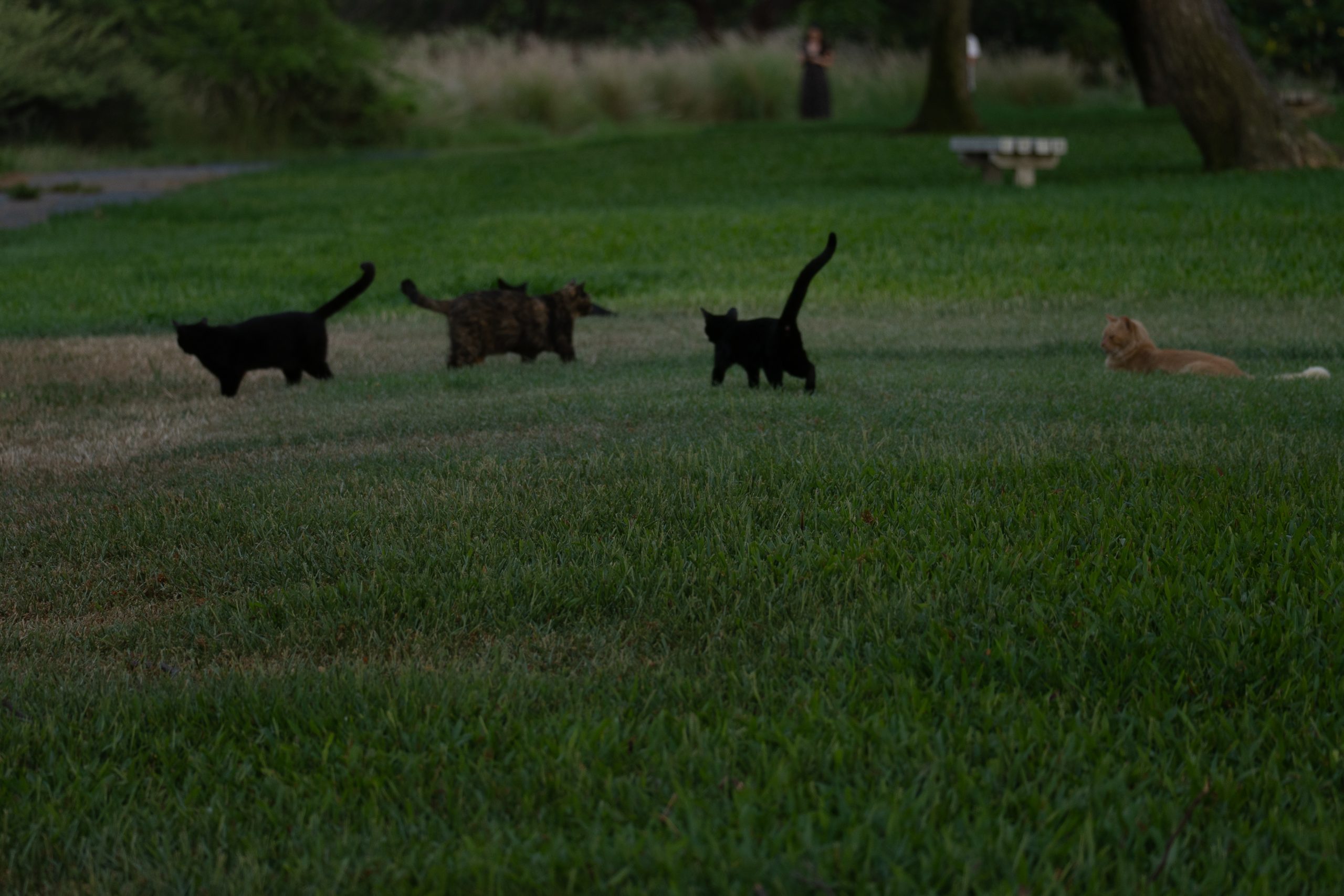
The bill passed without the proposed amendments that were initially approved during its first reading on the July 23 council meeting, which allowed the feeding of feral cats if they were certified cat takers approved by animal control. The amendment also included a plan to incorporate a certified community cat taker program.
The amendments were stricken from the final draft on Wednesday after councilmembers met with Hawai‘i County’s Corporation Counsel during an executive session after receiving a memo that challenged the legality of the bill’s amendments.
It wasn’t clear who the memo was from or its contents.
“By creating a program, which we were calling the Certified Community Cat Taker Program, we do run the risk of being outside of what is allowable under federal and state law,” said Councilmember Matt Kaneali‘i-Kleinfelder, the maker of the bill.
Kaneali‘i-Kleinfelder said the purpose of the bill was to address ways to lessen the impacts on Hawai‘i’s indigenous species and address the health and safety of the community in public spaces.
“After seven years of sitting in this chair, I have realized that when we decide to get ultra-specific and make things incredibly complex in our code language, we actually create more problems than we mean to,” Kaneali‘i-Kleinfelder said.
The bill also doesn’t stop people from continuing to run a trap, neuter and return program.
“This bill does not and isn’t centered solely around cats,” Kaneali‘i-Kleinfelder said. “They are part of feral animals, but the bill doesn’t say cats.”
Kaneali‘i-Kleinfelder believed the best thing to do was to return to the original form of the bill.
Councilmember Heather Kimball made a motion to postpone the bill, asking for the opportunity to work on it.
“I fundamentally believe, as drafted, this will not be successful,” Kimball said.
In past discussions, Kimball, along with Kagiwada, expressed concern over enforcement of the bill.
“We have laws on the books for abandonment that are not enforced,” Kimball said, adding the measure, which is difficult to enforce, will create nuisance calls to police that will ultimately not be responded to.
Testifiers for and against the measure once again came out in full force to voice their opinions on this controversial bill.
People on both sides asked to postpone the bill to iron out amendments, with one stating that community support is vital for the success of the measure.
“We’ve got a problem with cats, for sure,” one testifier stated. “I think Bill 51 is simplistic, hasn’t been thought through, and I think we could come up with something better.”
The testifier asked the council to reassess the measure, do research where other areas have dealt with this issue and come back with better solutions.
“You don’t build a better island by letting animals starve on county property,” one testifier stated during council meeting. “Neutering cats is obviously the most humane way to deal with the cats.”
A recent graduate from University of Hawai‘i at Hilo, who now works in conservation, testified in support of the bill, saying feral cats have gotten out of control.
The graduate stated that cat feces is the source of toxoplasmosis, a parasitic disease, which can cause illness to humans and even death in Hawaiian monk seals and was recently attributed to the death of a nēnē gosling at Lili‘uokalani Gardens and Park in Hilo in August 2024.
“We can’t leave the most vulnerable out to dry,” she said.
The graduate asked the council to pass the bill without the recent amendment that would designate community cat feeders and a trap, neuter, release program.
“Neutered cats can still kill,” she stated, adding the amendment undermines the intent of the bill.
Sponsored Content


Subscribe to our Newsletter
Comments