



Bill banning feeding of feral animals on Hawai‘i County property passes first reading
The Hawai‘i County Council, after two hours of emotional testimony, passed the first reading of a controversial bill that would make it illegal to feed feral or stray animals on county property.
During the Wednesday meeting at the West Hawai‘i Civic Center, councilmembers voted 5-2 to move forward Bill 51, with amendments. Councilmembers James Hustace and Dennis “Fresh” Onishi opposed the bill. Matt Kaneali‘i-Kleinfelder, who introduced the measure, and Holeka Inaba were absent.
There were 454 written testimonies against the bill and 25 written testimonies supporting it. Councilmember Rebecca Villegas also said she and her colleagues received more than 1,900 emails opposing the measure.
The bill will have its second and final reading during the Aug. 6 council meeting in Hilo.
If passed, someone caught feeding feral animals, including cats, pigs, chickens and goats, could face a fine of $50 for the first violation and $500 for additional violations.
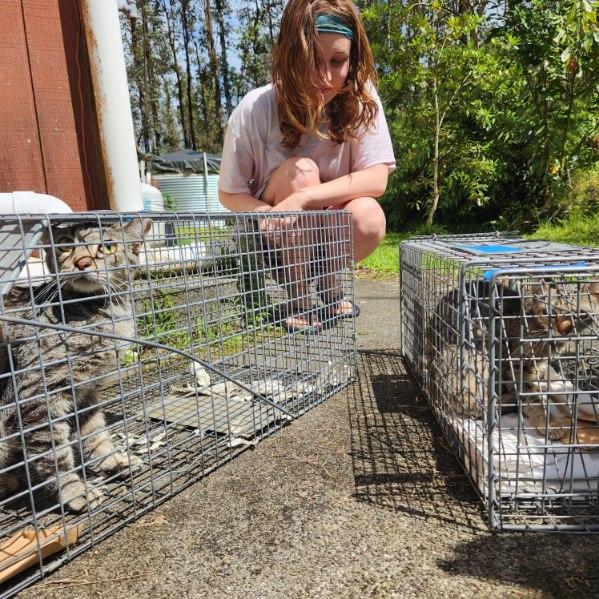
The Council on Wednesday approved an amendment made by Councilmember Heather Kimball that would require the county to implement a trap, neuter, release and management program in collaboration with Aloha Animal Alliance and Hawai‘i County Animal Control and Protection Agency to train specific individuals to be cat caretakers.
The Council approved another amendment, made by Councilmember Jennifer Kagiwada, that would set a specific time for when that program would begin. A time was not set.
“It comes down to a community approach rather than individuals and groups doing things on their own,” Matt Runnells, director of the county’s Animal Control, said after the meeting.
Villegas said she was pleased the amendment provided more specificity. However, she doesn’t like the “return” aspect of the proposed pilot program, referring to releasing the cats back to their colony on county land after they are fixed.
However, Villegas added that she didn’t want the program to become a loophole.
Villegas said domesticated cats are beautiful creatures, but, once again, this issue is about an imbalance in the ecosystem, which is causing problems.
Addressing the large number of people in opposition to the bill, she emphasized the bill does not ban the feeding of feral cats.
“It bans feeding of feral animals on county property,” she said.
Kimball said the program is not meant to create a loophole but to provide specific and targeted language about the management of the colonies on county land.
Onishi reiterated that this bill is not banning all feeding and said he wants to discuss how the county can create a sanctuary to help those who are abandoning cats in public places.
During a previous committee meeting, County Parks and Recreation Director Clayton Honma said feral animals are a problem at many county facilities.
He said there are about 600 cats in and around Lili‘uokalani Gardens, but other types of animals also cause havoc.
“It’s chickens and pigs tearing up our ballfields in county parks,” Honma said at the committee meeting. “We have issues everywhere.”
At one park, Honma said a sand pit meant for beach volleyball can’t be used because it’s been a feral pig “litterbox” for years.
But public testimony during Wednesday’s meeting was overwhelmingly opposed to the bill.
One testifier described the measure as a deceptive and evil edict designed to break the human spirit.
“Some of these cats will starve and those that hunt will increase the transmission of toxoplasmosis,” another testifier stated. “We can’t let injured cats suffer in public spaces. Please give us the time and money to support this work.”
Toxoplasmosis is a parasitic disease found in cat fecal matter and is known to be deadly to Hawaiian monk seals and confirmed to be the culprit in the death of a nēnē gosling found in Lili‘uokalani Gardens and Park in Hilo in August 2024.
The cause of death was confirmed in a necropsy performed by the National Wildlife Health Center.
Another testifier said he had to “speak up for these ladies,” referring to the volunteers who feed and water the felines. “You’re turning these women into criminals and enemies of the county.”
Another testifier, who identified herself as a kanaka, supported the bill, saying feeding feral cats on state property in Hawaiʻi is so damaging to the native manu (birds).
“While some may feed cats as an act of compassion, doing so on our state lands causes irreversible harm to our manu,” the testifier stated. “We ask that those who come here to live in our ʻāina also respect the voices of Kanaka Maoli rather than impose outside values that conflict with the needs of our ʻāina and our unique species here in Hawaiʻi. We are not anti-cat, we are pro-ʻāina.”
Sponsored Content

_1770333123096.webp)

Subscribe to our Newsletter
Comments