


Sea Dragon Energy comes to Kona’s technology park to turn seawater into jet fuel
"I would wager that just about everyone here, when they first heard it, said it must be the craziest idea ever," said John Kohut, chairman and CEO of the energy company operating on the Big Island. "I know I did when I first heard it."
Seawater to jet fuel?
It sounds like science fiction, but the leader of an energy company operating on the Big Island said this idea could soon become a reality.
“I would wager that just about everyone here, when they first heard it, said it must be the craziest idea ever,” said John Kohut, chairman and CEO of Sea Dragon Energy. “I know I did when I first heard it.”
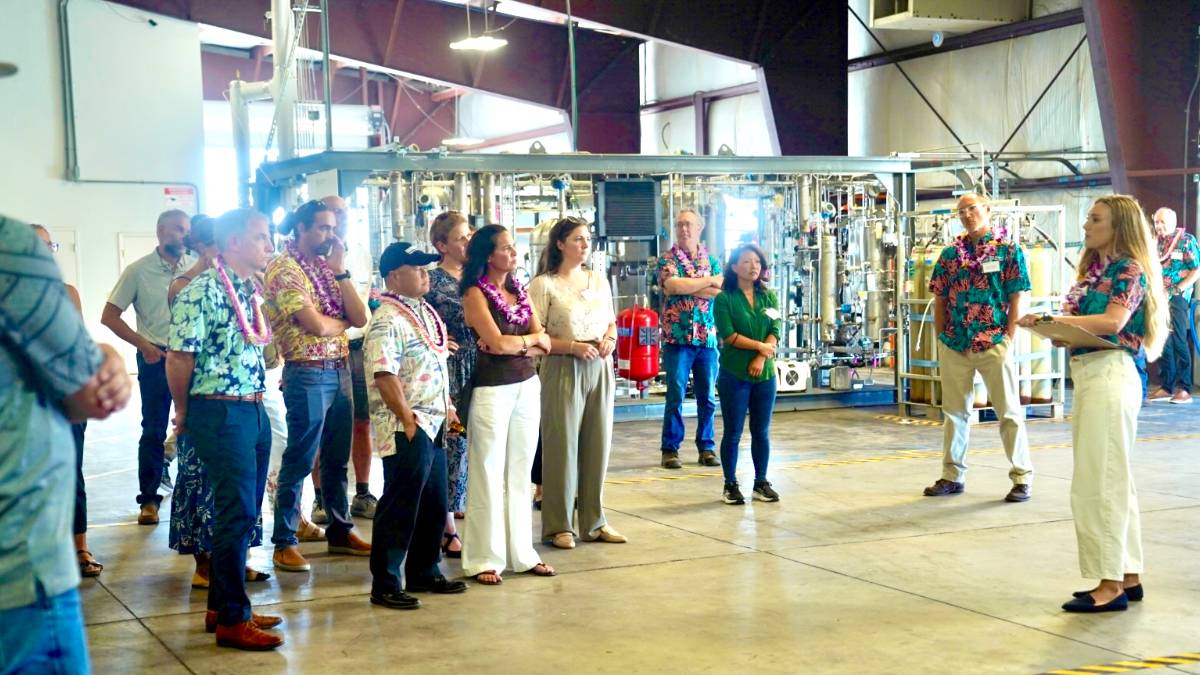
On Wednesday, Kohut spoke to a group of community and business leaders at a traditional Hawaiian blessing the company held at its warehouse located at the Hawai‘i Ocean Science Technology Park in Kailua-Kona that is operated by the Natural Energy Laboratory of Hawaiʻi Authority.
Suzanne Shaske, director of operations of engineering at Sea Dragon, led a tour of the facility’s emerging fuel-production technology.
“Today’s milestone represents an important step in Sea Dragon’s proof-of-capability program,” Kohut said. “Producing our first fuel demonstrates the advancement of our efforts to develop distributed, modular and scalable systems capable of producing fuel at or near the point of need.”
The large facility is not producing fuel yet, but the company expects it will have samples created by early 2027. The long-term goal is to create fuel on a barge at sea that would be used by the military.

Kohut said seawater-to-jet fuel is based on sound science and technologies, some of which were invented more than 100 years ago, and others that are much more recent.
Jet fuel is a combination of certain hydrocarbon molecules made up of hydrogen and carbon.
“In the early days of the Earth, organic material ended up getting buried in the Earth and over millions of years be turned into hydrocarbons that are now our fossil fuel for many things that we do in the modern age,” Kohut explained. “But about 100 years ago, two scientists determined that you can synthesize a whole group of hydrocarbons if you just have hydrogen and carbon, or carbon monoxide in our case.”
There are seven major steps that Sea Dragon will be integrating at the facility and proving so they can ultimately scale up.
“The bottom line is, first, you extract carbon dioxide from seawater and ultimately convert it into carbon monoxide,” Kohut said. “Also, from water, you can get hydrogen.”
With the carbon and hydrogen, engineers at Sea Dragon will use the Fischer-Tropsch skid to produce hydrocarbons. From there, Sea Dragon will refine, distill and get the right mix of hydrocarbons and additives to meet the requirements for specific jet fuels.
The technology breakthrough to convert seawater to jet fuel was developed by the U.S. Naval Research Laboratory in 2014. The Navy then awarded a $9.4 million contract to Sea Dragon Energy in August 2025 to fund the research into what it would take to develop the jet fuel on scale, according to the U.S. Department of War.
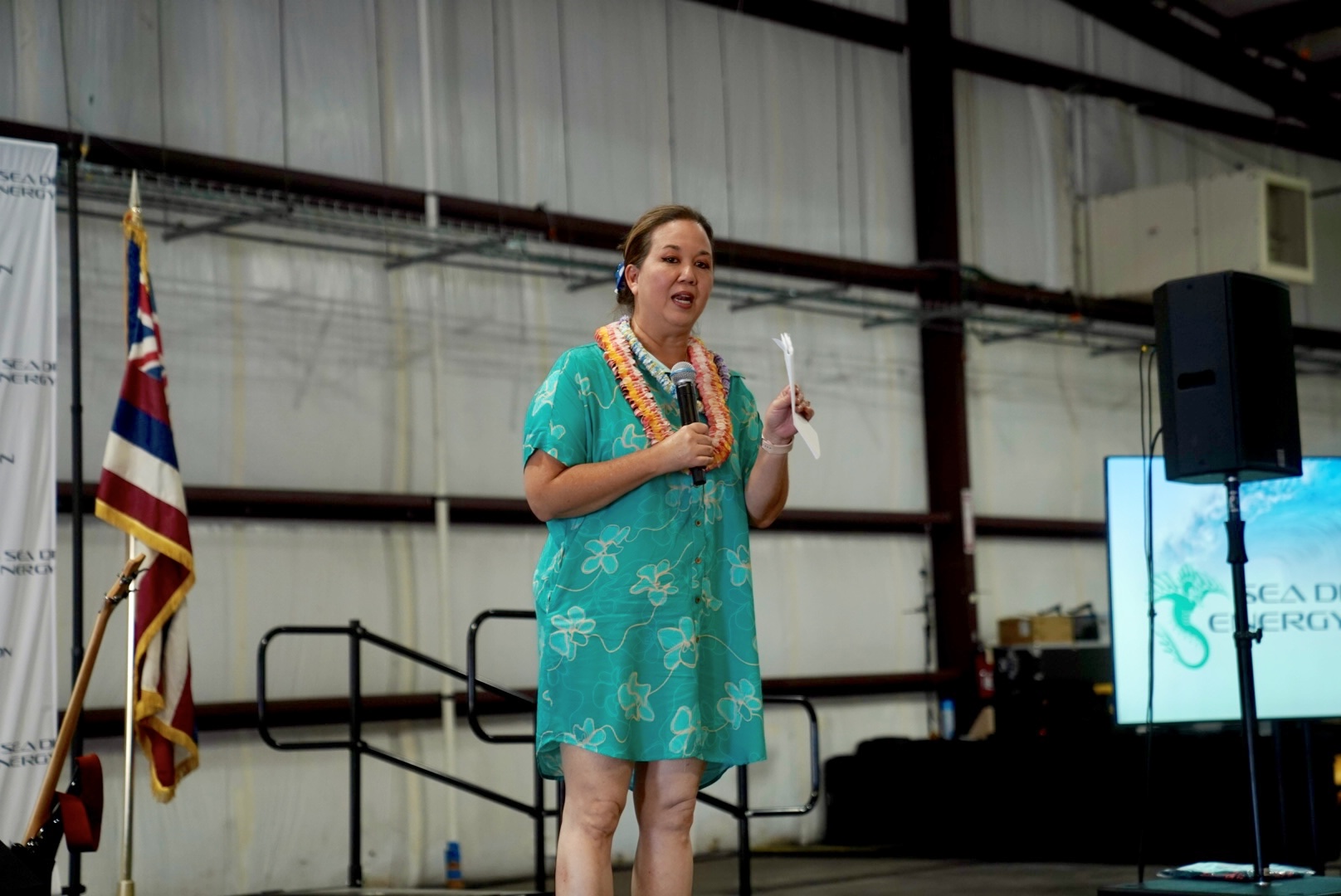
“Not to be melodramatic, but today you’re witnessing that next step of a very collective and engaged and resilient partnership as we challenge our Sea Dragon teammates to move the dream of science into reality of jet fuel,” said Mat Winter, retired vice admiral from the U.S. Navy.
Winter told the group he had a front-row seat to the discovery in 2014. He was working hand-in-hand with the Naval Research Laboratory scientists who were taking the seawater-to-jet-fuel science and putting it together so companies, specifically Sea Dragon, could then license, mature and produce it.
“As we look at this science and, I’ll say, transition to reality, you’re going to realize that this is a pivotal change for our Navy,” Winter said. “The ability to actually provide the fuels needed at the point of need (on the sea). That’s an incredible opportunity.”
While it’s still in the exploratory phase to determine if jet fuel created from water will be able to be produced on a large scale, Winter said, Sea Dragon will take that dream and move it forward.
“It’s much more mature than it has been,” Winter said.
With the technologies developed, Sea Dragon has chosen to set up shop at Kona’s technology park to prove the concept of seawater to jet fuel works. The company’s mission is to address a critical challenge for military operations and remote communities: the dependence on extensive, often vulnerable fuel-supply chains.
By developing technology that produces drop-in aviation fuel from seawater and power, the company seeks to reduce logistics burdens, strengthen fuel independence and enhance operational readiness.
“Over the last four years or more, we’ve been on contract under the Office of Naval Research to develop these technologies, to integrate this together, and demonstrate the capability, and prove that this type of fuel can, in fact, be totally synthesized from seawater,” Kohut said.
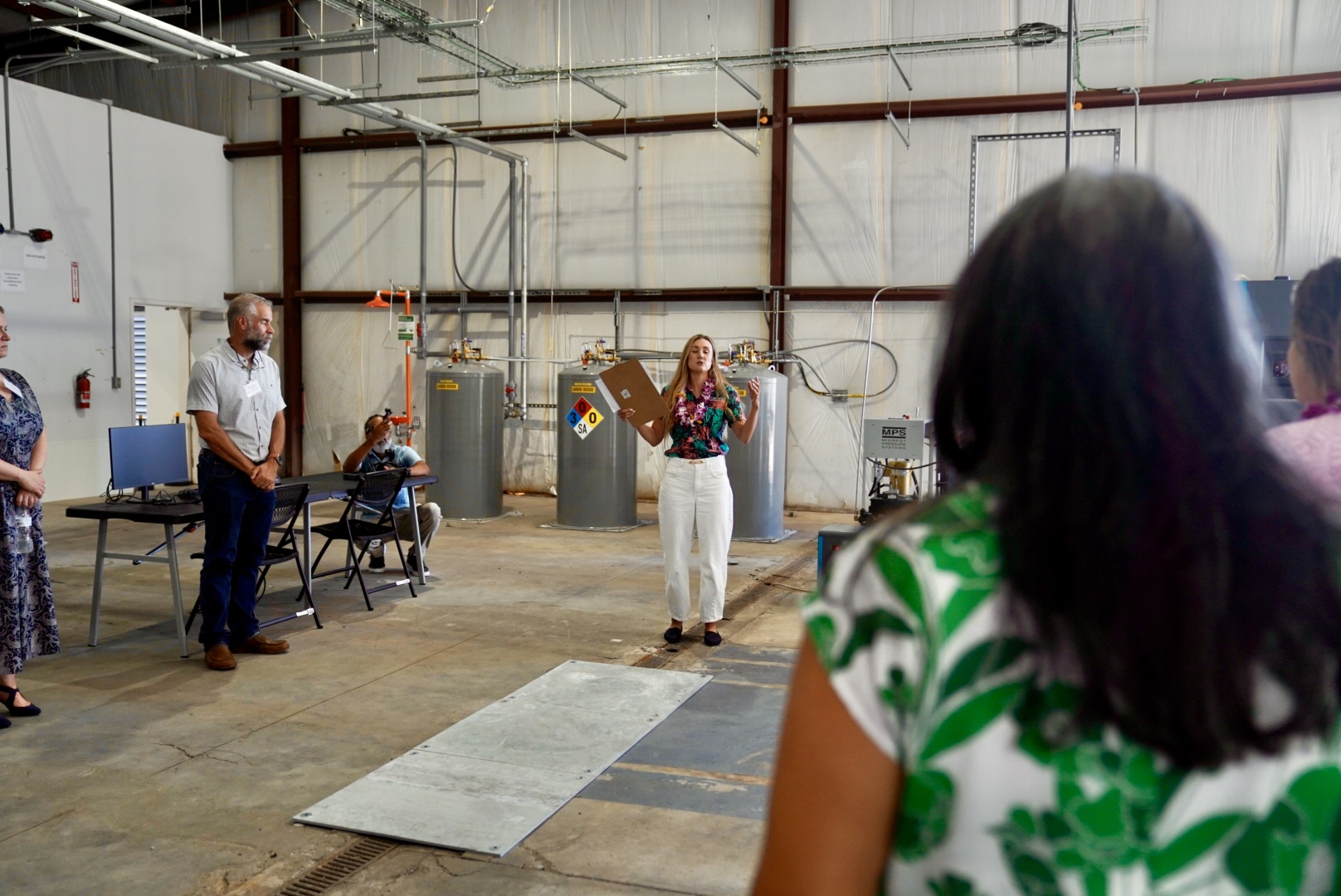
In the next two years, the energy company hopes to refine the technology, work with catalysts and try to figure out how they can produce the fuel as efficiently as possible.
“Because that’s the name of the game,” Kohut said. “It’s efficiency. It’s ultimately, how much does a gallon of jet fuel cost when we’re complete with the process?”
Also, Kohut said the other big piece is how that fuel is being delivered.
“The next step is to move from here onto a barge,” he told the group. “Our plan is to move this technology onto maritime vessels.”
Keith Olson, interim executive director of the Natural Energy Laboratory of Hawaiʻi Authority, said the state agency provides deep and surface-sea water to clients at the technology park.
What the authority tries to do, Olson said, is bring in new companies, like Sea Dragon, that would utilize either the deep or the surface-sea water or both, and then create new technologies and a business, which would then be employing people that live here on the island.
“They fit perfectly because they’re going to be utilizing our deep-ocean water for their feed for the CO2 (carbon dioxide) that they need to create,” Olson said.
Hawai‘i U.S. Rep. Jill Tokuda was among the guest speakers on Wednesday. She noted that as she flew into the Big Island, she has officially flown a million miles.
“I literally run on jet fuel, and a lot of Kona coffee,” Tokuda said with a laugh.
But on a more serious note, she said: “It reminds me how important it is to have safe, responsible jet fuel being produced throughout our country, throughout our world, and especially right here on our islands.”
Tokuda said the Big Island and the state have had a rough year, with communities suffering damage from Kona low storms to an earthquake in South Kona to Hurricanes Lala, Lowell and Nolo. These disasters are a reminder of the critical need to ensure the islands have access to resources.
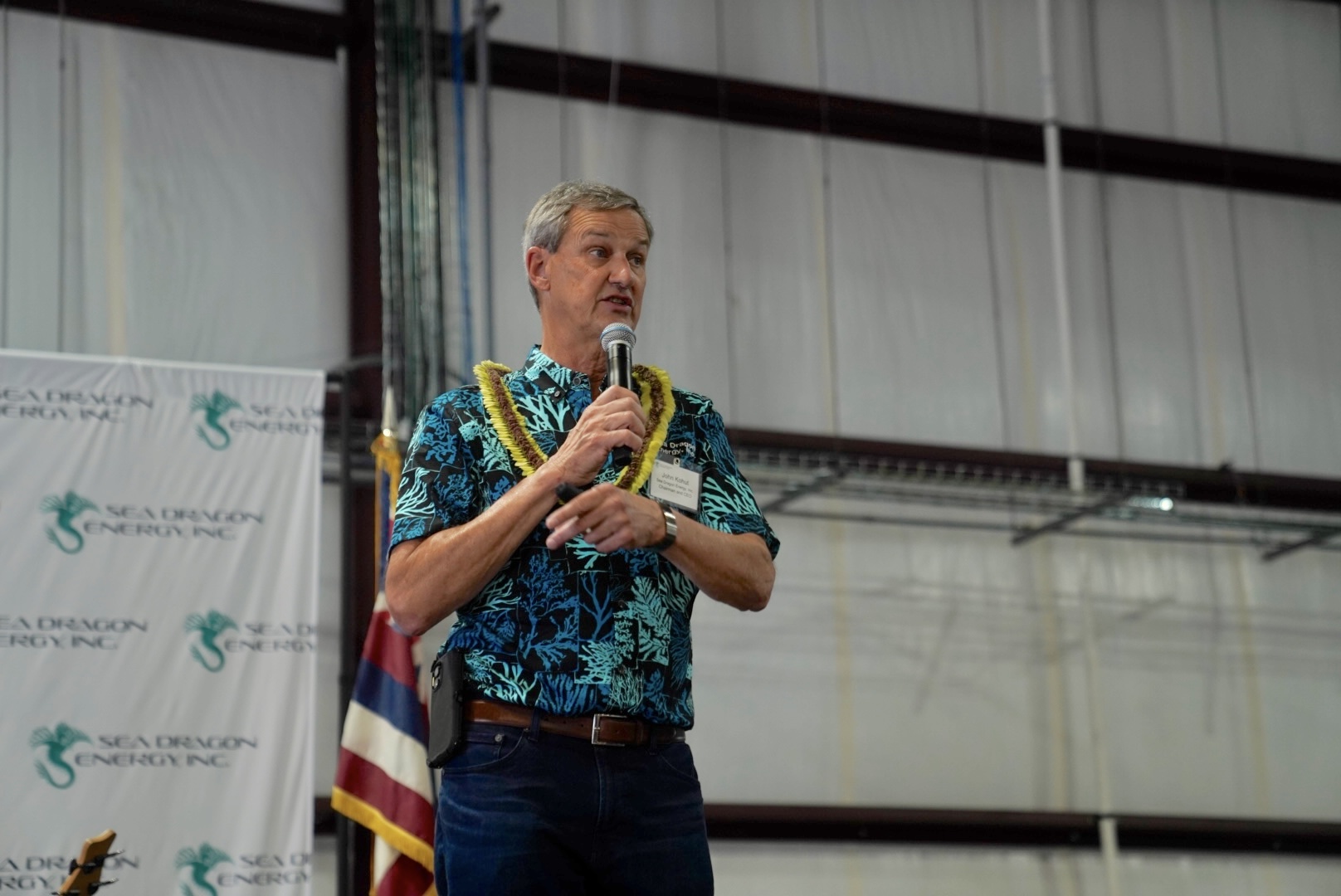
“When I think about companies like Sea Dragon Energy, when I think about the groundbreaking work and research that you will do here, I can’t help but think about the greatest resource we will bring to the table and to your endeavors: our people,” Tokuda said. “The very best and the brightest you will find anywhere in the world, I would argue, totally biased, but the ones that we want to make sure can see a future for themselves right here at home in Hawaiʻi.”
Tokuda said too many keiki (children) think they have to travel a million miles away to find opportunities.
“When we invest in places like Sea Dragon, we tell them you don’t need to leave home to find opportunity, to be able to raise your family, to plant the seeds of a future right here for yourself,” Tokuda said.
Tokuda said the Natural Energy Laboratory of Hawaiʻi Authority has been a “bastion of hope” for so many people that had a seedling of an idea, took it to scale, and then created jobs for young people in Hawai‘i.