


In Hawaiʻi County’s Emergency Operations Center, officials rely on weather information from in-house meteorologist
Days before Hurricane Lala struck the Big Island with 70 mph winds, heavy rain and flash floods on Aug. 15 and 16, Sean Miller was in Hawaiʻi County’s Emergency Operations Center helping officials make educated decisions and craft public messages.
Miller is Hawai‘i County’s in-house forecaster, an emergency response specialist from the National Weather Service.
“He gave us precautions that were stronger than we were getting from the Honolulu office,” Hawai‘i County Mayor Kimo Alameda said. “With the storm moving around the mountain and the warm weather, he said this could be an issue for us. And he was right.”
The storm hit residents in the Ka‘ū District hard and fast at around 8 p.m., with many people being trapped in their homes, forced to watch the floodwaters rise from bedroom windows, praying for them to subside. Two people died.
Miller has been partnering with the county during potential severe weather events since June 2024 as part of the National Weather Service’s focus to provide in-person decision support services to local governments, rather than just putting out a forecast, said John Bravender, Warning Coordination Meteorologist for the National Weather Service.
Miller now is monitoring Tropical Storm Lowell, which is approximately 1,200 east-southeast of Hilo.
“We’ve been focused on helping emergency managers get the information they need for making decisions,” Bravender said. “We can do that remotely, but it’s even better in person when you can build up relationships and you can have face-to-face conversations.”
Bravender said the National Weather Service has a forecaster based on Kaua‘i who is starting this year. Forecasters were brought on in Maui and on O‘ahu after Miller.
“The weather service would tend to be more in the background, issue watches and warnings, but we wouldn’t necessarily always be out front and center with the folks that are actually dealing with the emergencies themselves,” Miller said.
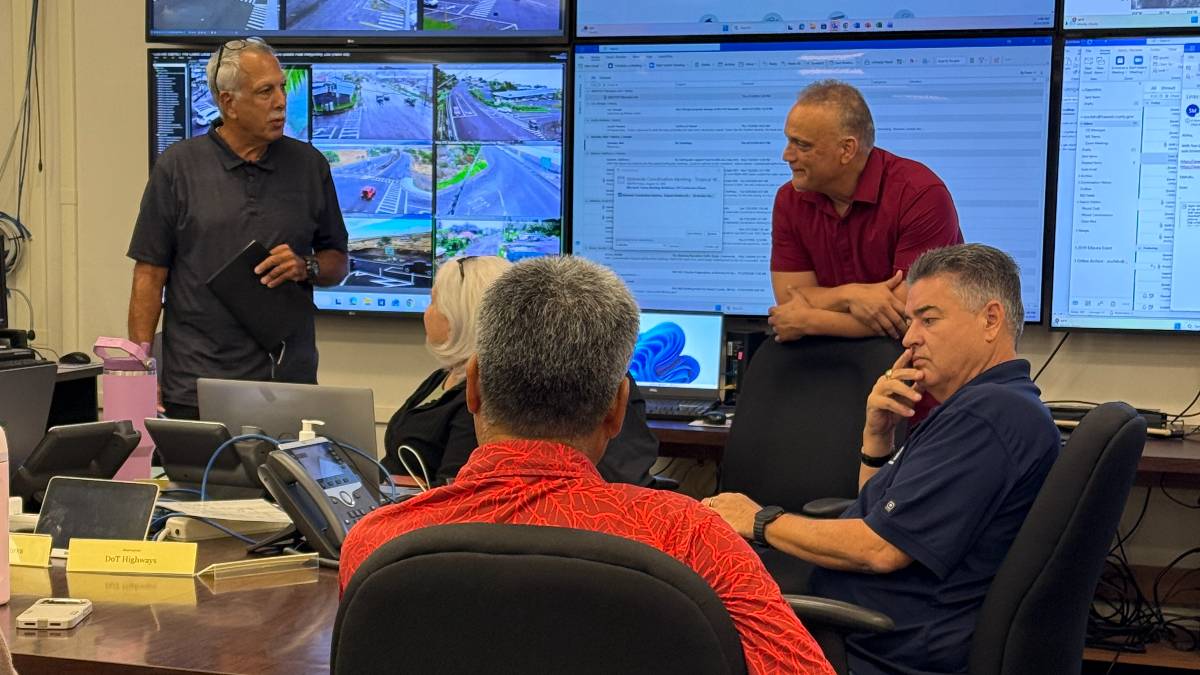
The emergency response specialist position was born out of a need to provide in-person forecast help to keep communities safe.
“There’s just no substitute,” Miller said. “You can’t get that same kind of interaction being back in an office somewhere farther away; you can’t know all the specifics about what’s being discussed.”
That’s been the focus of this initiative, Bravender added, “to embed meteorologists in state, county, local governments or other agencies to not only provide service during events, but also to work with them during quiet weather, build up those relationships, get to know each other, so there’s more trust in the communications of the forecast as the events unfold.”
Darryl Oliveira, acting administrator for Hawai‘i County Civil Defense, said with Miller present in the Emergency Operations Center, he and other officials can get expert forecasts early on for weather systems circulating thousands of miles east of the Hawaiian Islands.
“For the public’s assurance, I would say that we watch everything that develops out in the Eastern Pacific and around us to be able to provide early information about any possible threat,” Oliveira said.
With their expertise, Oliveira said the county can identify the threat and take the appropriate action with communication, messaging and other tasks.
Oliveira said Miller’s presence is helpful for explaining how the weather forecast correlates with the Big Island’s specific environment and communities.
In an example, he said Miller’s provided the county’s mass transit director with real face-time discussion regarding wind and how that could affect the high-profile vehicles with the buses on the routes that they’re traveling. This enables the director to make really good, tactical decisions about whether routes need to be modified and suspended.
“It’s down to that granular level that communication takes place here and allows for better situational awareness and better planning for modifying operations to avoid exposing people to risk,” Oliveira said.
Like meteorologists at the National Weather Service in Honolulu, Miller also identified flash flooding as a big risk for Ka‘ū and Puna. He was able to have conversations with the Hawai‘i Fire Department about where to place resources to address the areas vulnerable to flooding.
“Obviously all the decision-making completely rests with them, but our role is in helping to support those decisions by providing the best available forecast information that we can,” Miller said.
Alameda said Miller is an important member of the Emergency Operations Center team, breaking down forecasts by districts.
“He’s live and direct and we get to ask questions,” Alameda said. “And, he’s educating us.”