


Volcano Watch: A decade of disaster response; mahalo to Hawaiʻi County Civil Defense Administrator Talmadge Magno
“Volcano Watch” is a weekly article and activity update written by U.S. Geological Survey Hawaiian Volcano Observatory scientists and affiliates.
Hawaiʻi County Civil Defense Agency Administrator Talmadge Magno, who navigated the Hawaiʻi Island response to volcanic eruptions from multiple volcanoes, the COVID-19 pandemic, fires, earthquakes, tsunami warnings, hurricanes and historic kona low storms, retires effective Aug. 1.
Talmadge grew up in Mountain View, so well before he was Civil Defense administrator, he was familiar with the range of hazards that can affect Hawaiʻi residents. He took college classes after graduating from Hilo High School, introducing him to environmental hazards and mitigating their effect on people.
He graduated from University of Hawaiʻi at Hilo with a degree in geography and then pursued a career with the National Park Service.
Talmadge worked as a ranger in environments vastly different from his island home — from the jagged peaks of Grand Teton National Park in Wyoming to the watery reservoirs of Lake Mead National Recreation Area spanning Arizona and Nevada.
He also gained experience in emergency response to natural hazards such as wildland fires, hurricanes, floods and landslides.

Talmadge’s National Park Service career finished on his home island, where he spent 8 years as chief ranger at Hawaiʻi Volcanoes National Park.
He was one of the pillars leading the park response to the then-ongoing Puʻuʻōʻō eruption on the middle East Rift Zone of Kīlauea volcano, with lava flows on the coastal plain feeding ocean entries and building lava deltas on the coast, and a new lava lake eruption that began in 2008 in Halemaʻumaʻu Crater at the volcano’s summit.
Talmadge’s team focused on planning for increased summit visitation and potential explosive eruption hazards with the new summit eruption.
He retired in 2015 from the National Park Service and in 2017 became Civil Defense administrator.
Kīlauea experienced its largest lower East Rift Zone eruption and summit collapse in at least 200 years less than year after he began his tenure with Civil Defense. A federal disaster was declared in 2018, and though the eruption ended after3 months, recovery is ongoing still today.
Talmadge’s approach to being Civil Defense administrator was influenced by his experiences responding to disasters such as Hurricane Katrina in 2005, as well his role in responding to volcanic activity in Hawaiʻi Volcanoes National Park.
However, he emphasized that a strong foundation was laid by previous Hawaiʻi County Civil Defense administrators and their staffs, enabling county, state and federal officials to work effectively together during 2018 and later.
A slew of Kīlauea summit eruptions that started in 2020 brought Talmadge’s attention back to Hawaiʻi Volcanoes National Park, followed in 2022 by the first eruption of Mauna Loa in nearly four decades. Earthquakes and ground deformation in the months prior prompted Civil Defense to host several community meetings in the steeply sloped high-hazard regions on the west flank of Mauna Loa.
Like during previous volcanic unrest, Talmadge relied on the long-term monitoring by scientists at Hawaiian Volcano Observatory and their prognoses of the scenarios that could occur.
Messaging emphasized that a Mauna Loa eruption could begin with little notice, and it did, with less than an hour of rapid earthquakes marking the magma’s ascent to the surface.
Lava flows during the 12-day eruption got to within 2 miles of the Daniel K. Inouye Highway, also known as Saddle Road, and the eruption was a stark reminder that Mauna Loa remains an active volcano with the ability to affect different parts of the island on very different timescales.
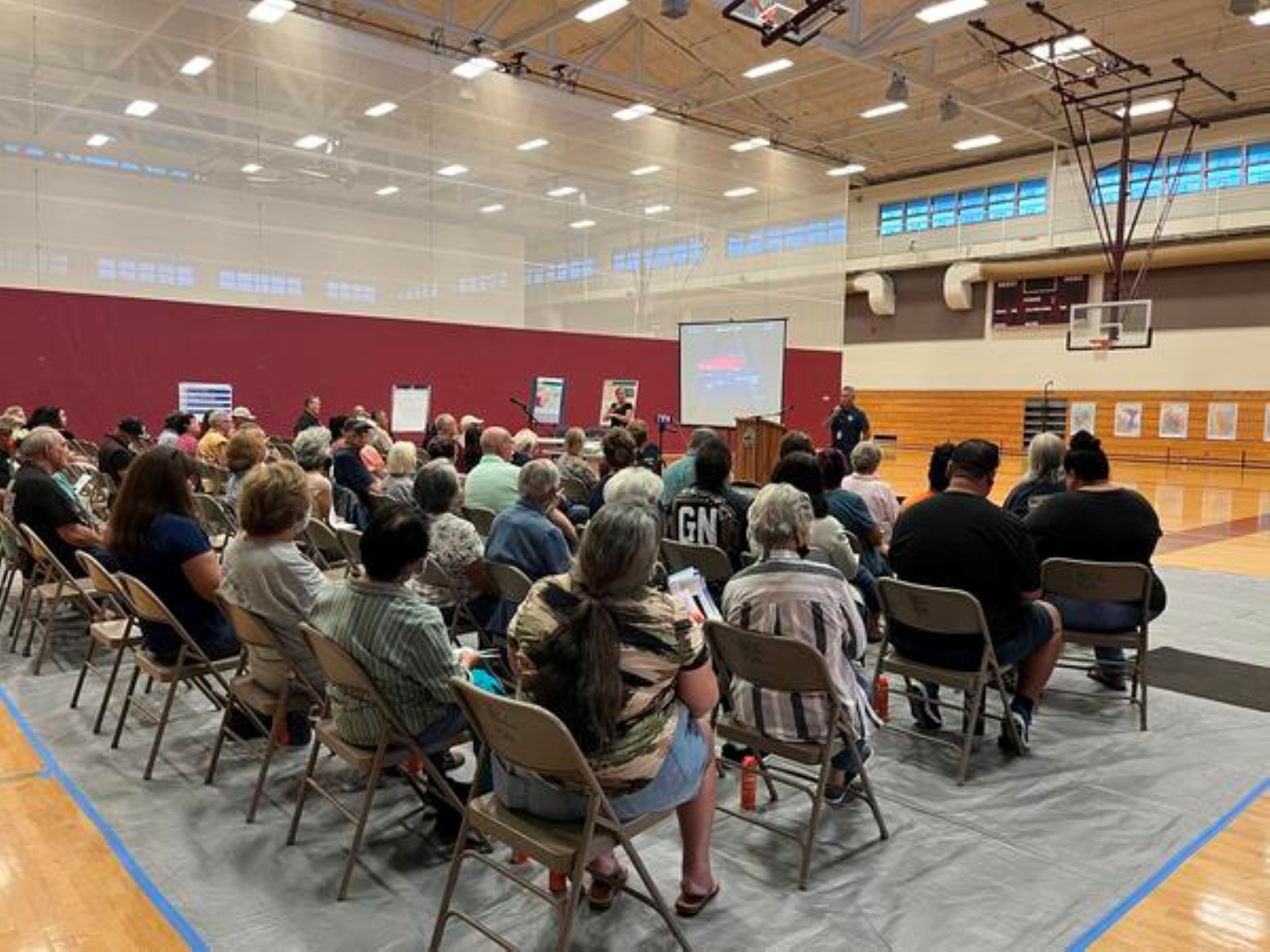
As Talmadge retires in the midst of another historic eruption, with episodic lava fountaining at the summit of Kīlauea ongoing since December 2024 resulting in tephra fall on areas downwind, he reflected on the island’s supportive communities.
He emphasized that community support has been crucial to every natural hazard event response and recovery in Hawaiʻi. As our communities grow, so too do our vulnerabilities to natural hazards. Forward planning and educational efforts will remain important to building our resilience.
Hawaiian Volcano Observatory sincerely thanks Talmadge for his sound, sure and steady leadership during the past decade.
His parting advice to the next Hawaiʻi County Civil Defense administrator is all about building relationships: get to know everyone, as it will only be a matter of time before the next natural hazard event and response in Hawaiʻi.
* * * * * * * * *
VOLCANO ACTIVITY UPDATES
KĪLAUEA volcano
VOLCANO ALERT LEVEL: Advisory
Kīlauea has erupting episodically since Dec. 23, 2024, within the summit caldera. Episode 52 of the summit eruption happened for just fewer than 7.5 hours July 28-29, with a lava fountain from the north vent reaching up to about 500 feet. No unusual activity has been noted along Kīlauea’s East Rift Zone or Southwest Rift Zone.
WHAT’S NEXT: Summit region inflation since the end of Episode 52 indicates another fountaining episode is possible, but more data are needed to make the forecast.
MAUNA LOA volcano
VOLCANO ALERT LEVEL: Normal
Mauna Loa is not erupting. Read more about the activity at the volcano in the most recent monthly update on the Hawaiian Volcano Observatory website.
Hawaiian Volcano Observatory continues to closely monitor Kīlauea and Mauna Loa.
* * * * * * * * *
EARTHQUAKE ACTIVITY UPDATES
Two earthquakes were reported felt during the past week throughout the Hawaiian Islands:
- MAGNITUDE-3.6 earthquake at 2:16 p.m. July 28 located 24 miles south-southeast of Mākena at a depth of 19 miles below sea level.
- MAGNITUDE-3.0 earthquake at 10:30 a.m. July 26 located 13 miles southeast of Waikōloa at a depth of 14 miles below sea level.
Visit the Hawaiian Volcano Observatory website for past “Volcano Watch” articles, Kīlauea and Mauna Loa updates, volcano photos, maps, recent earthquake information and more. Email questions to askHVO@usgs.gov.