

13 new state laws and Big Island’s no feeding feral animals on county property take effect Jan. 1
The new year in Hawaiʻi County begins with a controversial law that bans the feeding of feral animals on county property, aiming to protect native species while challenging years of care by animal enthusiasts.
This is one of the new county laws and 13 state laws, including the nation’s first climate impact fee, taking effect on Jan. 1.
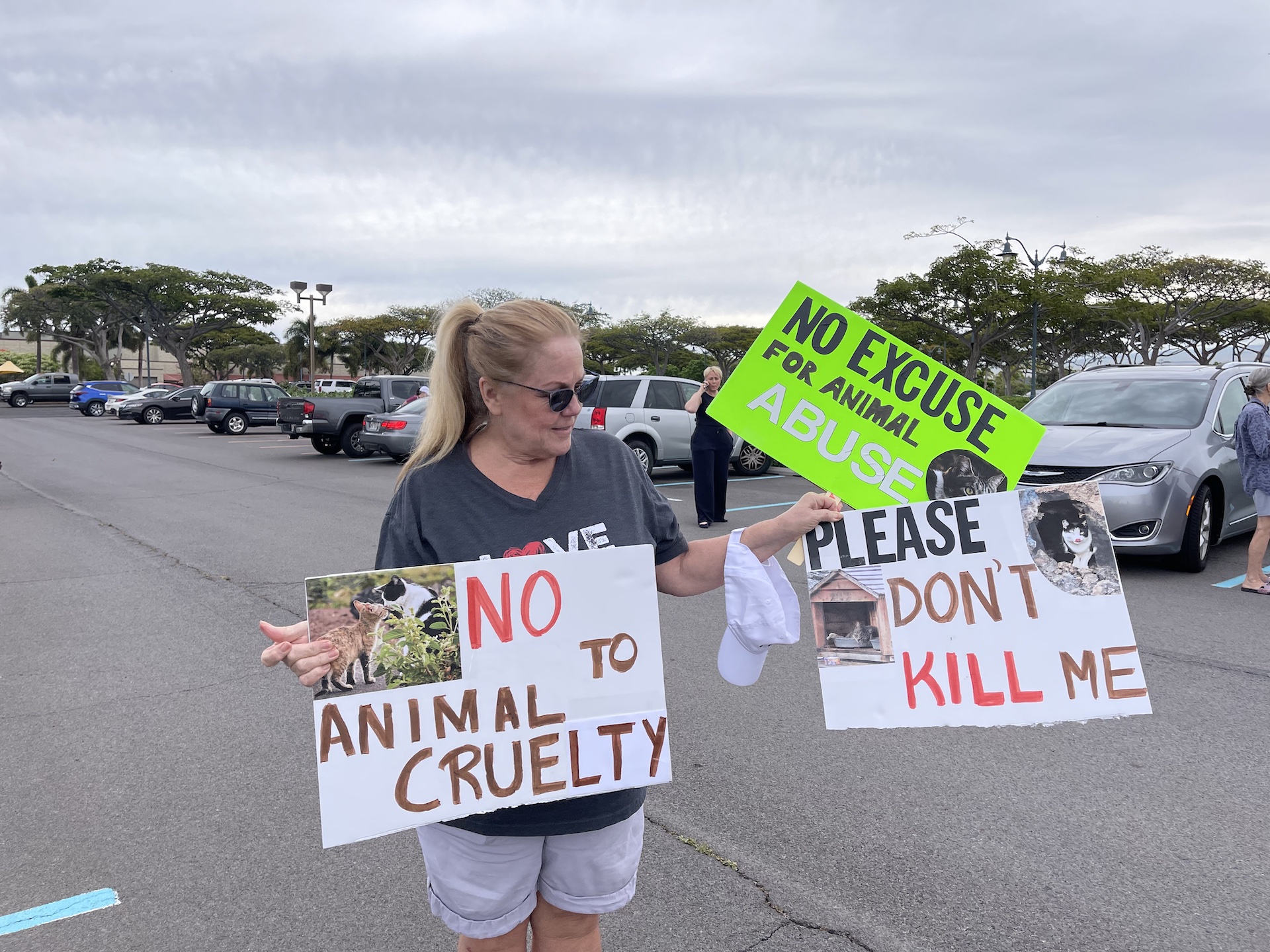
The bill banning feeding feral animals, now known as Ordinance 25-63, was created to protect native species, according to its author, Councilmember Matt Kanealiʻi-Kleinfelder. The measure responds to concerns that food distributed to feral cats attracts endangered nēnē, the official state bird of Hawaiʻi, onto county property.
In 2024, feral cats were linked to the death of a one-month-old nēnē gosling at Liliʻuokalani Gardens, which had toxoplasmosis, a disease spread by cat feces. But people continued to feed the cats there.
Raymond McGuire, a biologist for the Department of Land and Natural Resources, noted a disconnect between feral cat feeders, who love animals, and their actions, which harm and kill wild animals like the nēnē.
“We don’t want to go after them with fines and citations,” he said. “But their actions are having a clear effect on our native wildlife and our threatened and endangered wildlife. Not just nēnē, but monk seals. And not just toxoplasmosis, but cats attack and eat native birds. We want people to understand there’s a place for these cats. Keep them home. Never abandon a cat.”

While many animal lovers understand the need to protect native species, some community members oppose the bill because they believe it causes undeserving animals to starve. However, the bill does not prevent individuals from feeding feral cats on private property nor from continuing to run trap, neuter, and return programs.
The second law in effect today for Hawaiʻi County is Ordinance 25-70, which amends real property tax credits.
The ordinance establishes a private road tax credit for real property owners whose only vehicular access is by a private, ungated roadway, with maintenance fees not covering its repair.
Statewide action is being taken to protect Hawaiʻi’s native species and biodiversity, and address climate change impact, with Act 96, Senate Bill 1396, which will increase transient accommodations taxes to directly protect, manage and restore natural resources.
The law, commonly called the Green Fee, is the first of its kind in the country. It increases the existing tax on hotel stays and rentals by 0.75% (raising the TAT to 11%), and applying this total tax to cruise ship passengers when a vessel is docked at a state harbor. It is expected to generate $100 million annually.
But on New Yearʻs Eve, a federal appeals court ruling blocked Hawaiʻi from enforcing the tax on cruise ships passengers, according to ABC News.
In August, Cruise Lines International Association, Honolulu Ship Supply, Kauaʻi Kilohana Partners, and Aloha Anuenue Tours filed the lawsuit alleging the fee was unconstitutional and burdened cruise operators and passengers.
The law had looked like it would take effect on cruise ship passengers when earlier this week a U.S. District Court judge dismissed most claims of that lawsuit before it was reversed by the federal appeals court.
The Green Fee was originally pitched by Gov. Josh Green years ago and recommended by the Climate Advisory Team after the fatal 2023 Maui wildfires revealed the need for strategies to respond to the increasing frequency and intensity of natural disasters in the state.

The Hawaiʻi State Legislature supported the law to increase the state’s resilience against climate disasters and to support natural resources against degradation that comes from activities stemming from tourism, agriculture and Hawaiʻi’s largest economic industries.
The Green Fee aims to secure long-term economic stability while preserving its unique landscapes and biodiversity. The other state laws in effect today include:
- Act 21, (SB 1508 SD1): Amends or repeals provisions of the Hawaiʻi Revised Statutes to correct errors, clarify language, or delete unnecessary provisions.
- Act 47, (SB 1035 CD1): Exempts medical and dental services provided to Medicaid, Medicare, or TRICARE recipients from the general excise tax.
- Act 79 (HB 544 CD1): Requires clarity in pet insurance policies offered to Hawaiʻi residents, following the National Association of Insurance Commissioners’ Pet Insurance Model Act.
- Act 90,(HB 1370 CD1): Amends the liquor tax law definition of draft beer as beer in containers of five gallons or more.
- Act 110, (SB 752 CD1): Increases notice periods for property insurer notifications of cancellation or nonrenewal.
- Act 119, (SB 1189 CD1): Requires preliminary campaign finance reports from candidates by Feb. 28 in election years.
- Act 138, (SB 2342 CD1): Clarifies coverage requirements for peer-to-peer car-sharing programs and mandates rate filings from insurers.
- Act 171, (SB 1195 CD1): Prohibits parking within certain distances of crosswalks and intersections, with fines going to the Safe Routes to School Program Special Fund.
- Act 199, (HB 2278 CD1): Requires labeling of products containing macadamia nuts not grown in Hawaiʻi.
- Act 203, (HB 692 CD1): Expands eligibility for the Preschool Open Doors Program by removing accreditation requirements for providers.
- Act 205, (SB 2983 CD1): Requires registration of fundraising platforms and charities with the Department of the Attorney General and imposes liability for fund misuse.
- Act 298, (SB 1231 HD1): Updates parentage laws to recognize modern family structures and parenthood concepts, ensuring equal treatment of children born to same-sex couples and includes provisions for surrogacy agreements.
The Hawaiʻi State LGBTQ+ Commission welcomes Act 298 as landmark legislation that modernizes Hawaiʻi’s parentage laws and updates decades-old statutes to reflect the realities of today’s families.

The law significantly strengthens legal protections for LGBTQIA+ families by replacing gendered assumptions about mothers and fathers with gender-neutral definitions, enhancing stability and privacy rights for children, and clearing pathways to legal parentage.
“For too long, many of Hawaiʻi’s LGBTQIA+ families have faced unnecessary legal uncertainty simply because our laws failed to reflect how families are actually formed,” said Michael Golojuch Jr., vice chair and legislative lead for the Hawaiʻi State LGBTQ+ Commission. “Act 298 brings Hawaiʻi’s parentage laws into the present and centers the best interests of the keiki, regardless of their parents’ gender, sexual orientation or marital status.”
The law expands and clarifies multiple ways to establish legal parentage, such as voluntary acknowledgment of parentage without lengthy or costly court proceedings and adjudicated parentage, which provides courts with modern, equitable standards when parentage is contested.
The new law also reflects Hawaiʻi’s current medical practices, such as in vitro fertilization, sperm or egg donation, and gestational surrogacy. Intended parents, regardless of gender or marital status, are provided clearer legal recognition and protections.