


Forecast window for next eruptive event at Kīlauea continues to remain unknown
Because of the irregular changes in inflation and deflation, the Hawaiian Volcano Observatory reports that forecast windows for its next eruptive episode can no longer be modeled.
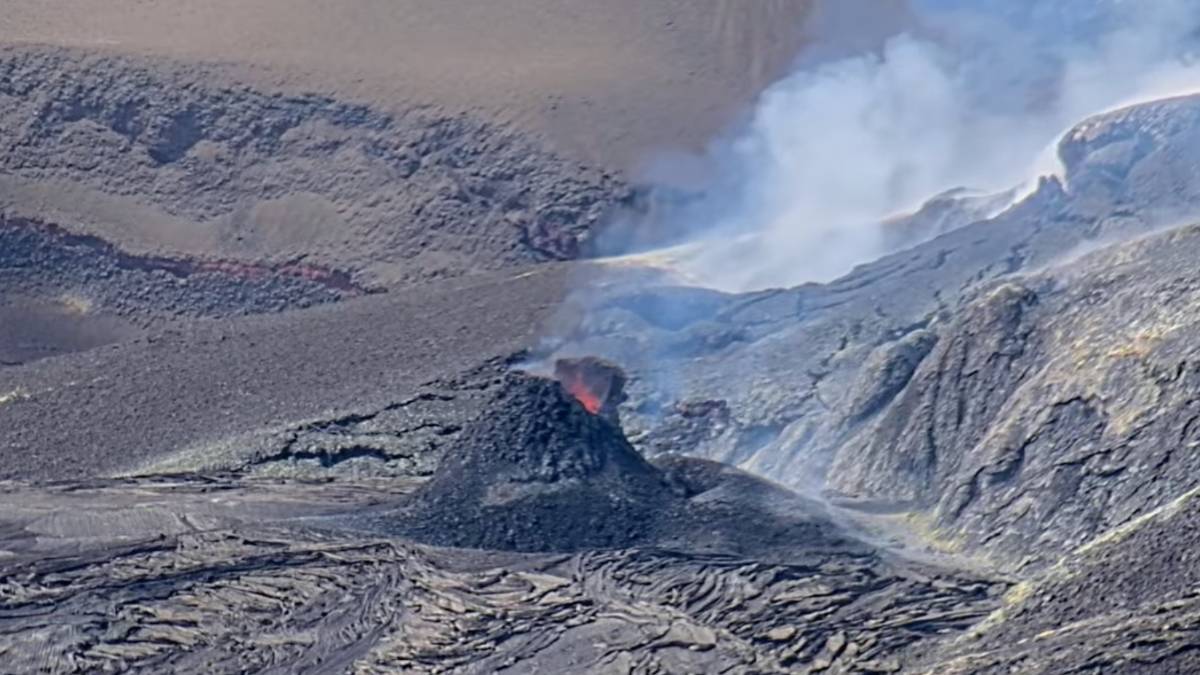
There is currently no active lava on the ground within Kīlauea’s Halema‘uma‘u Crater as of Friday morning.
While five new vents had opened on and near the northwest wall of the crater and produced small lava flows earlier this week, they have since stagnated.
None of the new vents along the crater wall showed any signs of activity in the past 24 hours, according to the latest Hawaiian Volcano Observatory report on Friday. The north, south, and west vents continue to glow and emit flames, with minor intermittent spatter.
“This indicates that magma remains close to the surface in these vents,” according to the report.
The small summit deflation on Wednesday, Sept. 17, switched to inflation around 6 p.m., gaining 0.5 microradians through this morning. Tremor bursts continue to be the dominant seismic signal across the summit.
Because of the irregular changes in inflation and deflation, the report states that forecast windows for its next eruptive episode can no longer be modeled.
There is no anomalous activity outside of the summit.
Strong tremor bursts continue this morning and are the dominant seismic signal across the summit. There were nine earthquakes located across the summit region but do not form clusters in time or location and are all small magnitude.
The magnitude 4.1 earthquake that occurred last night south of Pāhala had no apparent impact on eruptive activity on Kīlauea.
While the forecast window cannot be predicted, the Hawaiian Volcano Observatory reports that current conditions remain favorable for either another fountaining episode or a change in eruptive activity if inflation continues.
Some potential scenarios are described below based on past episodic eruptions of Kīlauea (1983 Puʻuʻōʻō and the 1969 Maunaulu eruptions). These past eruptions both continued after lava fountaining episodes ended, with fissures opening nearby that erupted more continuous lava flows.
- Eruption becomes continuous at the new vents: Lava could continue to erupt from the vents in Halemaʻumaʻu, as lava flows or spatter bursts, for an unforeseeable amount of time. The prolonged nature of low-level activity since September 7 and opening of new vents could be signs of a transition to lava erupting more continuously within Halemaʻumaʻu from existing vents. The only similar scenario is the onset of episode 48 during the Puʻuʻōʻō eruption where pressure built up to a new fountaining episode, but instead of fountaining a new fissure opened up down rift of Puʻuʻōʻō and began erupting continuously.
- Eruption returns to fountaining: Alternatively, a fountaining episode from an existing vent in Halemaʻumaʻu could begin at any point during this period of increased pressurization. Prior to episode 35 of the Puʻuʻōʻō eruption, a fissure erupted uprift of the vent before fountaining began and continued for 2 weeks after the end of the fountain episode. Normal fountain episodes resumed after the end of this extended excursion.
- Formation of new vent(s) in summit region: Magma could form a new shallow pathway toward the surface, potentially resulting in other new vents erupting lava within the summit caldera. In this scenario, we would expect earthquakes, potentially with tightly clustered locations, along with changes in the patterns of ground deformation indicative of shallow crack formation, similar to what occurred in the new vent formation during episode 30 on August 6, 2025, when a crack in the southwest wall of Halemaʻumaʻu briefly erupted.
- Intrusion into the upper parts of the Southwest Rift Zone or East Rift Zone: Magma could migrate into the upper portion of the Southwest Rift Zone or the East Rift Zone in Hawaiʻi Volcanoes National Park. In this scenario, we would expect an extended period of increased rates of earthquakes migrating from the summit towards a rift zone, along with ground deformation indicative of summit magma chamber deflation.
No significant activity has been noted along Kīlauea’s East Rift Zone or Southwest Rift Zone. However, tiltmeters on the East Rift Zone did show minor excursions triggered by heavy rainfall over the past 24 hours. These changes are not related to magma movement.
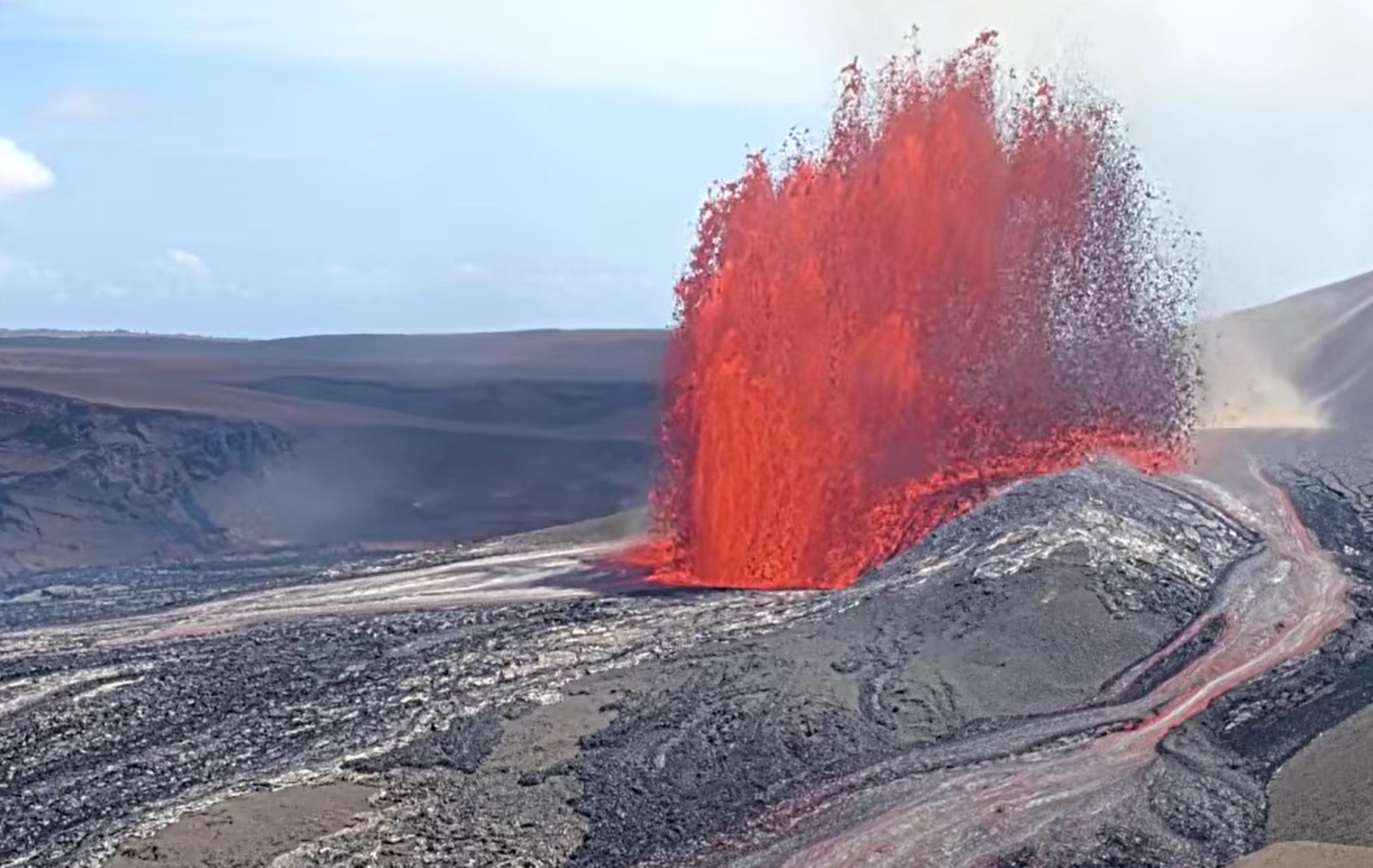
Kīlauea has been erupting episodically since Dec. 23, 2024, from two vents (north and south) in Halema‘uma‘u. Lava fountaining episodes, which generally last for less than 12 hours, are separated by pauses of two or more weeks.
Eruptive Episode 54 occurred on Aug. 25 at 10:30 a.m. and ended at 7:33 p.m. after continuous lava fountaining.