


Gov. Josh Green signs budget with key investments in affordable housing, public health, economic growth
Out of 267 bills reviewed, Gov. Josh Green has only put four on the intent-to-veto list.
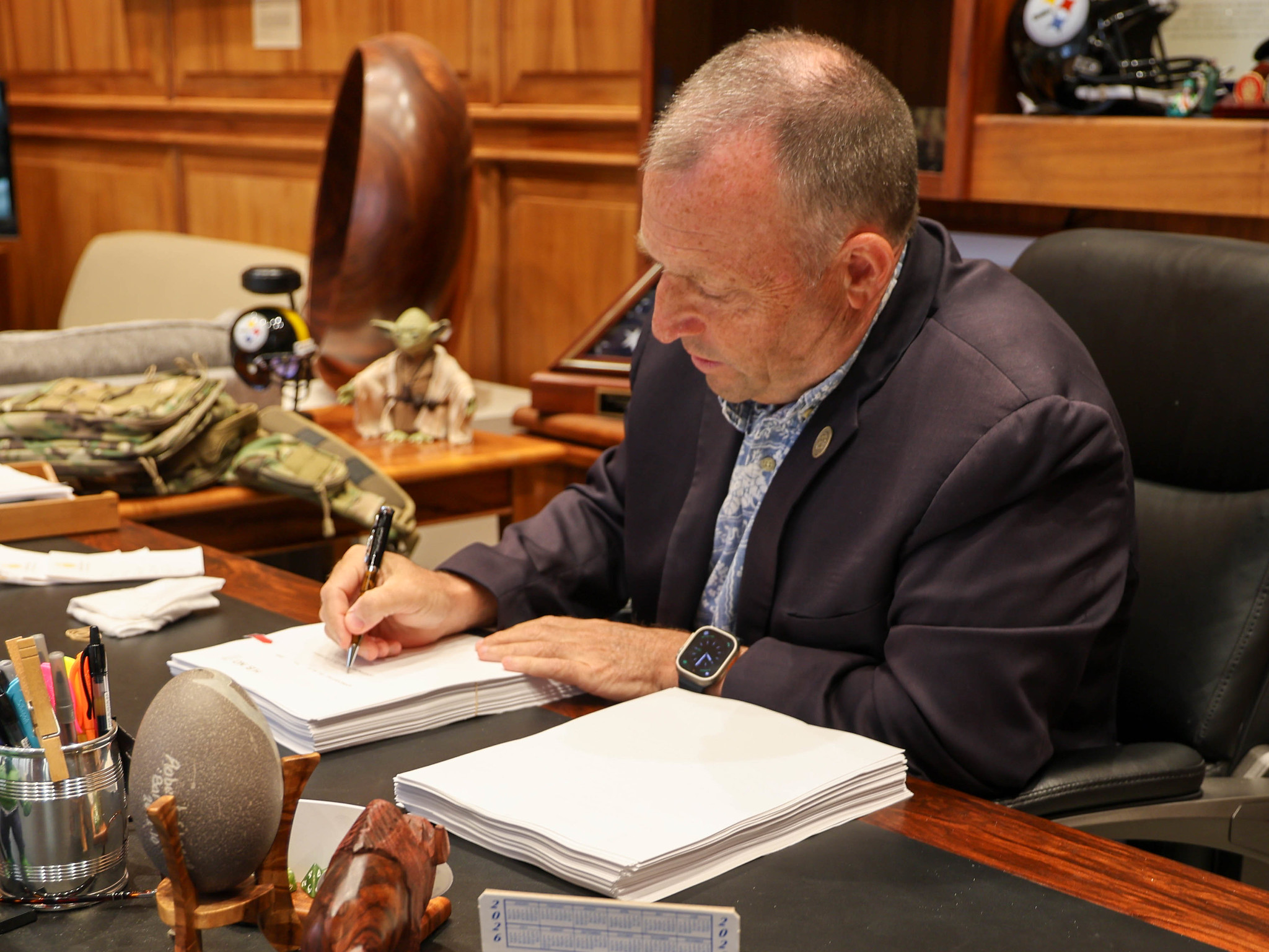
Governor Josh Green signed the state’s supplemental budget bill, appropriating funds for Executive Branch operations and capital improvement projects, on Friday.
According to House Bill 1800 (HB 1800), the operating budget provides $10.42 billion in general funds for fiscal year 2026 and $10.63 billion for fiscal year 2027, representing total expenditures of $19.77 billion and $20.31 billion across all means of financing for each fiscal year. For capital improvement projects, $4.53 billion in appropriations across all means of financing includes $1.51 billion in general obligations for fiscal year 2027.
The budget balances the financial plan and maintains state reserves. It continues to invest in Hawaiʻi’s priorities, including affordable housing, support for local families, public health initiatives, and economic development opportunities, particularly in light of reductions and uncertainty in federal funding.
Consistent with these priorities, the state budget also provides critical funding for Act 96, SLH 2025, known as the Green Fee, including approximately $129 million over 18 months to support 91 projects across 11 departments.
Green also signed the Judiciary’s budget bill, House Bill 2095 (HB 2095), now Act 178, SLH 2026, continuing its support for a well-resourced and effective judicial branch that serves the people of Hawaiʻi.
Green also informed legislative leaders and stakeholders of his intention to veto four measures passed by the Hawaiʻi State Legislature during the 2026 legislative session. The small number of measures included on the intent-to-veto list reflects collaboration and hard work among the Legislature, the administration, and community stakeholders throughout the session.
While Green is not required to veto every bill on the intent-to-veto list, he cannot veto any bill not included on the list. He has until July 15 to issue final vetoes, after which all remaining bills will become law on July 15.
“Our team has been working diligently to review the 267 bills passed by the legislature this session, most of which will become law,” Green said. “Of the 267 bills reviewed, only a handful have landed on this list through extensive legal and fiscal analysis. Our assessments are guided by sincere dedication to our community, considering each opinion with the goal of making decisions that truly reflect what is best for Hawaiʻi.”
The following bills are being considered for veto or line-item veto, or reductions:
SB2338: Relating to Housing
Exempts certain employment actions and job descriptions for the Hawaiʻi Housing Finance and Development Corporation and Hawaiʻi Community Development Authority from approval by the Director of Business, Economic Development and Tourism.
Establishes salary provisions for the executive directors of Hawaiʻi Housing Finance and Development Corporation and Hawaiʻi Community Development Authority, with compensation capped at 99 percent of the governor’s salary and subject to approval by the Director of Business, Economic Development and Tourism.
Renames the Hawaiʻi Housing Finance and Development Corporation executive assistant position to deputy executive director and increases its salary cap. Establishes conditions for the issuance, renewal, and termination of employment contracts for the Hawaiʻi Housing Finance and Development Corporation, Hawaiʻi Community Development Authority, and the Hawaiʻi Public Housing Authority.
Veto rationale:
This bill would impose statutory requirements in an area where existing authority may already provide sufficient flexibility to achieve the measure’s intended objectives. Additional review and consultation are needed to determine whether the proposed changes can be implemented administratively. Further analysis is also needed to better understand how current provisions of the Hawaiʻi Revised Statutes may be utilized to accomplish the same goals.
SB2600: Relating to the General Fund
Makes a deposit into the emergency and budget reserve fund pursuant to Article VII, Section 6, of the Hawaiʻi State Constitution.
Veto rationale:
Given disaster recovery efforts and other state priorities such as affordable housing and reducing the cost of living for residents, it would be financially imprudent to transfer $50 million in general fund money to the emergency budget reserve fund, also known as the Rainy Day fund.
The current balance of the Rainy Day fund, at more than $1.5 billion, is the largest it has ever been — and the state is committed to making regular payments on its unfunded liabilities, including its pension obligations.
SB3262: Relating to Education
Requires that the Hawaiʻi Teacher Standards Board submit three nominees for its executive director to the Board of Education. Requires the Board of Education to appoint an executive director from the list of nominees, subject to the advice and consent of the Senate.
Veto rationale:
This bill warrants further review regarding the separation of responsibilities and duties between the Board of Education and the Hawaiʻi Teacher Standards Board. Additional evaluation is needed to assess how the proposed changes may affect the respective roles, authorities, and oversight functions of each entity to ensure that any changes are clearly defined, appropriately structured, and do not create ambiguity regarding governance and accountability.
HB2344: Relating to School Facilities
Establishes a temporary, independent Public School Realignment and Closure Commission to develop and recommend a comprehensive package for school consolidations, realignments, and closures based on the federal Base Realignment and Closure model. Requires reports to the Legislature. Requires an expedited approval process for the recommended school consolidations, realignments, and closures. Appropriates funds.
Veto rationale:
The amendments would establish requirements for matters that are already within the authority and responsibility of the Board of Education and the Department of Education. These changes may create duplicative processes and administrative burdens without providing a clear benefit. Further review is warranted to determine whether the measure’s objectives can be achieved through existing authorities and practices.