



Researchers find a bacterial protein is key to healthy development of bobtail squid
A University of Hawaiʻi at Mānoa study revealed an unknown benefit of a partnership between a bacterial protein and the Hawaiian bobtail squid.
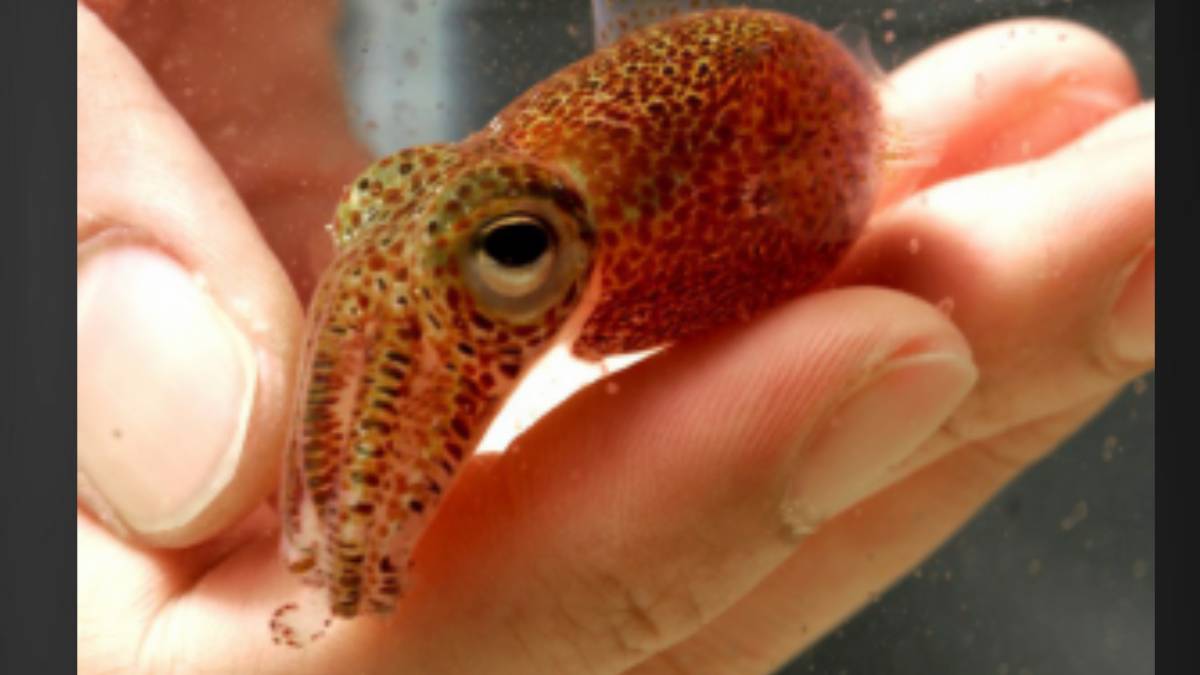
Researchers have known that the bobtail squid recruits Vibrio fischeri from the ocean to provide bioluminescent camouflage, but recently, the bacteria were found to play a vital role in the healthy development of the squid.
Jill Kuwabara Smith, lead author of the study, was a postdoctoral researcher at the Pacific Biosciences Research Center at the University of Hawaiʻi at Mānoa School of Ocean and Earth Science and Technology at the time of this research.
“Our recent work revealed that in order to develop properly, the squid host requires a protein provided by its bacterial symbiont,” said Jill Kuwabara Smith. “This was very surprising, but given that the work we do with this symbiosis model is always pioneering, just about every new finding is a surprise!”
Most bacteria release tiny, protein-filled “delivery packets” from their surfaces. Researchers previously knew that the Vibrio fischeri bacteria used a specific protein in these packets, called SypC, to start its relationship with the squid.
“Once the bacteria and its vesicles are inside the squid host, the new research found that the SypC assumes a new function—it prompts development of the light organ itself,” Smith shared.
To test this, the team tracked SypC by making it glow under a microscope. They found that without this single bacterial protein, the squid’s body did not develop correctly. Interestingly, the squid’s own immune cells—which usually kill germs—actually helped pick up these bacterial packets and carry them to the exact spot where the light organ needed to grow.
Without SypC, the expression of 138 different genes in the squid was altered.
“In addition to contributing light-production capabilities, Vibrio fischeri are prompting the squid’s development of organs and healthy expression of genes that are involved in a wide range of functions,” said Smith.
Nearly every organism and environment hosts a collection of microbes—a microbiome—which are an integral component of health. But the communication between bacteria and host before, during and after the meet-up has been mysterious.
According to Margaret McFall-Ngai, senior author on the paper, professor emerita at PBRC, and senior staff scientist at Caltech/Carnegie Science in Pasadena, the bobtail squid is easier to study since it only interacts with one bacterial species.
Given the small size of baby Hawaiian bobtail squids—only a couple of millimeters long—it is possible to visualize, by confocal microscopy, the effects of host-microbe interactions with great resolution.
“The goal of our research is to discover those features of symbiosis that are evolutionarily conserved, from less complex animals through humans,” said Smith, who is now a science teacher at ʻIolani School. “Those elements that are evolutionarily conserved are likely to be very important. Once we discover something, it can provide clues as to how things work in mammalian systems. The squid-vibrio system has guided the biomedical community.”
Sponsored Content


Subscribe to our Newsletter
Comments