


UPDATE: Kīlauea summit eruption Episode 43 ends after 9 hours of lava fountaining
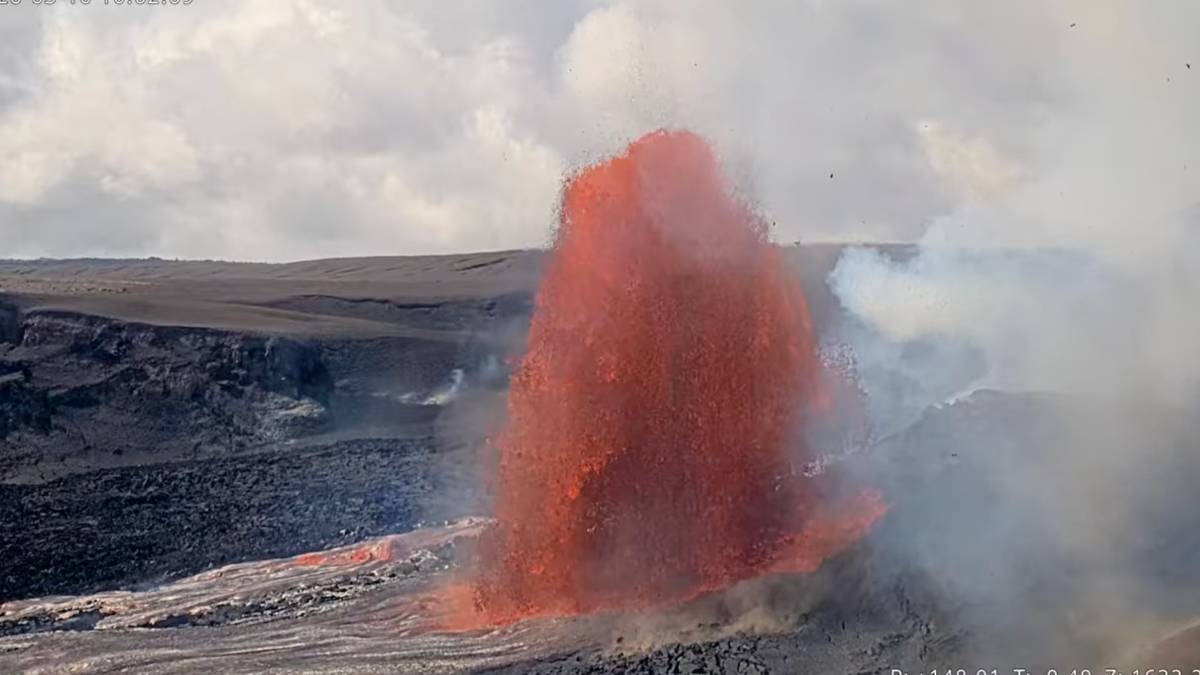
Update at 7:08 p.m. March 10, 2026: Episode 43 of the ongoing Halemaʻumaʻu Crater episodic eruption at the Kīlauea summit ended abruptly at 6:21 p.m. today (March 10) after 9 hours of continuous lava fountaining.
All eruptive activity was confined to Halemaʻumaʻu within Hawaiʻi Volcanoes National Park.
Hawaiian Volcano Observatory continues to closely monitor Kīlauea and will issue additional notices as needed based on activity.
Additional details on this eruptive episode will be provided in the next official report.
Find more information closures, tephra fall and more on Big Island Now.
Story originally posted at 10:10 a.m. March 10, 2026: Episode 43 of lava fountaining as part of the continuing episodic summit eruption of Kīlauea volcano began at 9:17 a.m. today (March 10) within Hawai‘i Volcanoes National Park.
Initial fountains began from the north vent, with the south vent starting just before 10 a.m., according to the Hawaiian Volcano Observatory. As of 12:42 p.m., the south fountain is 1,150 feet high, and the north vent is 1,000 feet high.
Maximum fountain heights for both vents were over 1,300 feet.
Lava flows are have covered about one third of the floor of Halemaʻumaʻu crater.
Tephra fallout was visible in HVO webcams from as early as 9:50 a.m., which is creating hazardous conditions in areas downwind, including neighboring communities and Highway 11.
An ashfall warning is in place for areas surrounding the park and a portion of Highway 11 is closed.
The National Weather Service reports that the plume from this eruption is reaching 25,000 feet above sea level. Ground-level sensors near the eruptive vents indicate that winds are blowing from the south direction, which suggests that volcanic gas emissions and volcanic material may be distributed to the north direction from Halemaʻumaʻu.
The Hawai‘i County Civil Defense Agency said communities adjacent and downwind of the eruption need to take necessary precautions for the elevated tephra fallout and volcanic gases.
Sensitive individuals affected by the volcanic gases can shelter indoors or leave the area.
Episode 42 of the ongoing Halemaʻumaʻu Crater episodic summit eruption at Kīlauea volcano on the Big Island began on Feb. 15 and ended after 9 hours and 48 minutes. Both vents were active for most of the eruption, according to the observatory.
Episode 42 ended at an average effusion rate of 430 cubic yards per second. An estimated 15 million cubic yards of lava erupted and covered about 50% of Halemaʻumaʻu Crater floor.
Most lava fountaining episodes since December 23, 2024, have continued for a day or less.
More information about this eruption will be provided as it becomes available.